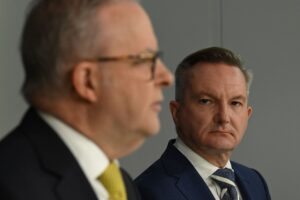
Climate Change and Energy Minister Chris Bowen is leading the charge, so to speak, when it comes to setting a goal at this year’s global climate conference in Turkiye that the world can get behind.
That goal would by deriving 35% of final energy use from electricity by 2035, the “35 by 35” mantra that, as Renew Economy has reported, comes with a very Australian accent (even if most of the media hasn’t cottoned on).
In any case, as President of Negotiations at the Conference of the Parties, or COP31, Bowen is keen for the target to get momentum, and jointly commissioned – along with the event hosts – a report to bolster the case by the International Energy Agency.
The world – and Australia, as it happens – presently sources about 23% of its final energy use from electricity, and so it’ll be a bit of a stretch to hit 35%.
“[W]e do need a big lift in activity, and that’s why the pledge I think is so important because it’s a commitment to work across the board, globally, to achieve that lift,” Bowen told an electrification plenary overnight, according to a recording shared with Renew Economy.
“[W]e need to move from a rate of increase of 0.3 [percentage points] a year to a rate of increase of 1.2 percentage points per year,” he said. “That’s four times faster than we’ve been doing it over the last 15 years.”
Fortunately, there’s scope for some optimism. Here’s an IEA chart showing the present rate of electrification by both sectors and region.
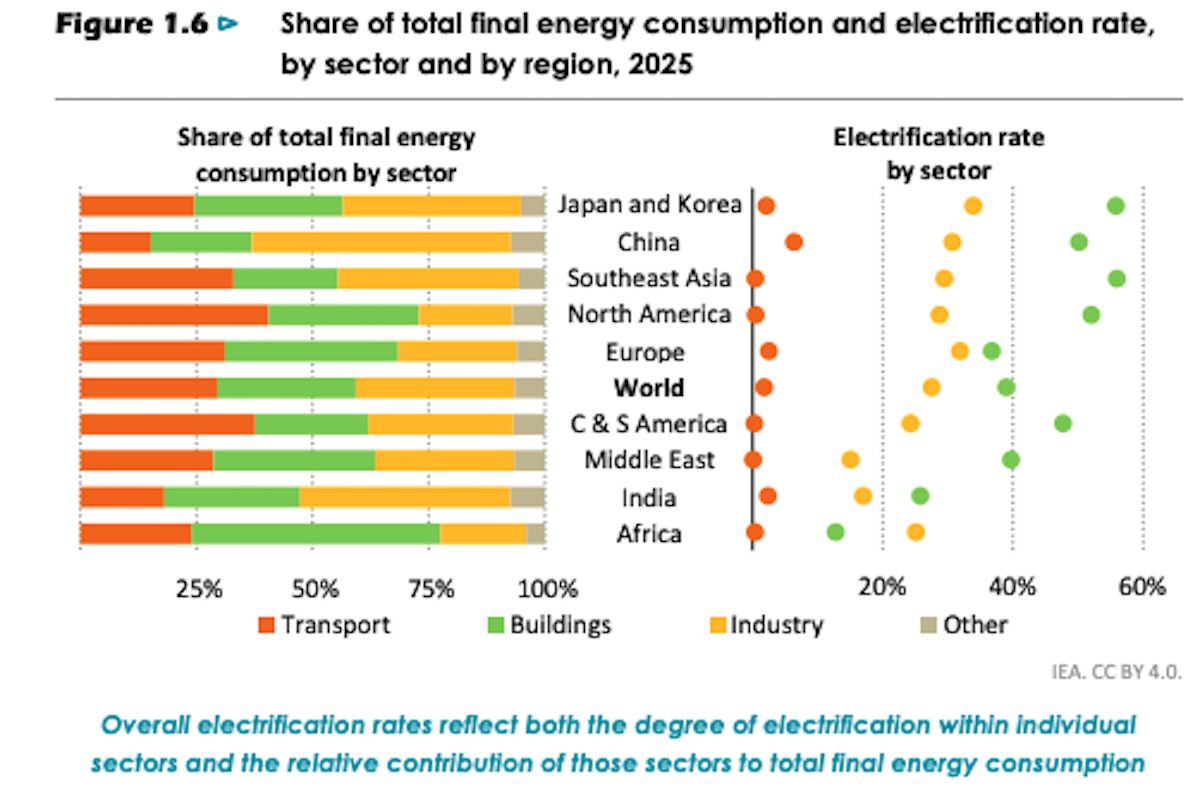
What stands out is how low the electrification rate is on the transport sector.
Now, one issue is the slow turnover of existing fleets. In Australia, for instance, the average car is on the road for about 11 years, while for trucks, it’s about 15 years or more.

The trend of electrification, though, is dramatic, particularly in places such as China. Cities such as Copenhagen and the Hague are also making rapid strides, with their bus fields now 100% electric, according to Singapore-based Assaad Razzouk on X.
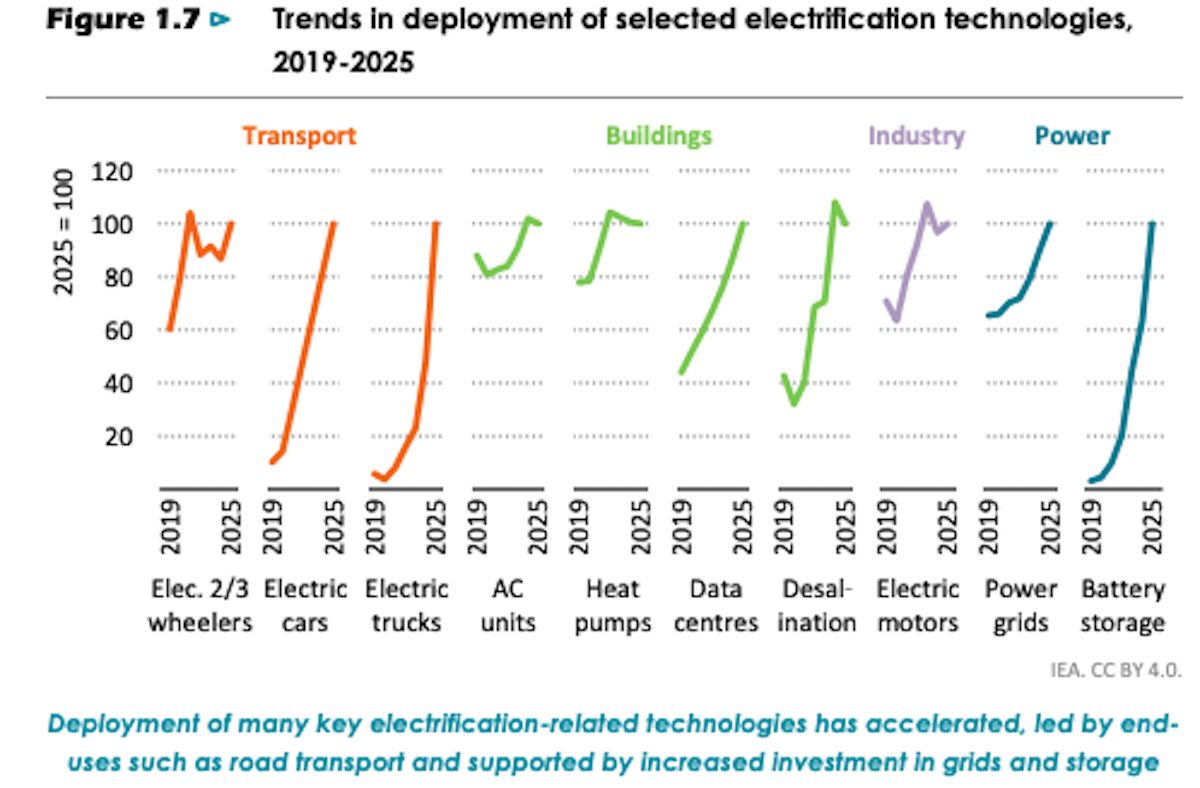
Indeed, “exponential” might be an apt description for the pace of change in transport, according to the trends chart in the IEA report.
Of course, it matters what energy source is supplying the electricity, as Climate Analytics’ Bill Hare has noted here, for Australia.
Powering our economies by clean energy, though, is one – perhaps, the only – way to keep global temperature rises in check.
A “35 by 35” electrification goal “is aligned with pathways to achieve net zero emissions by 2050”, the IEA report states.
But perhaps the last word belongs to Bowen.
“We’ve taken good steps as a COP and as individual countries on renewable energy and energy efficiency, but electrification is a frontier that we haven’t made enough progress on,” he told the electrification plenary.
“[T]his is our opportunity to make that progress on that frontier.”
If you would like to join more than 29,000 others and get the latest clean energy news delivered straight to your inbox, for free, please click here to subscribe to our free daily newsletter.