We know that big batteries are playing an increasing role in the grid, including setting wholesale power prices in the National Electricity Market for almost half (48%) of the time during the September quarter, according to the Australian Energy Market Operator.
A year earlier, the ratio was important but utility-scale batteries charging and discharging set the price just 18% of the time in the NEM.
A self-described energy analyst, Kanav Verma, has taken to LinkedIn this week to highlight another interesting trend with batteries, but at the small-scale end.
Analysing the Clean Energy Regulator’s data by home-battery storage, Kanav V, as he dubs himself, has produced a ranking of 2473 postcodes across Australia for how much battery capacity they have added behind the meter since the Cheaper Home Battery scheme kicked off in July 2025.
Topping the list was post code 2765, covering Riverstone/Marsden Park suburbs in Sydney’s west. This area had installed 156 megawatt-hours of storage.
He compared that tally with the Wallgrove grid-scale battery in Eastern Creek (some 16 kilometres away, so not super close) with its 78 MWh capacity.
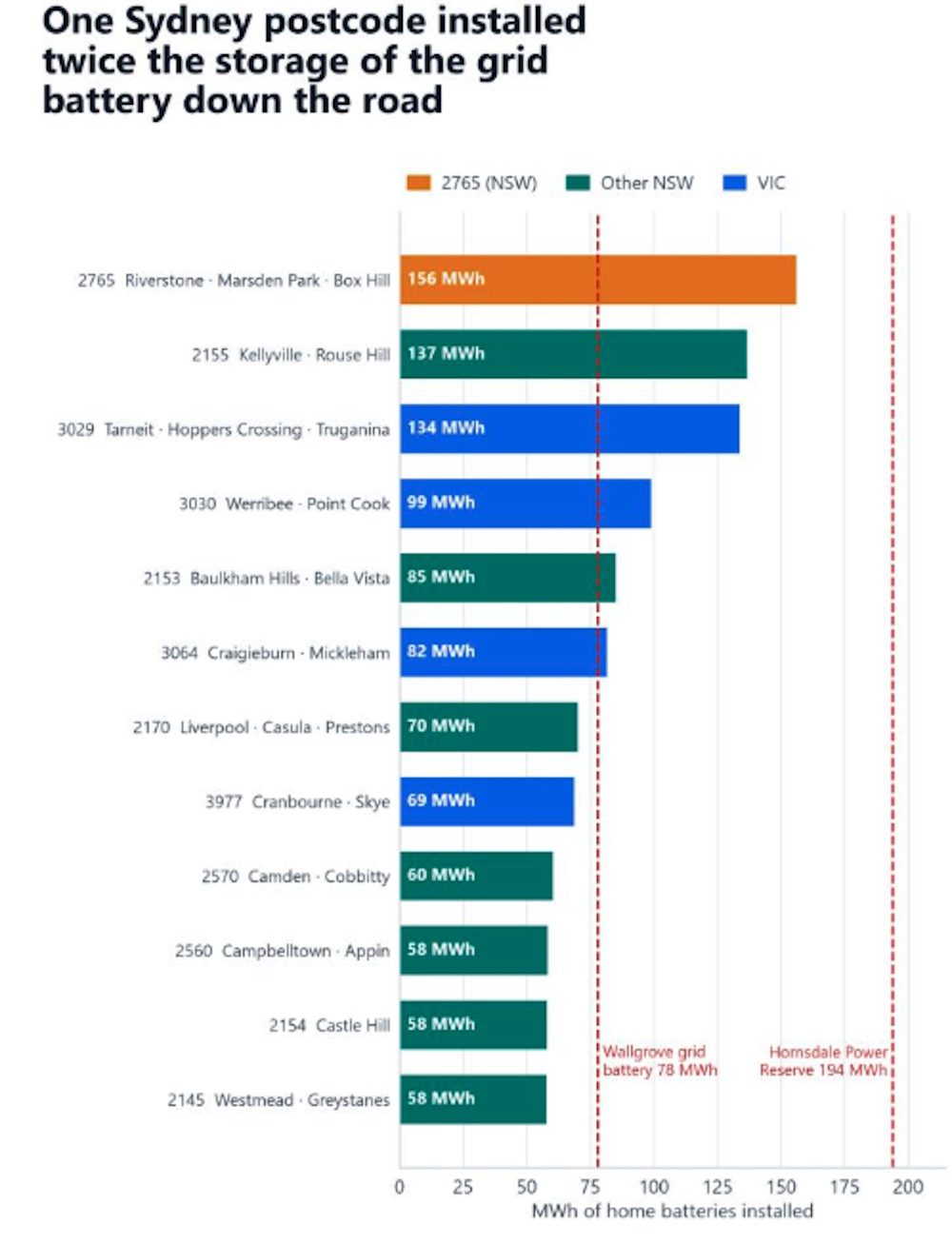
Next in the ranking was postcode 2155, covering Kellyville – Rouse Hill also in western Sydney. This area has now some 137 MWh of home batteries, and counting.
Third and fourth ranked postcodes were both in Melbourne’s western suburbs. These were postcodes 3029, covering Tarneit – Truganina with 134 MWh of storage, and Werribee-Point Cook’s 3030 postcode, with 99 MWh.
Kanav V notes that the top two postcodes now hold more storage capacity combined than the original “Big Battery” built at Hornsdale in South Australia, which debuted with (194 MWh).
“But there’s a big difference,” he says. Wallgrove – and Hornsdale – are run by the market every five minutes. “The 4202 batteries in [postcode] 2765 mostly just look after their own homes.”
“Same amount of storage. One is a grid asset. The other is invisible to the grid, unless someone pools them together,” Kanav V notes, adding a question about whether network planners in western Sydney and western Melbourne were planning around these suburbs’ batteries yet?
AEMO is trying to get a handle on household behaviour, mostly sampled households to extrapolate from.
“Uptake of home batteries continued to reshape demand profiles,” AEMO noted in its most recent quarterly markets report.
“Sample data analysis suggests households equipped with rooftop solar and batteries drew around three-quarters less power from the grid during the evening peak (1600 hrs to 2100 hrs) than households with rooftop solar alone,” it said.
“Along with milder conditions and increasing daytime load shifting, this contributed to lower evening peak operational demand across the NEM.”
As summer approaches, electricity market watchers will have to pay ever closer heed to household activities as home battery capacity increases day by day.
To join more than 29,000 others and get the latest clean energy news delivered straight to your inbox, for free, click here to subscribe to our free daily newsletter.