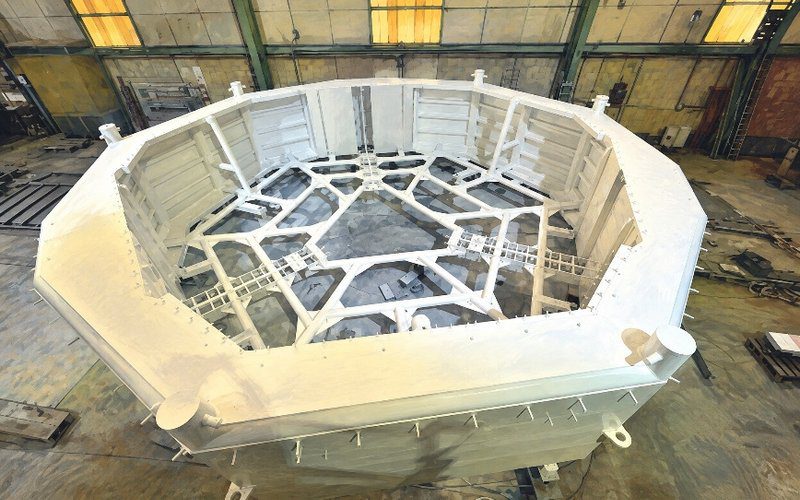
Western Australia-based wave energy pioneer Carnegie Clean Energy is nearing the first stage of ocean deployment of its Ceto wave energy technology in the Bay of Biscay in Spain.
Carnegie announced last week that it had completed fabrication in the Basque Country of its Ceto Buoyant Actuator (BA), a key component of its Ceto wave energy technology that it describes as the “prime mover” of the system.
Basically a fully submerged buoy, the BA creates power from the movement of the waves while tethered to the seafloor.
The Ceto BA has been built in three modular sections to simplify road transport and will be re-assembled quayside before being towed out to the Biscay Marine Energy Platform (BiMEP) for its first stage of deployment, designed to validate its hydrostatic characteristics, towing performance, and local offshore supply chain.
This is the first stage of deploying Carnegie’s technology under the Achieve Programme, which is being delivered by Ceto Wave Energy Ireland and Carnegie Technologies Spain.
Carnegie acknowledged that it has progressed slower than originally planned, but explained that, “as is common for first-of-a-kind offshore energy systems,” additional time had been taken to invest in engineering validation, operational readiness, installation planning, and integration activities.
“Additionally, the team has dealt with unforeseen challenges such as first-of-a-kind manufacturing issues and supply chain delays which have impacted the schedule,” Carnegie said in a press release.

Carnegie will also deploy an initial mooring system at its BiMEP berth for the first stage of Ceto’s deployment. The Ceto team have also completed physical system fit tests during which they confirmed that the three power take-off (PTO) modules and the electrical module can be quickly inserted and removed from the BA.
“This feature provides significant advantages for installation, operations and maintenance activities by enabling works on any module to be undertaken with ease by simply lifting the module out and allowing for any work to be completed on shore,” said Carnegie.
“With this approach, any module can be swapped out with a spare, thus enabling a quick turnaround during maintenance periods and reducing downtime of the CETO system.”

The power take-off (PTO) assembly and onshore testing will be completed in preparation for the second stage of deployment, expected in the northern Spring of 2027, when the full CETO system will be deployed and connected to the grid.