Last month was the hottest October globally, increasing the odds that 2026 will the second-warmest since reliable records began, according to Zeke Hausfather, a prominent climate researcher, citing data from Europe’s Copernicus Programme.
In posts to social media, including Bluesky, the researcher from Berkeley Earth and Carbon Brief said Europe’s ERA5 dataset showed October was 1.75°C above pre-industrial levels, pipping the previous record anomaly of 1.7°C set in October 2023.
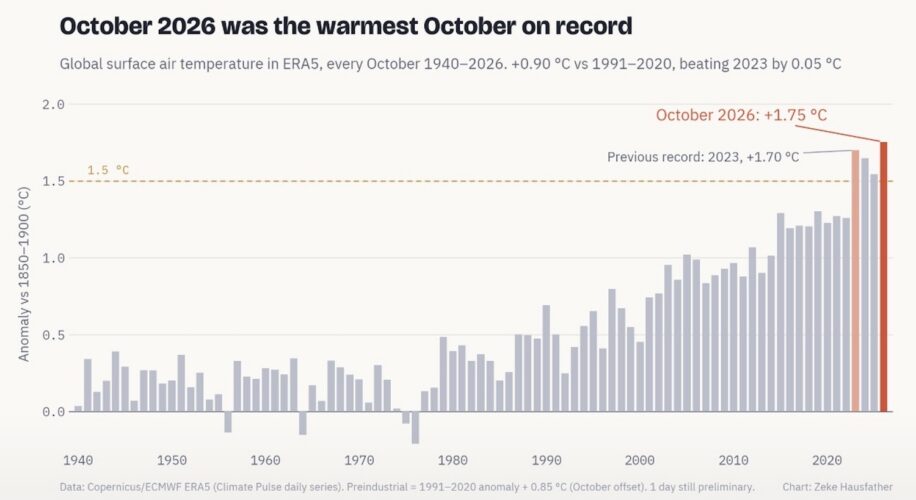
October’s readings may come in slightly differently when other datasets, such as from NASA, are released in coming days. Still, they are likely to show last month to be among the warmest on record as the background heating from climate change combines with the record-breaking El Nino event in the Pacific, a phenomenon that tends to see oceans release heat back to the atmosphere.
According to Hausfather, October’s warmth adds to the likelihood that 2026 will come is just shy of 2024 as the world’s hottest year on record. The ERA5 dataset suggests this year will end about 1.56°C above pre-industrial levels, compared with 2024’s 1.6°C anomaly.
El Ninos tend to span the latter months of any year and the lagging efforts of the event mean the following year sees a further spike in heating. On present ERA5 projections, 2027 will be 1.8°C above pre-industrial levels, easily the hottest year on record, Hausfather noted in a separate Bluesky posting.
The record warmth for last months comes as more than 500 Australian and international academics released an open letter to Australia’s leaders including Prime Minister Anthony Albanese and all state premiers, calling for stepped-up action in Australia to curb the release of greenhouse gases that are stoking the world’s biosphere.
The letter, issued just a week before leaders gather in Antalya, Türkiye for the COP31 global climate summit, noted Australia had continued to advance new and expanded fossil fuel projects in the past couple of months even as evidence of worsening climate impact mounted.
“On 26 August, a glacier collapse above the Nepal-Tibet border unleashed a deluge of ice, rock, mud and water, killing more than 1,400 people,” the letter noted. “Seven days later, the United Nations Environment Programme (UNEP) announced to the world that exceeding 1.5°C of warming is now unavoidable.”
It noted Australia’s climate change and energy minister Chris Bowen would help steer talks at COP31 through his role as president of negotiations.
“Australia has the knowledge, the wealth, the renewable resources and this year, the diplomatic platform to lead,” the letter, sent on Monday, noted,
“What is required now is your courage. If not now, while leading negotiations and standing before our Pacific family, then when? We ask you to be brave, to be bold, and to act with the urgency that the evidence demands.”
The letter’s core demands are:
End approvals for new or expanded coal, oil, and gas projects, including by declining federal approval of NSW’s Hunter Valley Operations (HVO) Continuation Project and by halting further Beetaloo expansion in the Northern Territory;
Legislate a binding phase-out timetable that guarantees a just transition for workers and communities;
Use the President of Negotiations role to steer COP31 toward a time-bound roadmap for the transition away from fossil fuels, a loss and damage outcome commensurate with need that includes non-economic loss and damage, and adaptation finance that reaches frontline communities directly.
Signatories included Australian National University climate scientist, professor Sarah Perkins-Kirkpatrick, coral expert emeritus professor Terry Hughes from James Cook University, CSIRO researcher Rebecca Gregory and University of Melbourne researcher Graeme I Pearman.
As Renew Economy reported last month, an all-staff CSIRO workshop over several days discussed how Australia might hold an “open” conversation about the looming perils from climate change including the depopulation of northern Australia because of rising heat, storms and fires. CSIRO’s chief executive Doug Hilton subsequently admonished staff via email for leaking details of the discussions to the media.