Andrew Forrest’s Fortescue says it will be ready to illustrate the “future of mining” as the first of its huge electric haul trucks and other heavy equipment is delivered to its iron ore mining sites this year, at the same time as the first of its “self-lifting” wind towers are erected.
To deliver green electrons to power its mines and the hundreds of electric hauls trucks and other mining equipment, Fortescue is building more than 2 gigawatts of wind and solar capacity, and another 4 gigawatt hours of battery storage.
Construction of two large solar farms at Turner River and Solomon Airport is already underway, and the company is now erecting the first of its unique “self lifting” wind turbines at the133 MW Nullagine wind project.
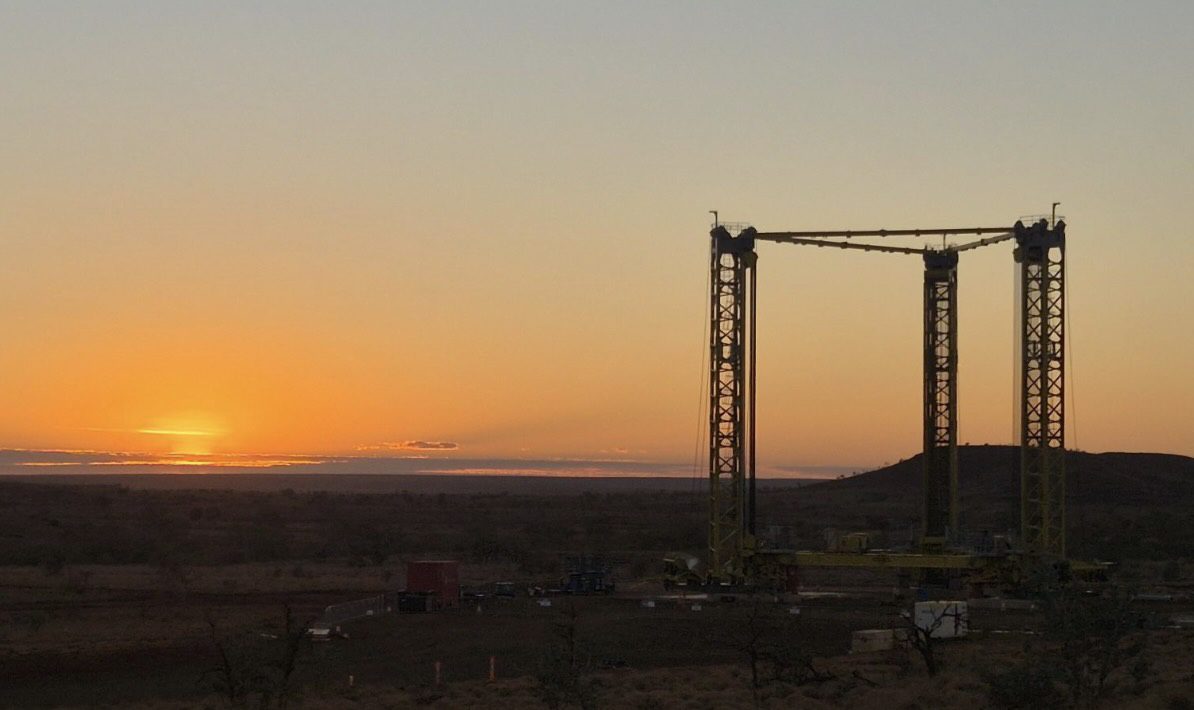
The “self lifting” tower technology – designed by Nabrawind, a Spanish company it now owns – enables the wind turbines to tap into better wind resources at a higher elevation, reduce the amount on concrete foundations required, and also eliminate the need for giant cranes.
“I was on site last weekend, where we’re well into installing the first three 8 MW Nabra wind towers, and they are an unbelievable sight to see,” CEO Dino Otranto told an analysts briefing on the company’s September quarter production report.
“And when you look behind that, the flat ground with that consistent wind blowing, again points us to an enviable position (we hold) globally right now.”
The picture above, showing the base of the self-lifting tower technology, was published on Nabrawind’s LinkedIn page several weeks ago. Renew Economy understands that the turbine towers are now in place and getting ready to be lifted.
Fortescue will erect 17 Envision turbines atop the Nabrawind towers, and with a hub height of 210 metres and a tip height of 280 metres, they will be the tallest in Australia, as well as the most powerful. Fortescue plans to build a bigger wind farm at Bonney Downs, taking its total wind capacity to more than 800 MW.
Fortescue’s plan is to power its own mining operations, and also have enough to deliver a 200 MW renewable baseload option for third party users, including data centres, and other industries looking to tap into low cost green power. It says it is in talks with multiple parties.
“I think the fact that data centers are in the news … is actually shining light to the the opportunity we’ve been talking about for years, which is the Pilbara, the midwest part of Queensland, around the world are sources of abundant energy at cost points now that significantly undercut all of that,” Otranto said.
“That will not change, and … it’s pointing to companies like ours who …. are building for our own operations, and have a unique ability to expand that. As I said to the earlier question, we’re in advanced discussions now with a number of third-party electron off-takers.”
Fortescue is also designed its own 6.4 MW heavy mining equipment (HME) EV fast chargers, which are undergoing testing at its mine site, and it says it now has 21 electric excavators operating. At Christmas Creek mine, the fleet of six electric excavators is outperforming their diesel equivalents.
The company’s first 240 tonne electric haul truck has been undergoing testing in Perth, and the company has also taken deliveries of the first of its giant electric water carriers, graders, dozers and other equipment that will now be readied for deployment at Flying Fish and the neighbouring Eliwana mine sites.
“The XCMG electric grader, dozer, loader and water cart have arrived from China, and our first battery electric haul truck is being built in Perth,” Otranto said in an earlier statement.
“In December, we’ll bring all this equipment together at Flying Fish, our first mine to be decarbonised, and show what the future of mining can look like.”
To join more than 29,000 others and get the latest clean energy news delivered straight to your inbox, for free, click here to subscribe to our free daily newsletter.