Plans to build one of the world’s biggest industrial heat battery projects in Australia, using “hot brick” technology, have won up to $75 million in Arena funding, in a bid to determine whether thermal energy storage can slash the emissions – and fossil fuel consumption – of aluminium refineries.
The project, a 30 megawatt (MW) and 360 megawatt-hour Rondo Heat Battery by US outfit Rondo Energy, would be slotted in at the site of Rio Tinto’s Yarwun alumina refinery near Gladstone in Queensland, where it would soak up cheap daytime renewables, convert the energy into high-temperature heat, and deliver it as steam at up to 1,000°C.
All things going to plan, the project will be Australia’s largest demonstration of industrial heat electrification. It will also be one of the first large-scale demonstrations of thermal energy storage for industrial process heat, globally, and a world-first for the alumina industry.
To claim all of these firsts, the team at Rondo Energy first has to complete a front-end engineering design (FEED) study for the project, a task it hopes to have knocked over in 2027 – and which the first $3.6 million tranche of funding from Arena is designed to support.
Once the study is complete – and a final investment decision locked in – Arena is offering up to $38 million to help fund the deployment of the Yarwun heat battery, with a further $33.3 million of “conditional contingency support” set aside for use in “defined circumstances” to manage specific project risks like cost overruns and electricity costs.
Arena CEO Darren Miller says industrial heat remains one of the toughest decarbonisation challenges facing heavy industries – and Australia, as it strives to keep its former industrial powerhouses economically competitive in a decarbonising global market.
“This project will test whether thermal energy storage can provide a practical pathway to lower emissions from industrial heat in a real-world operating environment, where reliability, performance and integration are critical,” said Miller in a statement on Wednesday.
“Large industrial facilities such as Yarwun provide the scale, infrastructure and operating conditions needed to properly evaluate emerging technologies.
“Demonstrations like this will help build the evidence industry needs to make future investment decisions so the value of this project extends well beyond a single refinery.”
For Rio Tinto, which co-owns and operates the nearby Boyne aluminium smelter – Australia’s second-largest – as well as the Yarwun refinery, technologies like the Rondo Heat Battery are going to be all-important to the company’s future success.
The Boyne smelter, which employs around 1,000 people in the region and is Queensland’s biggest single energy user, has been on “thin ice” for years, according to Rio Tinto, was in March handed a $2 billion lifeline from federal and state governments to keep the smelter it running until at least 2040.
For its part in the deal, Rio Tinto committed to underwriting $7.5 billion of new wind, solar and battery storage development in the once coal dominated Gladstone region, which it will contract to supply the smelter’s energy needs through power purchase agreements (PPAs).
This week’s funding announcement from Arena will hell Rio Tinto to decarbonise the refining part of the supply chain – while also testing out a technology that could have much broader applications in helping to decarbonise Australian industry.
“Reducing emissions from alumina refining is complex, particularly when it comes to generating the high-pressure steam needed for our operations,” says Rio Tinto pacific operations managing director Armando Torres.
“The best way to tackle challenges of this scale is through collaboration between industry, government, and technology partners.
“This study will help us determine whether thermal energy storage can provide a technically and economically viable alternative to fossil fuels for part of Yarwun’s steam requirements,” Torres said in a statement.
For Rondo Energy, Australia is proving a fertile and promising market for its brand of industrial heat technology – and Rio Tinto a powerful and highly motivated backer and project partner.
As well as Rio Tinto, the California-based company is backed by some big-name investors including Microsoft and Bill Gates’ Breakthrough Energy, and its technology has already been proven at operational facilities producing fuels and cement in the US and in Thailand.
Rondo Energy head of Australia, Kira Rundel says the planned Yarwun project is a “particularly interesting application” for the company, as it continues to prove out its technology, both technically and economically.
“This is our first alumina application, and it’s one we’re particularly excited about because alumina is a traditionally hard to decarbonise process,” Rundel told Renew Economy in an interview on Wednesday.
“It requires enormous amounts of heat on a 24-7 continuous basis, which conventional decarbonisation technologies … have had challenges competing with, which is the beauty of heat batteries because we can selectively charge and take in energy when electricity … is abundant and cheap.”
Rundel says what differentiates Rondo’s thermal energy storage from other technologies is the main medium it uses – a refractory brick material that uses abundant and low-cost ingredients.
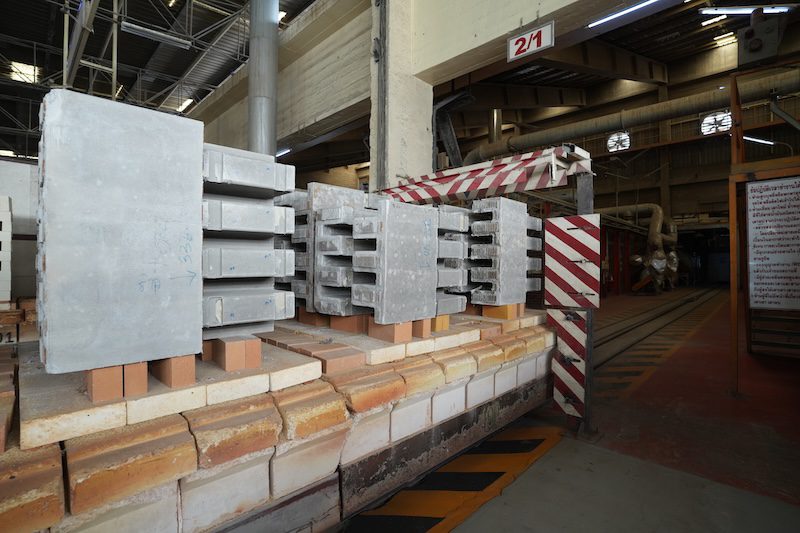
As Renew Economy has previously reported, the technology essential encolses a toaster-like element inside a 500 kilo brick made of the same stuff that lines concrete kilns and steel blast furnaces, add some inventive aerodynamic design, and uses it to superheat air – or in this case, steam.
“You see [other thermal storage technologies] using graphite, molten salts,” says Rundel. “Our [heat bricks] were selected because of the simplicity of using that material, so we don’t undergo any phase changes.
“We can operate the material in air. It’s inert. We’ve got projects at chemical processing facilities, obviously now at an alumina refinery, which is a caustic environment.
“So it’s an incredibly robust material. We don’t have to operate under any kind of inert atmosphere or pressurised system. The way that we extract energy out is by circulating air through the heated up brick stack, and then that air is used, in this case, to generate steam through a heat recovery steam generator.”
It’s also, comparatively speaking, pretty compact.
“It’s incredibly energy dense,” says Rundel. “Because we’re converting power to heat directly and not back to power, we have very high round trip efficiencies, around 98-97 per cent which means that … our battery is designed to integrate into brownfield facilities and have a very small footprint.
“So in this case, we’re actually deploying the solution within the fence line [of the Yarwun refinery], and so the the footprint for this battery is about 100 meters by 30 meters… It’s energy dense and designed to have as compact a footprint as possible.”
“We see we see Australia as an incredibly important market,” adds Rundel. “Not only politically, but also … the national electricity market offers something that is very unique, globally, with the large fluctuations in electricity price offering these incredibly attractive charging opportunities for energy storage.
“And … the fact that Australia already has a high penetration of renewables and is continuing to invest in [the] renewable rollout means that there’s also a little bit less of a risk with, you know, changes in politics and and political parties to continue to enable this technology.”
Once the FEED study is complete, the goal in 2027 is to get the project to a final investment decision and crack on from there. And Rundel says the company is fairly confident it will find financial backers beyond Arena.
“We’ve got a compelling technology, we’ve got a great market, we’ve got a great use case. So, yeah, feeling confident,” she tells Renew Economy.
“We’ve obviously deployed much less volume than conventional battery storage technology, but the the solution will absolutely benefit from the same scale once these early projects are deployed.
“And so it’s really an important enabler to have early projects receive funding support to help us to build the supply chain and come down the cost curve on on this technology.
“Rio Tinto is an incredible partner for us,” she added. “They first invested in Rondo in 2023 as a strategic investor. At that time, they also became a member of our …strategic investor advisory board, and so we work very collaboratively with them, and we’re just thrilled by being able to talk about this project with them.”
To join more than 29,000 others and get the latest clean energy news delivered straight to your inbox, for free, click here to subscribe to our free daily newsletter.