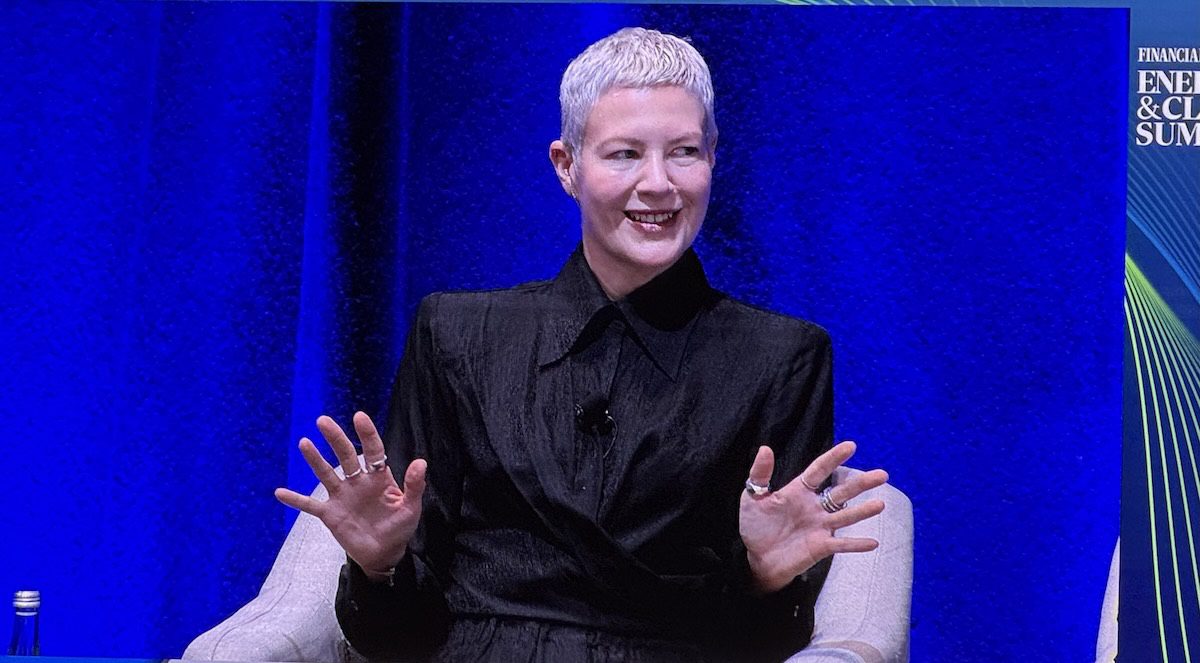
Maia Schweizer, Snowy Hydro’s chief operating officer, said the Commonwealth-owned corporation was “working very closely with our shareholder” to complete a cost review of its giant 2.0 pumped hydro project that some critics expect will come with a $20 billion-plus price tag.
“We’ve been working on it for a while, and it is imminent,” Schweizer told the AFR energy and climate summit in Sydney on Tuesday. “It is coming to the tail end of it.”
Earlier this month, Snowy Hydro marked its one-year anniversary since announcing a review of Snowy 2.0, which is presently listed as costing $12 billion, already six times the original estimate, and more than twice its first contracted cost.
Ted Woodley, a former energy executive and long-standing critic of the project says the project is likely to cost much more than $20 billion, and even more when required transmission augmentation and finance costs are included.
Schweizer, though, stood by the economic value of 2.0 even as on-going construction issues add to the challenges, making the projected completion date of the end of 2028 challenging. The latest Integrated System Plan by the Australian Energy Market Operator continues to stick by that finishing line date.
Snowy 2.0 would offer 160 hours of backup for the grid, a contribution that would take 40 GW of batteries to match, and those devices would “last about a seventh as long as our 150-year asset”, she told the summit.
“So it is unique [and] it’s irreplaceable, and it’s hard to see [in a] 10- or 20- or 30-year time frame how that changes”, which is why we’re building it for 150 years.”

Schweizer said Snowy had an “incredibly full investment pipeline” over the next couple of years, including “projects that no one else would execute”.
Spot price signals alone would not generating the investment in upgrading the grid that was needed, she said, citing the 2022 national electricity market crisis as an example of an issue that had so far not triggered the necessary upsurge in new projects.
That event, Schweizer said, had been triggered by “the confluence of soggy coal and low wind and solar for a number of weeks”, and caused unprecedented disruption in the grid.
“Snowy Hydro was very much on the kind of cutting edge of it. Our little thermal assets, which are built for peaking operation – somewhere between half a per cent and maybe a few percent a year – were running at 37 per cent capacity factors for eight weeks straight on any fuel we could get them.”
“We were switching back and forth between gas and diesel, basically depending on what kind of truck or pipeline was able to supply molecules at the time,” she said. “We literally kept the lights on.”
Along with Hydro Tas, “we used 15 times as much hydro capacity defence in those eight weeks than we would in a normal year”, Schweizer said.
“The future is more and more of that, more of that kind of incredible uncertainty about the utilisation of assets and the market they’re playing into,” she said. “So clearly, something that goes beyond smoothing out spot prices is needed to give those investment signals.”
Schweizer later discussed “the untapped potential in the distributed energy space”, describing as “incredibly real”.
“You just have to look at the incremental installed capacity to see … how quickly batteries have changed the way that thermal peakers are used in the system,” she said. “[It’s] almost made it irrelevant for the evening peak to run your gas plant.”
Schweizer said that Snowy Hydro was in the final stages of commissioning its 660-megawatt Kurri Kurri gas plant the Hunter, and flagged on-going use of diesel if necessary at that plant.
“[E]ven if you put aside the cost of gas and the cost of running a thermal asset for peaking, the availability of gas is going to be a real challenge,” she said. One problem was “this vanishingly small utilisation”.
But Snowy Hydro also had to prepare for possible interruptions of gas supply, “whether it’s temporary or longer term restrictions on the availability” of methane.
“We don’t want to run it on diesel, but there may be times where [we’re] getting in diesel trucks to keep it online … if gas supply is interrupted,” Schweizer said.