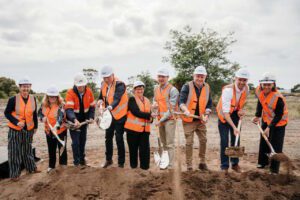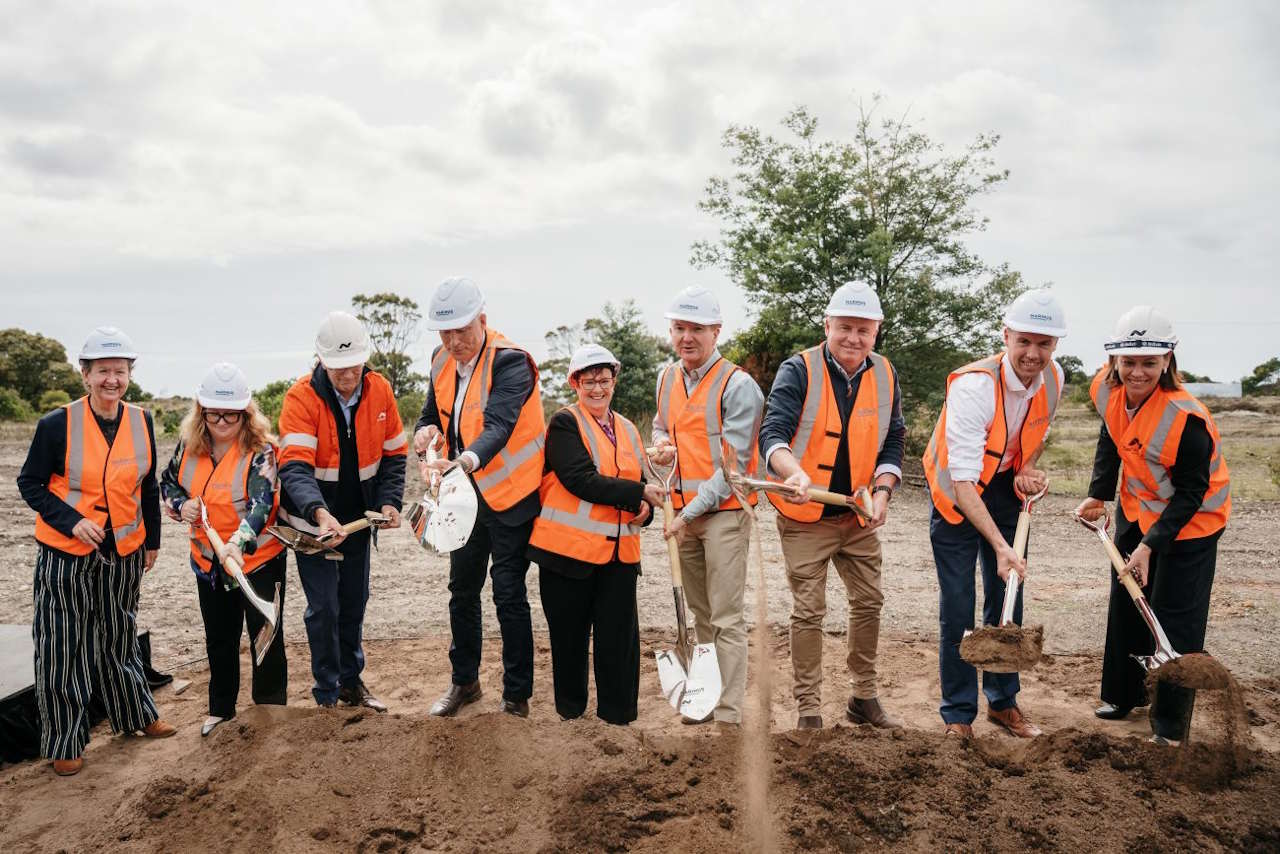
Government, business, and community leaders gathered late last week for a ceremonial sod-turning ceremony for the Marinus Link project, signalling a ramp up of construction activities at the controversial project that will provide a new sub-sea transmission link between Tasmania and Victoria.
Marinus Link, once dubbed as a key component of the so-called “battery of the nation” project, was to feature two subsea high voltage direct current (HVDC) cables with a combined transfer capacity of 1,500 megawatts (MW), but was scaled back in 2023 to a single 750 MW cable.
However, the link remains controversial, both over the cost and benefits, and also the environmental impact of the transmission lines required in Tasmania to service the project, and the new wind and solar farms that will be built to feed it.
“Every project is controversial in some form,” federal energy minister Chris Bowen told journalists at the ceremony last Friday. “Very few projects have 100 per cent support from every single person with a view.
But he said Marinus will unlock new renewable energy investments in Tasmania and open up more industrial opportunities for Tasmania into the future.
“Yes, it’s about exporting Tasmania’s clean pumped hydro to the mainland, but also importing solar and wind to Tasmania on days where that makes sense,” he said.
“There’s no transition without transmission, and this is hundreds of kilometres of transmission under the Bass Strait which will better connect the two islands that make up Australia, Tasmania and the mainland of Australia, and ensure our energy security, both on the mainland and in Tasmania for many generations to come.”
The current plan will consist of a 345-kilometre-long cable that includes HVDC cables, fibre optic cables, a communications station, and converter stations at each end, and is complemented by the North West Transmission Developments (NWTD) project.
The project reached financial close last year after a “substantially increased” commitment of up to $3.8 billion by the federal government’s Clean Energy Finance Corporation (CEFC). Construction of the NWTD has already started between Sheffield and Burnie, including building access tracks, fencing, tower foundations.
“As a two-way interconnector, Marinus Link will allow electricity to flow in either direction, improving flexibility, reliability and resilience across the National Electricity Market, getting the most out of hydropower, wind and solar resources, and bringing on new investment in industry and generation,” said Sandra Gamble, Marinus Link chair.
“Already, some 119 businesses and suppliers have been engaged across Project Marinus – including 59 from North and North West Tasmania.”
Tasmanian premier Jeremy Rockliff said the project will transform and provide energy security and economic security and social security to Tasmania “for generations” to come.
“It’s not often that you get the opportunity to make hard decisions but the right decision that transforms Tasmania for the next number of generations,” he said at the event.