In July of this year, the Prime Minister stated in a speech that, “We will create a legal obligation for the next generation of large-scale data centres… to build new renewable generation – and firming – to … ensure data centres do not increase power prices for Australians.”
While we commend the government’s objectives, as is often is the case, the devil will be in the detail. In our view, the following six practical polices are needed to efficiently and effectively achieving the government’s vision.
- Utilise Renewable Energy Guarantee of Origin (REGO) certificates from new (yet to achieve FID) Renewable Energy projects as the compliance mechanism
Data Centres should be required to surrender a new project REGO for every MWh of electricity they consume. Only by limiting REGO surrender to new projects, will the Government’s objectives of not raising electricity prices and preventing rises in emissions be realised.
- Large Data Centres must enter into long term contracts or Power Purchase Agreements (PPAs) with new renewable generation projects
It has been suggested that Data Centres should have the flexibility to just acquire and surrender new project REGOs to meet their obligations. However, for the past 20+ years, the vast majority of renewable energy projects (not owned by an electricity retailer) required a long term PPA to secure the revenue certainty equity and banks demand to be willing to finance the project.
There is no reason to think the situation has now changed. In addition, in order to effectively mitigate the power price impact of a Data Centre, the new renewable energy project really needs to be located in the same state as the data centre.
- Incentivise Data Centre owners to minimise the gap between when they add extra demand versus new supply
At present Data Centres tend to be built faster than the industry can build new wind and solar farms. But the extent of this gap needs to be kept to a minimum and can’t become a giant loophole for data centres to avoid paying for new supply to match their demand.
Some have suggested that allowing Data Centres to surrender renewable energy certificates of any type (these could be REGOs or another certificate known as LGCs) would be a suitable mechanism for this transition period until the new renewable energy projects can be constructed. However, there are serious problems with this approach.
First, it won’t act to reduce power prices or emissions as purchasing REGOs from a 40, 20, or even 10 year old renewable generator will not result in any additional megawatt-hours of generation from these plants (which are a function of the weather). A Data Centre could buy 3 years of REGOs and at the same time buy all their physical electricity from a coal fired generator. Does this make sense as a transition ‘obligation’?
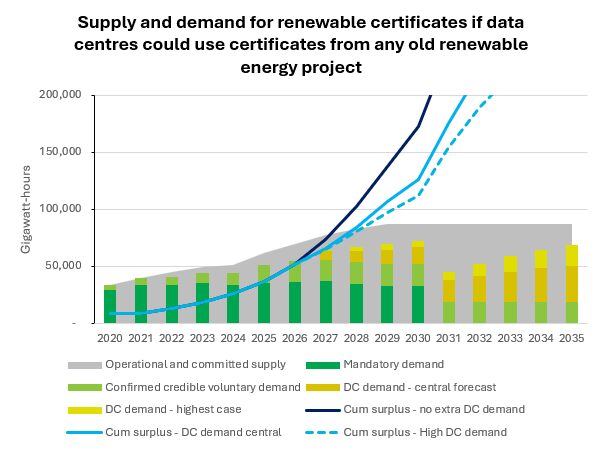
Second, it won’t provide an enhanced price signal that will encourage new projects to be built. This is because the supply of generic LGCs/REGOs from existing and already committed projects far exceeds demand, even if all existing and new data centre power consumption needed to be offset by a renewable certificate (see supply demand analysis at end of article).
Prices for these certificates have plummeted from over $40 to less than $5 over the past year and a half due to a huge excess of supply, such that they make little difference to the economics of a new project. Adding data centre demand won’t do much to lift the certificate price such that it makes new projects viable.
It doesn’t take much imagination to see how these cheap certificates from old projects could become a tempting loophole for data centres to pretend their power demand is zero emissions and seek to perpetually extend any transition period.
A better way to solve the time lag between data centre and renewable energy project construction is to require data centres to make-up for any shortfall in the short-term by surrendering additional new project REGO’s later on under a grace period.
This is precisely what we’ve already done under the current LRET scheme which allows electricity retailers to recover shortfall penalties within a 3 year grace period if they make good on their shortfalls. This has worked well to deal with the renewable energy investment drought induced by Tony Abott that left the market short of renewable energy in the years following his prime ministership.
A potential middle ground option would be to complement the make good requirement with a much more constrained transitional supply of REGOs from renewable projects energised after a recent point in time, such as 1 January 2026.
Green Energy Markets’ analysis indicates that already operational and committed projects energised from this date onwards will produce sufficient renewable certificates to cover incremental additional data centre electricity demand to at least 2030 (although to ensure data centre’s contract with new projects, eligibility of these transitional certificates may need to expire sooner).
A more constrained transitional supply would create a new market in renewable certificates that would provide a far better investment signal for construction of new projects than allowing the use of any old renewable energy certificate.
- Data Centres must secure the great majority of their firming requirements from new dispatchable capacity
Data Centres will need to purchase electricity cap contracts or write contracts directly with dispatchable capacity and/or electricity retailers to manage their wholesale market price exposure when their contracted renewable energy project is not operating at sufficient capacity.
If these contracts are not with new dispatchable capacity, there will be a significant adverse impact on wholesale prices that other consumers will pay. Therefore, new dispatchable capacity is required and that new capacity must be generating before, or at least close to, the Data Centre’s start of operations. Bringing in new dispatchable capacity 4-5 years after a Data Centre starts operating will result in years of higher electricity prices.
Fortunately, there are many advanced Battery Energy Storage System (BESS) development projects around the country and they are quicker to build than wind or solar farms. If a Data Centre writes a tolling agreement (PPA) with a large BESS, the battery should be at least 4 hours in duration and needs to be in the same state to effectively mitigate the Data Centre’s impact on power prices.
- The obligation should apply to new data centre capacity committed after 23 March 2026, when the government published their data centre expectations
On 23 March this year, the federal government published their Expectations of data centres and AI infrastructure developers. This document made it abundantly clear to businesses looking to develop new data centres or expand existing data centres that they needed to:
“Not place upward pressure on energy prices and should make a positive contribution to Australia’s energy transition. This includes working in coordination with energy regulators and suppliers to secure new and additional clean energy generation and/or storage to offset demand.”
From that date onwards any investor in data centres knew or should have known that if they committed finance to build additional data centre processing capacity they would be expected by government to procure new renewable energy and firming to power that capacity.
It doesn’t matter that the government is unlikely to legislate its data centre electricity procurement obligation until next year, the requirements data centres needed to meet were published in black and white on 23 March this year. Prudent investors would have taken this into account prior to committing to build new capacity as part of any half decent due diligence process, so any claims of sovereign risk are laughable.
- Data Centres supplied by state-owned generators must still surrender new project REGOs for their electricity use
Even if one accepts the Queensland Government’s argument that state government owned energy infrastructure is a ‘special case’ that somehow might defy economics to deliver lower power prices without adding new supply, they are not a special case with regards to Australia meeting its climate change obligations.
So, if the federal government wishes to achieve its emission goals it needs to require Data Centres to surrender new project REGOs for their energy use irrespective of any special deal with state government power companies.
The only other option if the federal government is to manage emissions would be to require the state government power company or the data centre to surrender Australian Carbon Credit Units to offset the extra emissions from supplying the data centre’s electricity consumption.
Only by adopting these six recommendations can the government make sure that growth of data centres doesn’t come at the expense of higher power prices for other consumers and carbon emissions and climate change for our children.
Jonathan Upson is a senior analyst and Tristan Edis is CEO with Green Energy Markets. Green Energy Markets provides analysis and advice to assist clients make better informed investment, trading and policy decisions in energy and carbon abatement markets.
Postscript – Allowing data centres to use old project LGCs could create a huge loophole
The chart below illustrates Green Energy Markets’ assessment of supply and demand of renewable energy certificates from already operational and under construction projects.
The grey area is the annual production of electricity that is eligible to create certificates under the Renewable Energy Target scheme (which isn’t tied to the 82% by 2030 renewables target but rather an earlier legislated target for 2020).
The coloured stacked bars represent demand for these certificates with the dark green being government mandated demand under the 2020 Renewable Energy Target (RET) scheme and the light green is voluntary and state government demand that is additional to the mandated RET scheme.
We’ve then added extra demand in yellow if all data centres (not just new ones) were obligated to offset all their electricity consumption with renewable certificates.
The dark yellow represents data centre electricity consumption forecast by AEMO under their central (Step Change scenario) forecast, and the light yellow is the high-end forecast of data centre consumption.
Source: Green Energy Markets LGC/Carbon Credits Price Drivers Report
You can see the grey area comfortably exceeds the demand bars from 2024 onwards. The black and blue lines show the resulting cumulative banked pool of certificates left over after deducting demand from supply.
The black line is the surplus with no data centre demand, whereas the solid blue line is the surplus if data centre electricity consumption was to follow AEMO’s central forecast and the dashed blue line is the high-end forecast of data centre demand.
This reveals we have a massive oversupply of renewable energy certificates even with data centre power demand at the upper end of AEMO’s forecasts. And even if all of this demand, not just new demand, was offset by renewable certificates and not a single new renewable energy project being committed to construction.