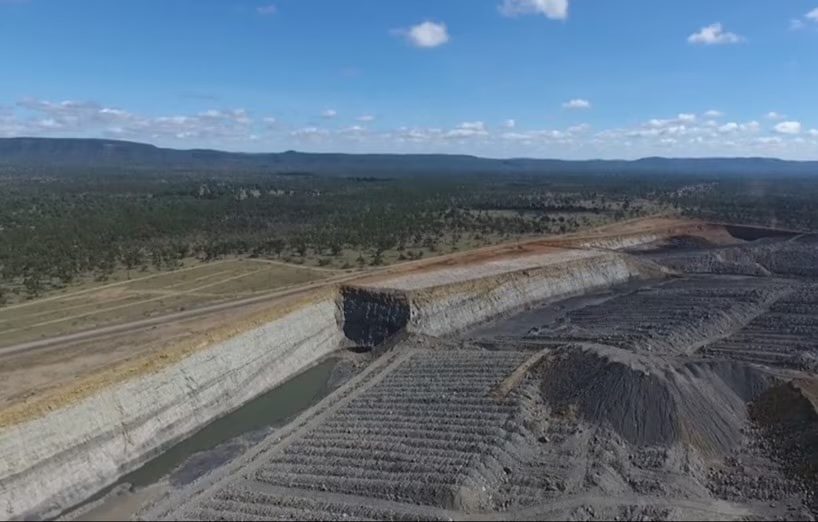
A massive Queensland coal mine expansion backed by global mining giant BHP has been given environmental approval by the state LNP government, despite the project’s huge projected climate impact and its plans to clear more than 136 hectares of koala habitat.
BHP Mitsubishi Alliance (BMA) – a 50/50 joint venture between BHP and Mitsubishi Development – is seeking both state and federal environmental approval for the Saraji East coal mine expansion, a greenfield underground metallurgical coal mine in Queensland’s Bowen Basin.
State approval was awarded by the Crisafulli government at 4pm on Friday last week, according to an email sent to green group Lock the Gate Alliance and shared with Renew Economy on Monday.
The coal mine, proposed for a 11,427 hectare site around 170 km south-west of Mackay, would produce an estimated 110 million tonnes (Mt) of coal, would use around 1,500 mega litres (ML) of water a year and is projected to more than 330 Mt of climate pollution in its 20-year lifetime.
The EIS identifies 11 threatened species within the project site, including the koala, the greater glider, the short-beaked echidna and the squatter pigeon. For koalas, the project site takes in 362.03 hectares (ha) of preferred koala habitat, 1,748.51ha of suitable habitat and 386.67 ha of marginal habitat.
The approval comes despite state government feedback on the project’s Environmental Impact Statement late last year that called the greenhouse gas abatement plan for Saraji East a “broad-brush corporate-level plan fail[ing] to sufficiently detail project emissions and abatement measures.”
The government said the EIS also “did not address the evidence requirements for the use of renewable power, as outlined in section 7.4(5) of the National Greenhouse and Energy Reporting (NGER) Measurement Determination 2008.”
For BHP and BMA, the approval comes despite the JV issuing a statement in November last year declaring that it would not pursue any new developments in Queensland due to the state’s “unsustainable royalty regime.” Meanwhile, BHP pocketed more than $620 million from federal diesel fuel rebates in the last financial year, alone.
BHP has also come under scrutiny for its spectacular backflip on decarbonisation, including in an ABC Four Corners program – and Guardian reports – based on a bundle of internal documents detailing decisions to dump planned wind, solar and battery projects, and put off electrification of its mining fleet by a decade or more.
“BHP has the most cumulative historical emissions of any Australian company, making it the biggest Australian polluter in history,” said Lock the Gate Alliance Queensland coordinator, Maggie Mckeown in a statement on Monday.
“Pressing ahead with this mega coal mine with a sloppy climate plan exposes a massive gap between the company’s climate commitments and actions.
“Saraji East would be a disaster for Queenslanders,” adds Mckeown. It would drain and potentially pollute our precious water resources and destroy koala and glider habitat, and generate 330 million tonnes of climate pollution.
“The climate impacts would contribute to the worsening droughts, extreme heat, fires, and storms that our communities across Queensland are already grappling with.”
The Queensland government’s approval of the mine gels with its broader support of coal across the economy, including a pivot back to policies supporting the extension of coal-fired power generation.
Just last week, the Crisafulli government released a statement detailing its $60 million overhaul of the state’s troubled Callide Power Station, including to the facility’s C4 unit which went offline for more than 1,000 days after an accidental explosion.
The government says the maintenance program follows the successful completion of a separate $80 million overhaul of the Callide Unit C3 in November 2025. Both units are now expected to be online by the end of this week in time to help meet winter peak demand.
But it looks like the costs of keeping Callide online won’t stop there for the Queensland government, with reports emerging on Monday morning that state-owned CS Energy has been hit with a $1 billion-plus legal action by its co-owner of the power station over allegations of plant mismanagement.