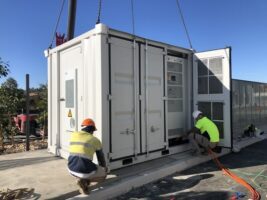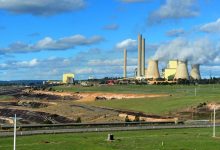
Plans to install a big battery with up to six hours of energy storage capacity in a sweet spot between Victoria’s coal generation heartland and Melbourne’s major electricity demand areas have been waved through the federal green queue.
The up to 400 megawatt (MW) and 2,400 megawatt-hour (MWh) Bunyip North Battery Energy Storage System (BESS) was this week determined not to require further assessment through the federal government’s environmental assessment process, the EPBC Act.
Res, the renewables developer behind the project, has welcomed the decision – which comes almost exactly one month after the project was referred for assessment – and says the project will now continue to progress through the relevant state and local planning processes.
When the project was referred to the EPBC, Res said the location for the battery was chosen to avoid other places that have sensitive environmental claims, or that were close to homes.
“Extensive environmental studies have confirmed the project is unlikely to have a significant impact on nationally protected species or habitats, and that gives us confidence as the project progresses through the assessment process,” Res director Greg Wilkinson said at the time.
In a statement issued this week, Res said that the federal environment minister’s determination that the battery did not need to undergo the full assessment process, confirmed is was “not expected to have a significant impact on matters of national environmental significance.”
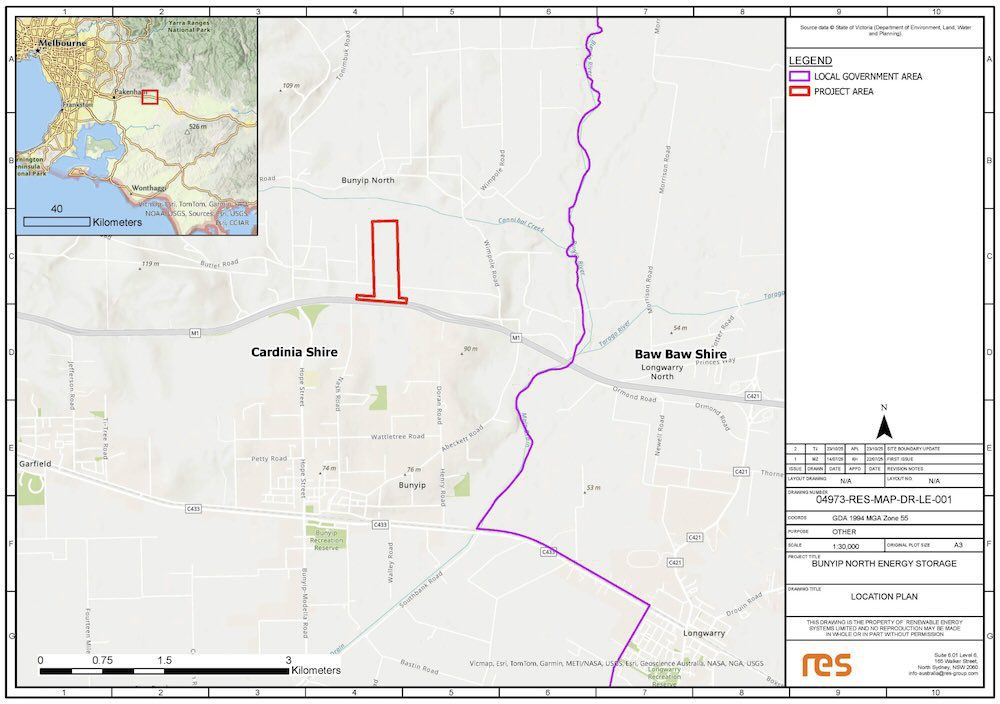
The Bunyip North BESS is proposed for construction around 3km from Bunyip, in Gippsland, on the traditional lands of the Bunurong People.
Res says the site is mostly rural land, currently used for grazing and cropping, and was also picked for its strategic location between the Latrobe Valley – the coal generation centre of Victoria – and Melbourne, and next to existing transmission lines and a major highway.
The transmission lines are the same that deliver power from Victoria’s remaining Latrobe Valley coal power stations to Melbourne – and, one day, will transport electricity generated by the offshore wind farms being developed off the coast of Gippsland.
“The Project Area also benefits from good access to transport infrastructure, being located adjacent to Princes Freeway.” The BESS will connect to the existing network via a new transmission terminal station, the Bunyip North Terminal Station.
“Following the outcomes of environmental surveys … the Project Area was selected to avoid direct impacts to Matters of National Environmental Significance (MNES) whilst remaining in proximity to existing transmission infrastructure,” the EPBC referral documents say.
The referral documents also note that, at the end of its operational life, the BESS may be upgraded, repowered, or decommissioned subject to relevant land agreement and planning approval requirements.
“Decommissioning activities will be conducted in accordance with applicable approvals and regulatory requirements and will generally include the removal of above-ground infrastructure and services, and rehabilitation of the site to a stable condition consistent with surrounding land uses.
“The BNTS may remain in place for ongoing use as part of the transmission network as operated by the Declared Transmission System Operator.”
If you would like to join more than 29,000 others and get the latest clean energy news delivered straight to your inbox, for free, please click here to subscribe to our free daily newsletter.