The Australian Energy Market Commission, which determines energy regulations, appears determined to push on with its plan to force households to pay network monopolies based not on how much they use the network, but instead via a large hike in the fixed daily access fee.
If the AEMC was able to push through with what it had suggested was the ideal outcome, then 100% of network charges would be fixed for customers who reside in distribution network areas which have excess capacity.
This happens to be the vast majority of the population, due to the large-scale gold plating by the network businesses over the 2000’s and early 2010’s, as well as customer investments in energy efficiency, solar and batteries.
Although based on its recent modelling, the AEMC seems to be moderating its ask slightly towards an 80% fixed charge, which would still increase most customer’s daily charge by around $350 per annum.
Normally, in an AEMC regulatory change process they would be lucky to get two dozen submissions. In this particular case they have been hit with an avalanche of 2700 submissions.
Of these, the overwhelming majority were opposed to the AEMC’s proposed plan. Unusually for AEMC processes, which are normally dominated by submissions from energy companies and industry and consumer representative bodies, thousands of individuals made submissions, with almost all of them indicating their opposition.
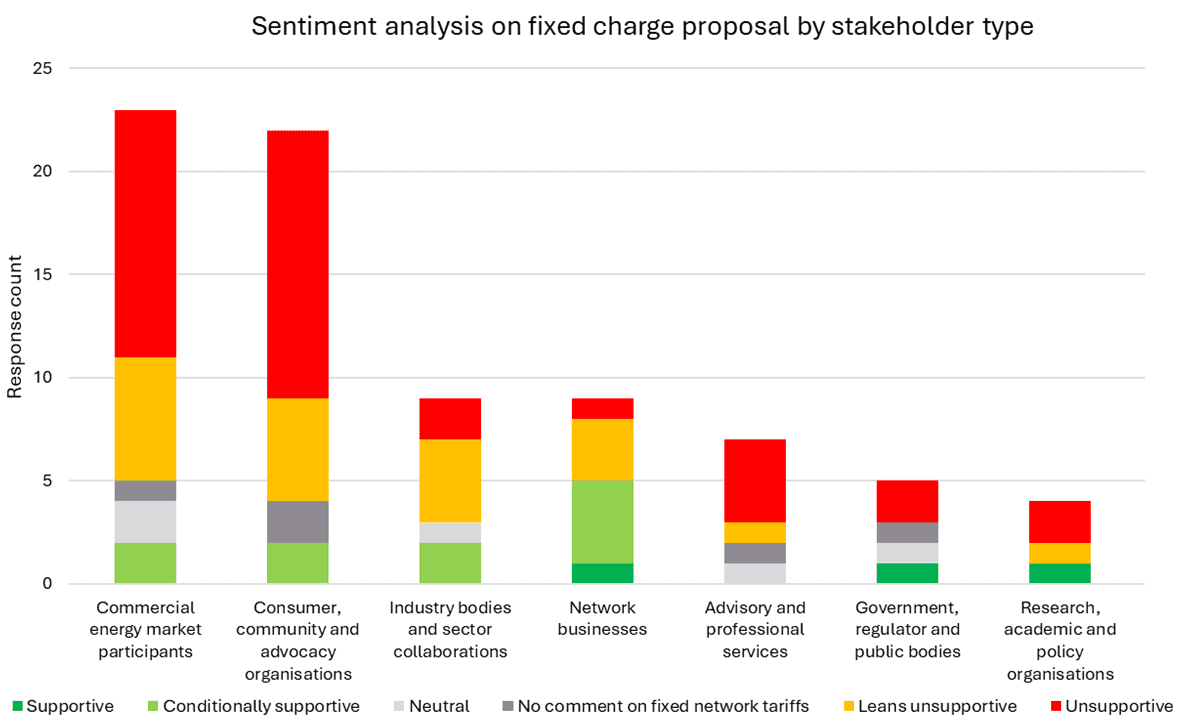
Yet even amongst the organisations making submissions, close to 70% were opposed to the hike in fixed charges according to analysis by consultants Nexa Advisory.
When Nexa breaks these down by organisational type we can see in the chart below that the opposition was very broadly spread. Only network businesses had a majority in support of a change where customers would no longer be able to avoid paying them by reducing their demand.
Source: Nexa Advisory
So what was the AEMC’s take on this flood of opposition?
In a report the AEMC released on Thursday last week, it said the feedback was “mixed”. Which is an interesting way of characterising a large majority of people telling you they’d like you to reverse course.
The AEMC report then proceeds to outline why it still wants to proceed with a radical change to residential electricity pricing which it describes in the title of its report as, “Smarter, cleaner, cheaper energy – what network tariff reform means for different consumers”.
This is based on economic modelling it has prepared to claim that the majority of consumers will be better off as a result of its planned changes to network tariffs, which is a major contrast to analysis I have presented previously.
At this point you need to realise that the analysis I’ve detailed in a previous article showing that households with low electricity consumption, and indeed most consumers with typical consumption, would be worse off under the AEMC change, is based on very simple maths.
I apply the current network fixed charge and a mixture of current retail offerings per kilowatt-hour against a household with median consumption (informed by ACCC data) or low electricity consumption and distribute that over a time profile of electricity consumption in line with what is typical in each distribution network (using substation data you can get from here).
To then estimate impacts from a move to an entirely fixed network charge, I remove any network charges per kilowatt-hour from the retail offerings, and adjust up the network’s fixed charge to reflect networks’ overall costs per residential customer.
My analysis is, admittedly, static, looking at the world as it stands today, and it has been informed by a time profile of electricity consumption in line with averages (but with adjustments in some cases to reflect the impact of batteries and electric vehicle charging).
The AEMC apply some far more complicated maths which allows them to assume they’ll capture $6 billion in savings through avoiding extra network upgrade costs over 15 years into the future and also some savings in the wholesale energy market.
They also state their analysis of the distribution of impacts on consumers is based on 25,000 real customers, involving, “400 million data points of real customer electricity consumption and exports, helpfully provided by 10 distribution network businesses.”
They also assume that the government will reach its targeted 2 million battery systems by 2030. At this point, it’s important to note that this assumption that we’ll get 2 million batteries is, I suspect, pivotal to their first assumption of $6 billion in network and wholesale market cost savings coming true.
If they don’t get these savings, then you’re left back with the result that the majority of people are going to be worse off (while network shareholders will be left nicely protected).
Indeed the chart below from the AEMC’s report shows in the dotted blue line that even for consumers without solar or batteries, about 55% would see an increase in their network charges under the AEMC’s proposed changes.
It is only once they include assumed savings in future network augmentation and wholesale energy costs that more non-solar/battery consumers gain than lose.
AEMC’s projected distribution of network bill impacts compared to no change for households with solar or a battery

Source: AEMC (2026)
So how on earth does the AEMC expect to get $6 billion in network and energy savings by shifting most customers onto a fixed charge and removing network charges on electricity consumption?
This is because while most customers will see a removal of the network price incentive for reducing peak demand as a result of the AEMC’s plans, there will be isolated examples of customers in locations where network capacity is constrained, and these customers will face what is known as a dynamic network charge.
A dynamic network charge can vary every five minutes and is a bit like ride hailing app Uber’s surge pricing mechanism, where prices can suddenly rise to many multiples above average pricing when demand exceeds supply of car drivers.
The AEMC, using results from a dynamic pricing trial led by the Ausgrid distribution network, assumes in its modelling that dynamic network pricing will lead to substantial curtailment in peak demand during periods where network capacity is approaching its limits.
This then leads to us avoiding a range of expensive upgrades to network capacity that the AEMC estimate will unfold (I suspect due in part to replacement of gas appliances and petrol cars with electric alternatives).
But you say you don’t have the time to be watching an app to check on network prices every five minutes to determine when to flick things off to curtail your demand?
Don’t worry, the AEMC understands that. So how do customers manage to quickly curtail their electricity demand in response to five minute changes in network pricing I hear you ask?
Through batteries is how. In Ausgrid’s trial, known as Project Edith, the measured reduction in peak demand was delivered through a range of energy companies which operated batteries as Virtual Power Plants.
When the dynamic network tariff went high, these energy companies discharged the batteries to offset other electricity demand.
And this is where the AEMC’s analysis all falls apart. The AEMC simply assumes 2 million batteries will magically appear by 2030 because that’s a government target.
But achieving that target, at least so far, has hinged on a government rebate program that has significantly improved the financial attractiveness of batteries for consumers.
From next week, the value of that government rebate for a 20 kilowatt-hour battery will be around $4,500.
Meanwhile if the AEMC was to achieve its goal to shift network charges for most customers from variable to fixed then it reduces the financial benefit of 20 kWh battery over a 15 year life for a median consumption household by around $7,000 and for an electrified household by about $13,000.
The AEMC pricing changes are highly likely to undermine the creation of a large installed base of batteries that are likely to be essential to deliver its assumed $6 billion saving.
The other serious flaw with their analysis is that they’ve assumed batteries can only charge up off a household’s own solar in the alternative world to their preferred option.
They’ve ignored the introduction of Solar Sharer retail offers that would allow households to charge up batteries from the cheap electricity from grid in the middle of the day (also, even with just standard time of use tariffs, data from Tasmanian Networks shows that household batteries in that state are regularly discharging into the winter peak period).
This acts to artificially hobble the effectiveness of batteries in curtailing winter network peak demand in their modelling of the alternative case to the one the AEMC would prefer.
They also ignore that retailers are now offering new tariffs that pay customers a premium feed-in tariff for exporting their battery generation during the evening peak demand period.
Lastly, the AEMC seem to be utterly naïve about how networks will game their proposed tariff design. You see, the people that are left in charge of implementing these tariffs are the monopoly network businesses.
If I was running one of these network businesses I would be desperately keen to encourage people to charge their electric vehicles the moment they got home from work, and stop worrying about trying to charge it late at night or in the middle of the day.
I’d also be keen to see them heat their house with inefficient but cheap electric resistance heaters to the point they started wearing board shorts in winter. Lastly I’d also want to stop too many people from installing batteries that they might use to cover that electric vehicle and electric heater demand.
Then once power demand took off I’d tell the regulator, “quick let me upgrade the network, or else black-outs will ensue.” Once I’d got that expenditure approved and rolled into my revenue allowance I’d then tell my team”
“Wait, hold off on building anything. Let’s save on spending on upgrades for a bit, pocket the allowance and instead apply some dynamic tariffs. But be careful to not make it too attractive, we don’t want too many household batteries. We want to adjust this dynamic charge just enough to keep demand right near the threshold where we can continue to fool the regulator that an upgrade of the network will be necessary sometime soon.”
An aside on the AEMC’s use of customer consumption data provided by network businesses
At this point I’m going to rant about the AEMC’s claims that they’ve done some great analysis because they got all this really detailed data on 25,000 customers’ electricity demand from electricity network businesses, which the AEMC then used to provide us with 4 household vignettes as well as ‘Barry the Baker’ and ‘Nina the Florist’.
Let’s put aside the fact the AEMC still haven’t provided evidence to refute my point that low income households tend on average to have lower electricity consumption than very high income households, and so will be disadvantaged by a shift of network costs to be largely fixed.
I asked the AEMC for this detailed consumption data (anonymised of course) to be made available publicly for everyone to scrutinise and analyse. I was told that wasn’t possible because the data belonged to the networks and sharing it with others would be contrary to the terms on which the networks made this available to the AEMC.
Let’s think about this for a moment. This is a government entity making public policy decisions with multi-billion dollar impacts that will affect just about every household outside of Western Australia and the Northern Territory.
This is based on data the rest of us are not allowed to see. Data provided to them by profit-oriented businesses who have a vested interest in driving a particular outcome.
In addition, these are businesses who are regulated monopolies and therefore arguments that data they have gathered from customers are commercially sensitive and proprietary are completely laughable.
Now, maybe the data are a very good representation of the spread of households in the NEM and has been accurately interpreted, but it would be nice if the rest of us could check and not just be expected to take this on trust.
So why shouldn’t we just take this on trust?
Well, as an just one example, back in 2015, the South Australian distribution network, SAPN, sought to impose a special extra electricity charge solely on customers with a solar system.
According to SAPN this was because it was terribly concerned for the plight of the poor and wanted to give those on energy payment hardship programs a discount. But to pay for this it needed to impose higher charges on solar owners because they were free-riders that didn’t pay their fair share of network costs.
According to SAPN, solar customers put a similar load on the network during peak periods as other customers, but consumed less electricity overall from which SAPN could recover their costs. In the interests of taking care of those poor people who can’t afford a solar system that free riding needed to end.
However the Australian Energy Regulator (different to the AEMC), after reviewing SAPN’s underlying data on customers’ power consumption which the network said proved solar customers were nasty free riders, came to a different conclusion.
They pointed out that SAPN had been “selective” in how they presented data, using just “a limited number of values extracted from extreme weather days”, with “no consideration of the load profile over a reasonable time period (e.g. summer, winter, various times of the day and night).”
Once the data was reviewed in its entirety it turned out that there was an awful lot of overlap in power demand profiles between those with and those without solar systems.
Surveys of energy consumers, such as those commissioned by Energy Consumers Australia, indicate very low levels of trust in energy companies and by extension I’d say their regulatory bodies. Refusing to release data used to make such important government decisions only acts to reinforce this distrust.