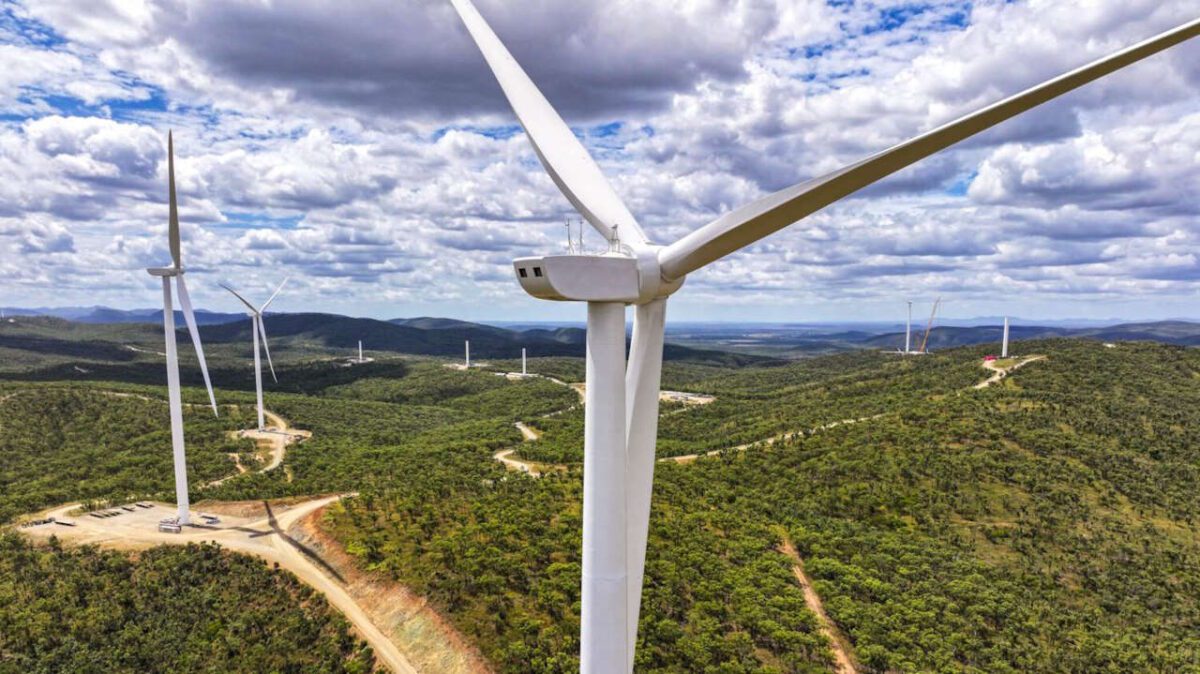
A senior federal government official has said that wind project developers are hoping that power hungry data centres can come to the rescue of projects struggling to land long-term supply contracts.
The Australian wind industry has been struggling to land long term contracts, and finance for their projects, because of the combination of high wind costs, falling wholesale prices, planning issues and transmission delays.
A 12-month finance drought for wind energy was broken late last year with a flurry of commitments that included the Waddi wind farm in Western Australia, the Carmody Hill and Palmer wind projects in South Australia, and the Delburn wind project in Victoria.
The issue was highlighted in a Senate estimates hearing on Monday evening, where senior officials from the federal Departments of Climate Change, Energy Efficiency and Water appeared before the environment and communications committee.
Matthew Brine, the acting deputy secretary of the department, and head of the office of the Capacity Investment Scheme, the federal government’s flagship support scheme for renewables and investment, says the difficulties facing wind projects is the expected fall in the wholesale prices over 2026.
“We mentioned earlier the need to deploy a lot of renewable energy very quickly to be online for when our ageing coal-fired generators reach the end of their effective life,” Brine told the committee.
“There is a real urgency around that. One of the key challenges in particular that big wind farms are facing is a lack of power purchase agreements in the market at the moment, exacerbated by … the expected fall in wholesale prices over 2026.
“A falling price is a good thing, not a great thing if you’re trying to build a build a wind farm. A lot of those proponents, when we talk to them, see data centers as a key source of those PPAs. So, it’s a complicated story.
“On the one hand, they (data centres) do add some challenges to demand. On the other hand, they may be that the key to solving some of the challenges around the rapid deployment of renewables, wind farms in particular.”
The government was asked about the impact that data centres may have, particularly in relation to added network costs – but it said that data centres were largely responsible for their own costs and the issue will be further discussed at a meeting of state and federal energy ministers in May.
The issue of data centres has been central to many economies, because of the extra demand they can put on the grid, potentially inflating prices for everyone. Some countries are requiring data centres to pay more for power they source from the grid, to ensure that other consumers pay less.
On the CIS, Brine was queried about the cost of the program, and repeated that the government wants the cost of the contracts themselves to remain unpublished to generate competitive tension in the bids.
“The underwriting costs … that really is a function of energy prices,” Brine said. “In the .. welcome world, where energy prices are low, the scheme will have a higher cost, but there will also be benefits to the economy, in terms of additional bill relief for households, more competitive businesses, more employment.
“In a world where energy prices are unfortunately higher … hope that isn’t the case …. if the scheme doesn’t work (to bring wholesale prices down), then the scheme is not going to cost very much.”
The administration costs of the scheme were put at $200 million originally out to 2030, with a further $7 million a year after that to manage the contracts. A further $34 million and a further $17 ,million have been added in response to the huge number of contract applications, and ongoing verification work.
If you would like to join more than 29,000 others and get the latest clean energy news delivered straight to your inbox, for free, please click here to subscribe to our free daily newsletter.