Iron ore billionaire Andrew Forrest has announced supply deals for wind turbines, solar panels and battery storage as his company Fortescue Metals ramps up plans to reach “real zero” emissions at their giant operations in the Pilbara.
Forrest announced from New York, where he is attending NY climate week and the UN General Assembly, that partnerships have been struck with battery giant BYD, solar module supplier Longi, and wind and smart energy solutions company Envision.
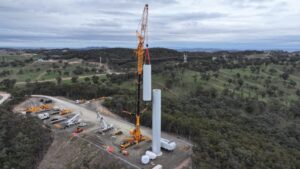
Fortescue has also taken full ownership of Spanish company Nabrawind, which is developing an innovative “self-lifting” turbine design that the company plans to use at its first large scale wind project.
The Nabrawind self-lifting technology will be integrated with Envision’s 7.2 MW turbines and rolled out for the first 132 megawatt (MW) stage of the giant 2.1 gigawatt (GW) East Pilbara generation hub near Marble Bar that was unveiled earlier this year.
The announcement continues a week of extraordinary scenes at the UN, where US president Donald Trump branded climate science as a giant hoax and said wind energy doesn’t work because the wind “doesn’t blow”.
The next day China president Xi Jinping announced his country’s first emissions reduction target, and a goal of reaching a staging 3,600 gigawatts of wind and solar by 2035 – which even analysts said was underselling the rate of installations in China.
“The world once benefited from open trade and cooperation – now it is divided,” Forrest said in a statement.
“Fortescue is showing that industry can help glue back that multilateral spirit, not through rhetoric but through practical alliances that prove heavy industry can follow a new path – one where profits rise as emissions fall.
“China is scaling and manufacturing green technologies at unprecedented speed and our partnerships give Fortescue access to that capability.”
Fortescue’s plans for “real zero” are the most ambitious in the world, as they assume the company will not burn any diesel or gas for its terrestrial operations at the giant iron ore mines.
Even if it gets close to the target , it will be a major achievement given the scale of its operations in the Pilbara.
But other mining groups are also active: Rio Tinto has made it clear that its giant smelter and refineries in Queensland have no future if they have to rely on coal generation, and has signed a series of landmark deals for giant wind, solar and solar-battery hybrid projects.
In South Australia, BHP this week signed another “baseload renewables” contract with Neoen’s proposed wind and battery at Goyder North, meaning 70 per cent of its huge mining operations and smelters in the state will be powered directly by renewables, with the rest coming from Australia’s most renewable grid.
And in Western Australia this week, Renew Economy revealed that the new Bellevue gold mean achieved 79 per cent renewables average in August, and 84 hours of “engine off” at its remote off-grid mine.
See: Off-grid gold miner says 100 pct renewables is possible after running 84 hours with “engine off”
But that achievement was trumped, if that’s the right word, by the Kathleen Valley lithium mine – partly owned by leading renewables critic Gina Rinehart – which achieved an average 81 per cent renewable penetration in its first year of operations at its off-grid location.
Meanwhile, the Fortescue announcement also includes a new supply deal for giant 240-tonne electric haul trucks for the mines with construction and mining equipment company XCMG, which will now build half the up to 400 giant electric trucks needed for its mines, with Liebherr constructing the other half.
“These partnerships … will not only enable Fortescue to electrify its Pilbara operations and deliver on its target of Real Zero by 2030, but also catalyse decarbonisation globally,” Fortescue said in a statement.
The heads of agreement with Envision is particularly interesting, as they are a new player in the Australian market traditionally dominated by Vestas and Goldwind, and some expect will add much need price competition in a sector struggling with increased costs.
Fortescue says a prototype of an Envision EN182-7.8 MW turbine erected with the “self-lifting” technology developed by Nabrawind, which it now fully owns, is being built in China. The first example is expected to be on display in Australia, possibly by the end of the year.
The self-lifting technology should deliver lower civil construction costs for Fortescue’s planned wind farms. and which allows blades to capture winds at a greater higher.
“These turbines are engineered to perform in low-wind conditions and withstand extreme weather, including cyclones,” Fortescue said. “They will be integrated with Nabrawind’s 188-metre tower technology and provide improved generation and cost efficiency.
“Together, these advances will underpin the first stage of Fortescue’s inaugural wind project, unlocking greater generation capacity and efficiency to help deliver Real Zero by 2030. “
The Longi MoU will most likely be used for Fortescue’s planned Turner River solar hub, which it also plans to build after completing its current work on the North Star and the Cloudbreak solar projects adjacent to its major mines.
(This story has been updated to provide more information on how the Nabrawind technology will be incorporated with the Envision turbines).