Australia’s biggest coal generator, AGL Energy, says its rapidly growing battery storage portfolio – both big and small – will emerge as a major cash cow for the company as the country’s main grid transitions from baseload to renewables and flexible capacity.
AGL, in its annual results presentation on Wednesday, underlined how battery storage earnings will surge in coming years as it builds new big batteries and signs contracts for others.
The company has increased its interim targets under its climate plan, and now aims to build 6 gigawatts (rather than 5 GW) of new renewable and firming capacity by 2030, part of its 12 GW target for 2035.
At least half of that new capacity will come from battery storage, and CEO Damien Nicks and chief financial officer Gary Brown made it clear in their presentations why the company’s focus – like those of the other major utilities Origin Energy and EnergyAustralia – is on storage rather than wind and solar.
For a start, as this graph below, illustrates, the company makes more money from its dispatchable assets, and – as the Australian Energy Market Operator has recently underlined – big batteries are extracting the highest premium of all.

AGL’s battery portfolio is gaining a 300 per cent premium on the average market price, considerably higher than its existing gas and hydro portfolio. And its overall premium to the average market price continues to grow, which reflects as much its market power as it speaks to the technologies themselves.
“Our grid-scale battery portfolio can respond to peak demand events in seconds – crucial in a transitioning energy market which is shifting away from baseload thermal generation to variable renewable energy,” Nicks said.
Note the graph on the right (above), and the considerable discount of wind, and particularly solar, whose price is being cannibalised by the middle-of-the-day “solar duck” that often sends wholesale prices into negative territory.
The solar returns have slumped from a small premium back in 2019 to a 50 per cent discount in 2025 – probably largely due to the huge growth of rooftop solar in those intervening years.

The next graph illustrates just how quickly AGL expects earnings from its fleet of battery and other flexible assets will grow in coming years. It does not exact forecasts in terms of dollars, but it underlines the scale of growth.
“We want them into the market as quickly as we can,” Nicks said, referring to the recent decision to give final investment approval to the 500 MW, 2,000 MWh Tomago battery, which is by far the biggest to date.
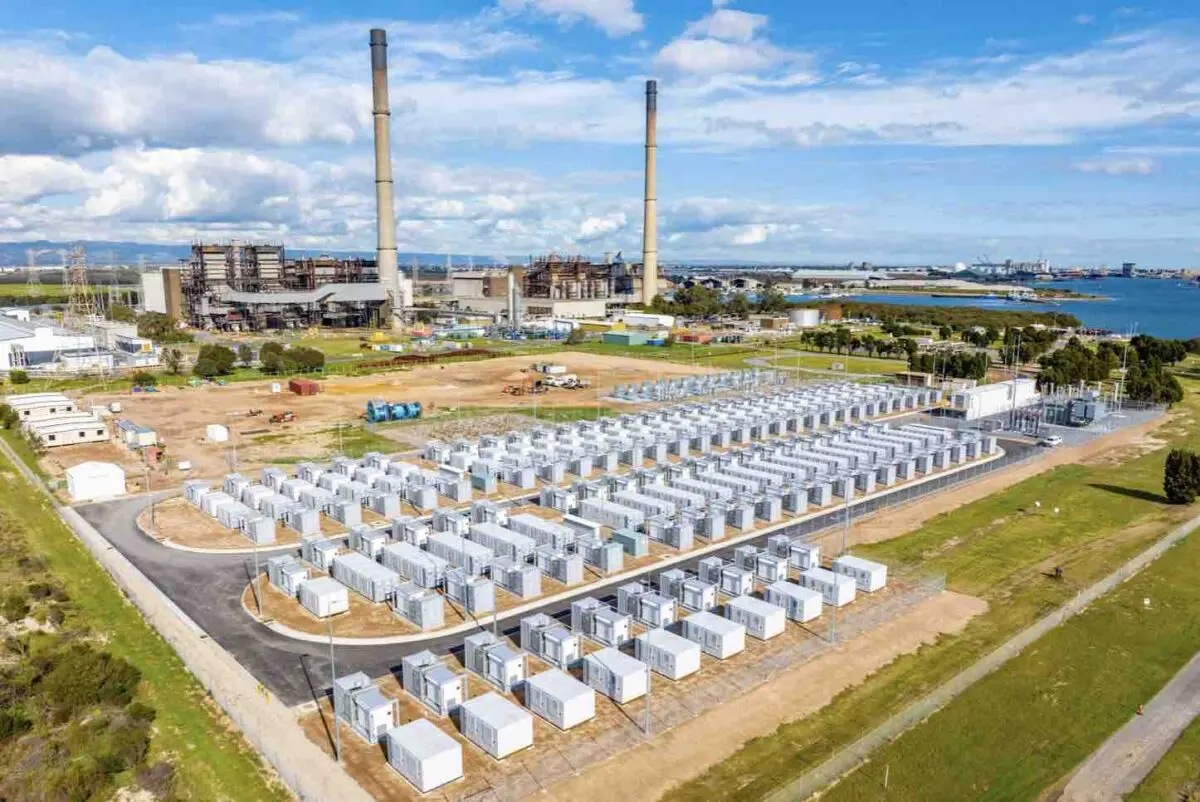
AGL says its big batteries, including the 250 MW, one hour Torrens Island battery in South Australia (pictured at top), and the 50 MW, one hour Broken Hill battery in NSW, earned $45 million in the latest year, compared to $28 million in FY24.
Those earnings will jump in coming years as the 500 MW, 1,000 MWh Liddell battery – built at the site of the shuttered coal generator – is commissioned in early 2026, and then again when the Tomago battery comes online in FY28.
“We’re confident that the earnings stream out of (those batteries) will be able to offset any reduction that we could see in both the coal and gas,” Nicks said.
Brown said that the majority of those battery earnings – 60 to 70 per cent – will come from selling “caps” (underlying their dominant position in the market), with another 20 to 30 per cent coming from energy arbitrage, and another up to 10 per cent from frequency control and ancillary services.

AGL and says it has “clear sight” on another 900 MW, presumably from several unnamed projects marked on this map above, including a 500 MW, 2,000 MWh battery being lined up in Queensland.
The company also has offtake, or “virtual storage”, deals with a number of third party battery projects, including Wandoan and Western Downs in Queensland, the Capital battery in NSW, and the Dalrymple North battery in South Australia.
The results presented on Wednesday reveal a bottom line loss of $98 million, the result of $596 million of significant items, mostly (386 million) from the impact of “onerous contracts” relating to losses from the carrying value of LGCs (large scale certifates), and other items including old wind contracts.
Nicks said they were essentially “paper losses” that had been hedged out and did not reflect underlying earnings, which nevertheless fell 9 per cent to $2.01 billion, albeit at the lower end of previous guidance, while its underlying net profit fell 21 per cent to $640 million.
AGL is expecting little change in the coming year – with underlying EBITDA predicted between $1.9 and $2.2 billion, and underlying net profit at between $500 and $700 million – but emphasises that growth in battery earnings will offset any decline from its ageing coal and gas portfolio.
The results were poorly received by the market, which slashed the share price by more than $1.20, or more than 12.3 per cent, to $8.96 – largely because the results were at the lower end of expectations.
AGL currently plans to close the 2.65 GW Bayswater coal generator in NSW by 2033, and the Loy Yang A brown coal generator in Victoria by 2035, in line with that state’s legislated target of reaching 95 per cent renewables by 2035.
In the latest year, coal generation fell sharply due to both planned and unplanned outages. The availability of its coal and gas generators fell to less than 80 per cent.
Overall generation was 1.2 terawatt hours (TWh) lower, with the lower coal output partially offset by the gas fleet and a stronger contribution from its renewable generation assets. Coal still accounts for more than 80 per cent of its total generation.
AGL says it now has 8.3 GW of “flexible” assets, including more than 2 GW from its coal generation portfolio that can ramp up and down according to market needs.
It already has 1.2 GW of battery storage operating, in contract or delivery, and says it has “clear sight” on another 900 MW, but Nicks says that the company is also looking at wind and solar, although these are likely to be “off balance sheet”, unlike the batteries.
“We will need bulk energy in our portfolio, so we will absolutely be both contracting (and building),” Nicks told Renew Economy.
“We still have a lot of wind in there, whether we, whether we put it all on our balance sheet, or whether we get others to do it with us, we’ll continue to look at the economics of that.” Among the projects being considered is the newly approved Pottinger renewable energy hub near Hay that it is developing with Someva Renewables.
“We see a sort of rough 80/20 rule, if you like, 80% of the batteries and firming will be on our balance sheet,” Nicks said. “Conversely, wind will be off our balance sheet. And it also just comes to sheer scale of what needs to happen, you know, 12 gigawatts in total.
“We’ve only got so much capital that we can deploy, so we’re looking to deploy that $10 billion in capital. We’ve got a couple of batteries off our balance sheet right now. We’ve got a couple of interesting transactions we continue to work on. We’ll, we’ll continue to evolve that, like we do with the rest of our portfolio.”
The company says it has invested half a billion dollars in the last year, including the construction of the Liddell Battery, and another $400 million for the acquisitions of Firm Power, Terrain Solar and its strategic investment in Kaluza.”
It also launched in July AGL Community Power, which it says aims to share the benefits of the energy transition with those who cannot purchase solar and batteries or who may be locked out due to barriers to home ownership.
That includes the purchase from tesla of the South Australia virtual power plant, one of the largest in Australia, as it advances its portfolio of decentralised assets under orchestration and demand side flexibility.
See also: AGL grabs big share of EV home charging market as it plots future beyond coal