The heads of some of Australia’s biggest renewable energy developers have admitted that a new approach to community consultation is needed because of a major shift in the way some communities are responding to project proposals.
“I think it’s very clear that things are changing. You can feel it in the community,” Rob Wheals, the head of Squadron Energy, the major renewable and storage developer that is owned by iron ore billionaire Andrew Forrest, said at a panel session at the Australian Clean Energy Summit in Sydney.
“There’s a lot more resistance, and so I think it’s incumbent upon us to be listening to what they what the community is saying … there’s definitely feedback from community that they want us to go about doing our community consultation in a different way.”
Wheals said there is a “new regional order” around how communities want to be treated, and that will mean earlier consultation and more transparency from developers, and it will need a new national shared benefits framework.
“I think there would be real value in having a regulated, transparent national framework around the benefits that are paid to hosts, into neighbors, because if that’s consistent and transparent, then there really is no need for some of these confidential arrangements to be entered into,” Wheals said.
“That removes that transparency issue, and certainly from a Squadron perspective, we will be sharing our minimum levels of investment much earlier in the communities.”
The sentiment was echoed by new Clean Energy Council chair and Iberdrola Australia CEO Ross Rolfe, who says that while it’s good Australia voted in May to continue the renewable energy transition, the industry is on notice.
“I feel as though we’re sort of on probation, and the probation element is really around demonstrating a real value proposition to regional communities,” he said during the same panel.
Squadron and Iberdrola are two of the heavyweight newcomers on the Clean Energy Council board. It is already apparent they are bringing a renewed focus on improving community engagement and reducing the resistance Wheals says they’re seeing in regions around the country.
Like Wheals, Rolfe is prepared to admit there is a problem.
“We need to recognise that delivering the transition does inevitably impact regional communities, landscapes and ecosystems. This raises complex challenges for governments power system planners and companies that develop and operate the infrastructure,” he said during a separate speech on the same day.
“The industry must satisfy the communities that host our plant that there are genuine net benefits from the changes that they’re experiencing.”
Removing irritations
Controversial confidentiality clauses are just one community bugbear, because they say it divides communities by forcing landholders to hide their negotiations with developers or land agents from neighbours and friends.
Others are only finding out formally about a project when development applications are being submitted, which appears to neighbours of a project as if it’s already a done deal.
“Traditionally, the way we’ve done projects is that we’ve started to engage in community consultation just before the approval process starts. So there’s been quite a lot of preliminary work done and feasibility work done,” Wheals says.
“[What communities are] saying is engage with us earlier, be more transparent, talk to us about the benefits for our community much earlier …. and I’d even go so far as to say that the old way of doing community consultation is dead.”
Squadron is one of a number of developers thinking of different ways to approach community benefits, and it is trialling a system that will allow communities to buy into some of its projects as a way to share equity as well as benefits.
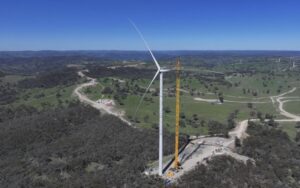
A fund open only to people living in the Central-West Orana Renewable Energy Zone (REZ), the home of the 414 megawatt (MW) Uungula (now under construction) and the proposed 700 MW Spicers Creek wind projects, gave locals an option to buy-in for a minimum of $1000 and a maximum of $20,000.
They have a promise of 7 per cent annual returns for ten years, after which the investor receives their capital back.
Make it national
Currently, shared benefits frameworks are a state-based choose-your-own-adventure.
New South Wales (NSW) moved first with guidelines that set shared fund rates of $850 per megawatt (MW) per year for solar over the life of the project, $1050/MW per year for wind, and $150/MWh per year for battery energy storage systems (BESS), all indexed to CPI.
The idea was to set expectations around what would be reasonable for developers to pay.
Victoria is still working on its guide, and after much nudging by councils who wanted the NSW rates set as a base, Western Australia came out with its own, much tamer, draft version.
Queensland now has the strictest and strangest guidelines, asking developers and communities to have a signed deal in place before a development application is lodged.
Rolfe called the change “interesting” and noted it comes with serious long term consequences.
“[It’s] interesting to see the current government in Queensland’s policy shift in this regard, which is as a result of a sense that the community engagement and consultation processes were previously too light on,” he said.
“They’ve now really delegated that authority back to local councils who are approving new projects.
“The challenge with that is that we’re talking about reinventing the power system here, so the councils can’t be expected to be taking decisions about what is the most efficient way to sort of construct the power system.”
Where is the developer rating scheme?
Wheals believes the impending developer rating scheme will be key to rebuilding trust with communities.
The scheme was due to launch as a pilot from July 1 this year with 10 developers.
The Department of Climate Change, Energy, Environment and Water did not respond to questions about the status of the pilot.
A 2023 community engagement review, part of a deal with Teal MPs to respond to rising community angst about renewable energy developments, found repeated poor engagement had created “material distrust” of renewable energy and grid developers.
The final report included feedback from 75 meetings with more than 700 people, and more than 500 submissions. It found some developers were just as frustrated by the way the industry was being tarnished by a few bad actors.
Winning a social licence to operate is now top of mind for almost all developers and governments, as a decade of construction in formerly sleepy country regions combined with badly-handled consultations has left a number of communities around the country reeling.
Neither developers nor government agencies have been entirely blame-free for the problems that Australian Energy Infrastructure Commissioner Tony Mahar says now require senior people from each to front up repair relations.
In 2023, market rulemaker the Australian Electricity Market Commission (AEMC) laid down basic rules for both transmission companies and the market operator to follow when planning new infrastructure.
These rules, put in place after the Australian Electricity Market Operator (AEMO) and Ausnet stuffed up consultation on the proposed VNI West transmission line, include talking to “stakeholders who are reasonably expected to be affected” by a development.