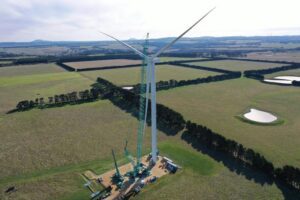
Selling off turbines for re-use and using a local contractor has allowed decommissioning work on Australia’s second-oldest wind farm to come in well under budget, Synergy’s environmental closure planning lead says.
Western Australia utility Synergy started the end-of-life process for the two Esperance wind farms in 2022 – once the option of repowering them was ruled out – and with the turbine removals now finished, the company is opening up about how it’s all gone.
The plans originally assumed most of the site would go to landfill. Instead, the state-owned company sold the six younger turbines from the Nine Mile beach section to Blair Fox, a family-owned electricity company.
“The [other] key factors in coming in under [budget] were the use of the local contractor,” Synergy environmental closure planning lead Kathleen Hammond told the Australian Wind Energy Forum in Melbourne this week.
“They came in about $1 million cheaper than the other two quotes we received.
“The ability to have the turbines refurbished and reused rather than just disposal was also a massive advantage.
“We did just assume straight disposal to landfill when we were provisioning, so those were significant deviations from what we’d estimated, so those resulted in some good savings.”
Synergy said in 2024 the road bases and concrete foundations would be gifted to the Shire of Esperance for use as road surfaces and other uses.
But Hammond says the local contractor brought in to decommission the site was able to use the crushed material to resurface its own site in town.
The road bases were ultimately left in place, to avoid erosion and support native revegetation, she says.
The Esperance wind farms on the south coast Western Australia include the nine-turbine Ten Mile Lagoon project, commissioned all the way back in 1993, and six turbines added at Nine Mile Beach in 2004. Together, they produced 5 megawatts (MW).
The state’s very first wind farm – and Australia’s first ever commercial project – was Salmon Beach, also near Esperance, with six turbines commissioned in 1987.
How to pull down a wind farm
With decommissioning now finished, Synergy’s efforts are an example for the circa 5 gigawatts (GW) of turbines that are coming to the end of their lives in the next 10 years.
The wind farms were built inside a natural reserve, which meant Synergy was required to put a decommissioning and rehabilitation plan to the state Environmental Protection Authority (EPA) before starting work.
Hammond says the plan broke the decommissioning up into three phases: disassembly and removal of the turbines, removing the underground cabling and materials, and rehabilitating the site, with a goal to minimise landfill waste.
Blair Fox bought the first six turbines “for a nominal fee” from Synergy, and they handled the removal, and the remainder were put out to expressions of interest EOIs.
One of those was to remove and refurbish the turbines, and this was accepted, but other ideas included turning them into a reef offshore.
“The majority of the remaining turbines went to another company that was going to refurbish them and reinstall them, and two turbines were donated to TAFE, the Learning Academy in WA, for as part of their clean energy skills development,” Hammond says.
“The reuse option did actually, from that expression of interest for the Ten Mile turbines, come in as the most cost-effective option.”
Another small Western Australian company, Advanced Energy Resources, won the bid to take down the final turbines, but it’s unclear whether they were the final buyer.
Synergy did not respond to requests for further comment before publication.
Revegetation efforts are subject to another five years of monitoring to meet EPA-approved conditions.
Miners might be turbine re-use option
Western Australia is famously heavy with mining, and Hammond thinks they could be buyers for still-usable decommissioned turbines.
The logistics could be “expensive” and it would require forward thinking from both wind farm owners and even developers in site selection.
“But factoring in supply chain issues, it may be quite a quick pathway,” Hammond says.
“There will be opportunities, but I don’t know that they will be particularly evident. I think you’ll either have to go out and search them out or you’ll have to wait for someone to approach you.”
She says Synergy, as a generation developer, is now having to put decommissioning plans into planning applications.
“More and more often we’re seeing that decommissioning and rehabilitation plans are actually required from local governments as part of your upfront approvals process,” she says.
“That is really driving a lot of good conversations early about what land owner expectations are at end of life project, and that’s helping us forecast costs for the future as well.
“We’re getting a better picture, and it’s factoring into our FID, obviously. So we were factoring those costs in, and it’s helping the overall viability of the project, or be a bit more realistic.”
She warns that reuse and recycling however take longer to figure out than sending materials straight to landfill, a process that “many projects revert back to”, so owners need to give themselves the time to do this and developers may even need to think about this when selecting sites.
“We went through the provisioning process, probably two years before the decommissioning actually commenced,” she says.
If you would like to join more than 29,000 others and get the latest clean energy news delivered straight to your inbox, for free, please click here to subscribe to our free daily newsletter.
If you would like to join more than 29,000 others and get the latest clean energy news delivered straight to your inbox, for free, please click here to subscribe to our free daily newsletter.