The chief judge hearing a court battle over one of the country’s highest profile and most contested wind projects has ordered the local council to re-replead its case, saying its current approach in federal court had “gone off the rails.”
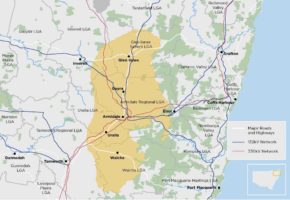
The Tamworth Regional Council is appealing against planning approval issued a year ago for the Hills of Gold wind project, now owned by Someva Renewables, arguing that it doesn’t have enough information to approve the road upgrades that will be needed to move tonnes of equipment and construction materials to the site.
However, in a directions hearing last week in the Land and Environment Court, the chief judge, Justice Brian Preston, said the council had “completely misunderstood” the basics of development in NSW.
“Again, this is another example of a case that’s gone off the rails by reason of faulty contentions,” Preston told the court last week.
“And the suggestion of the council that I give directions under 31.19, that there be permission to call experts, and for those experts to write individual reports, and then to confer about whether is adequate information, well, you’ve got to be joking.”
Preston said he was not interested in hearing from experts about whether the DA had adequate information. “What I am interested in is, will this development have unacceptable environmental impacts in particular regards, that’s what I’m interested in.
“Let’s go back to basics again. An applicant for development consent never needs to apply for consent to use public road.
“So it doesn’t matter how big these windmills, you know, turbines are, 91 metres and how difficult it is to get around a corner. They do not need to get consent to drive on a public road.
“So that’s the end of it, and it matters not that the environmental impact statement might say that these turbine shafts are going to be taken by public roads or that there is going to be these roads carrying spoil from excavation or gravel for formation of a road, consent is not required for that.”
The Hills of Gold project has been the centre of a very public dispute that has been closely watched by the clean energy industry because of its prominence, and because of its attempts to thwart wind developments using a clause about “phantom dwellings.”
It is still being closely watched because of the implications of this court case, and its potential impact on other projects and planning rules in the state.
Some wind projects are facing massive delays, and costs of up not $100 million, just to get through the planning process in NSW, a report found last week.
The Hills of Gold project first lodged its planning application in 2019 – a scoping report was published a year earlier.
It won a recommendation from the NSW government planning department in late 2023, but for only 47 turbines, and a shrunken capacity of 290 megawatts (MW), down from 64 turbines in its final application and the 97 turbines originally contemplated.
The then project owner, Engie, initially welcomed that decision, but a few months later applied for 15 of the 17 turbines that had been removed by the department to be reinstated, arguing that without them the project was not commercially viable.
The IPC, to whom the project was referred because of the number of objections, found Engie’s argument to be supported by independent research and resumed its assessment of the project based on a revised 62 turbine proposal, and a 100 MW, four hour battery.
The project received a whopping 1122 submissions, of which 747 were against. The IPC granted its approval in 2024 before a local opposition group flagged the legal action. It was supported by council, which is now taking the case alone after the local group dropped out.
Sam Allam, appearing for the project developers, say he is not aware of any case of this kind that is being run as an objector appeal by a council.
“We say it’s highly unusual because we, as a team, have looked through thousands of cases and we have not found one single example of a council, a local council in New South Wales, and there’s 120 or so of them, we’ve not found a single example of a council opposing a fossil-fuel project that’s been approved by the IPC,” he said.
A further directions hearing will be held in early December.
If you would like to join more than 27,600 others and get the latest clean energy news delivered straight to your inbox, for free, please click here to subscribe to our free daily newsletter.