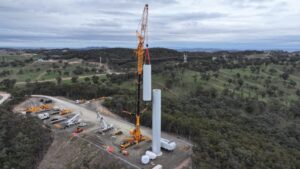
A major new wind and storage project proposed for central New South Wales has joined the queue for approval from both the federal and state governments, with plans to install up to 76 turbines and with the option for each of those turbines to have batteries included.
Goldwind Australia has lodged applications to develop the up 600 megawatt (MW) Milpulling Wind Farm around 40km north-west of Dubbo, in the Gilgandra Shire Council on land where the turbines and batteries would co-exist with cattle and sheep grazing and cropping.
The wind farm would include battery storage of up 250 MW with five hours’ duration (1000 megawatt-hours) and, according to planning documents, this storage would either be spread across the project – “DC-coupled” to the turbines – or installed the traditional way at the connection asset (AC-coupled).
As Renew Economy has reported, Goldwind has successfully piloted this hybrid wind and battery approach on the National Electricity Market by retrofitting one of the roughly 3 MW turbines at its 312 MW Moorabool wind farm in central western Victoria with a 2 MW/4.8 MWh GoldBlock BESS.
Off that back of that trial, the wind giant recently applied to modify the design of its 75-turbine, 298 megawatt (MW) Coppabella wind farm, also in NSW, to include co-located battery energy storage systems (BESS) at 53 turbine locations.
Goldwind Australia director John Titchen has since said that the China-based wind giant now plans to include these hybrid systems in all of its own development projects, and make it a standard offering to customers using their 7-8 MW turbines.
“These batteries provide the market arbitrage opportunity, they also provide the ability for ancillary services and income, but the core of this technology is the lower infrastructure costs,” Titchen told the Tasmania Energy Development conference in Devonport last month.
“What we’re doing is connecting batteries directly into the DC bus, so that’s effectively in the middle of the turbine. So you put a battery on the hard-stand next to the turbine and connect it into the turbine, share a whole lot of the infrastructure.
“We’re sharing the converter, we’re sharing the civil infrastructure, we’re sharing the reticulation system, the transformation, the grid connection; so it’s a lower-cost way of deploying batteries.
“We all know that batteries are getting more and more competitive; the cost curve is going down. This takes another step, and so the result of that is we find that longer duration is competitive in this sort of configuration,” Titchen said.
“One other attribute of it is that if you’ve got wind production and the market price is low, then you can store directly in the battery without having to go out into the transmission system to a battery somewhere else. So… that co-location means that there’s minimal loss between the generation and the storage.”
For the Milpulling project, planning documents say the up to 76 turbines would have a rated capacity of up to 10 MW each and would include an adjacent hardstand area (100m x 70m) that will be used for component lay-down and for BESS co-location.
The project will also include up to two substations and underground cabling to connect groups of turbines and DC-coupled BESS to those substations, according to referral documents submitted for federal environmental assessment.
Goldwind says early engagement has focused on identifying key stakeholders and building relationships with the host landowners, near neighbours and communities closest to the project area, including town of Gilgandra which is around 17 km northeast of the project.
The developer says feedback received during early consultation covered a range of issues, including jobs, economic benefits, community benefits package, local accommodation (constraints and opportunities), potential visual impacts and potential noise impacts.
If you would like to join more than 29,000 others and get the latest clean energy news delivered straight to your inbox, for free, please click here to subscribe to our free daily newsletter.
If you wish to support independent media, and accurate information, please consider making a one off donation or becoming a regular supporter of Renew Economy. Please click here. Your support is invaluable.