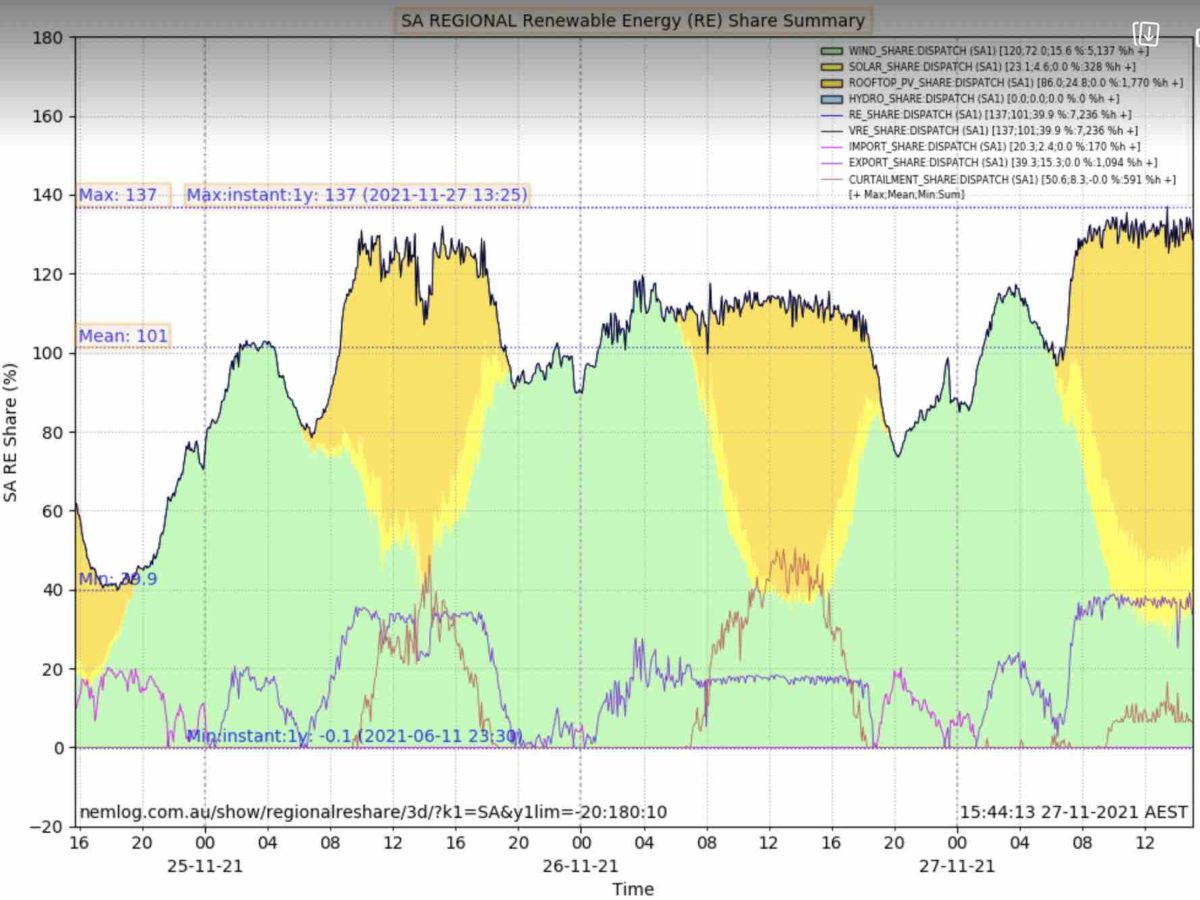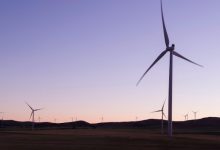
Wind and solar continue to smash records in South Australia, surging to a new high of a 135 per cent share of state demand on Saturday, and averaging more than 108 per cent of local demand over a 48 hour period to Saturday evening.
The new benchmarks were facilitated by good solar and wind conditions, but also by the decision by the Australian Energy Market Operator to dramatically dial down the amount of gas generation required to ensure the grid remains secure.
As RenewEconomy reported exclusively on Friday, South Australia until recently had required at least 240MW of gas generation to ensure enough “synchronous generation”. That required repeated “directions” from AEMO and meant that some wind or solar had to be curtailed to make room for that capacity.
But following the commissioning of four spinning machines known as synchronous condensers, (which do not burn fuel), AEMO has dialled back the amount of gas generation needed, first to 120MW and more recently to just 80MW, or just two gas generators (actually, only one is needed, the other is there for extra insurance).

It means that over the last 24 hours South Australia has become the first gigawatt scale grid in the world to be be nearly fossil free – with no coal generation (the last coal generator closed in 2016) and just a 4.4 per cent share from gas. (The thin orange line in graph above).
Market experts believe that share of fossil fuels will decline even further as the market operator becomes comfortable over time with using battery storage – specifically, “grid forming inverters” – to provide the “system strength”, inertia and other crucial grid services once exclusively provided by coal, gas and hydro generators.
AEMO has already issued one white paper on the potential role of grid forming battery inverters, and the Australian Renewable Energy Agency is preparing to launch a $100 million funding round to prove this technology at scale. So far, only a few battery installations have this capacity, and at relatively small scale.
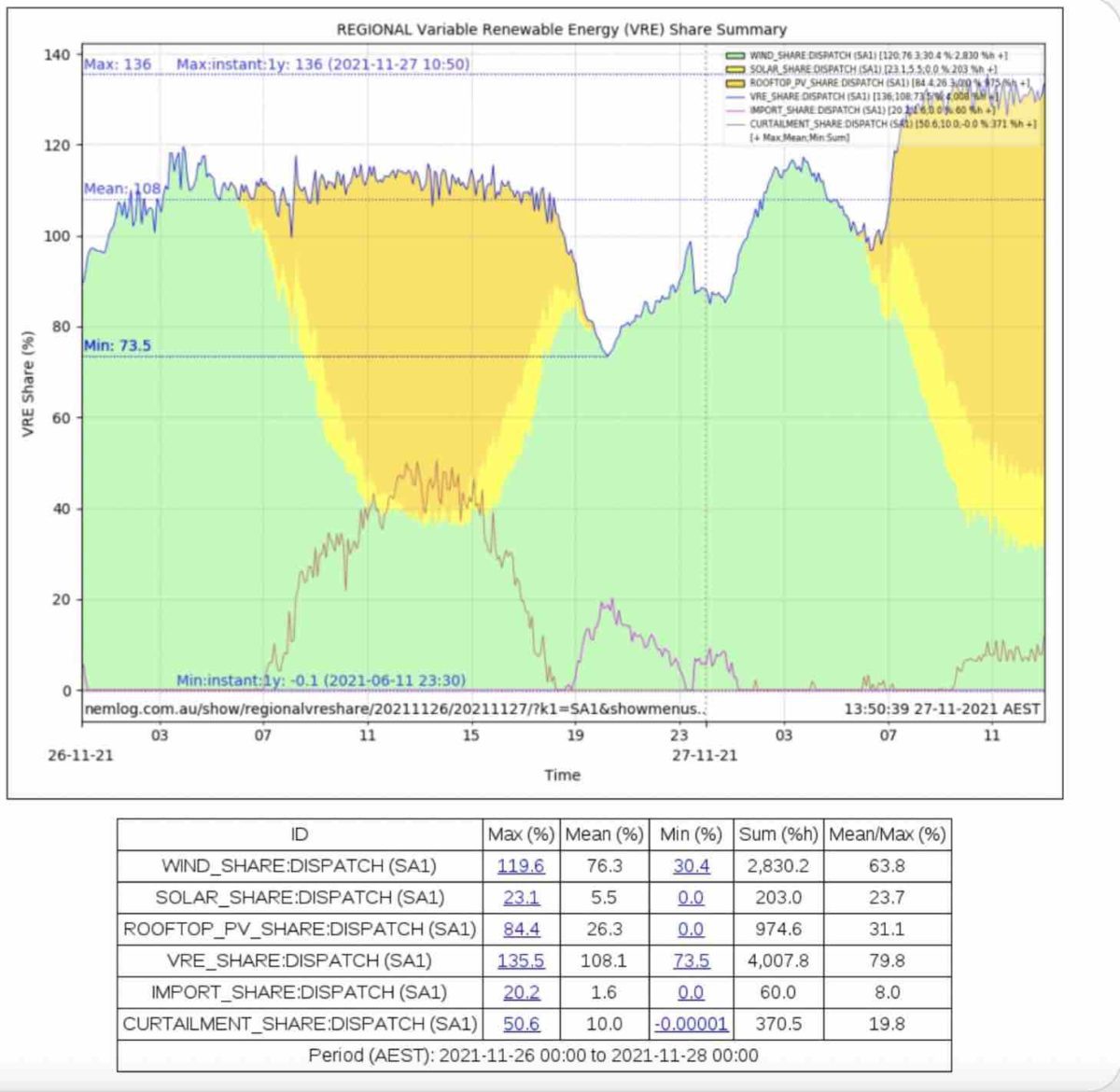
According to Geoff Eldridge, from the data provider NEMLog, lots of records fell on Saturday.
The record 135.5 per cent share of local demand for wind and solar occurred at 1050 AEST, (see graph above) while the two-day rolling share reached 108.1 per cent and there was also a new 72 hour rolling share record of 101 per cent (see graph below).
Network demand in South Australia went negative again to minus 42.8MW. It was only a week ago that negative demand in the state was recorded for the first time.
In Victoria, the maximum share of wind and solar hit a new record of 79.6 per cent at 10.55 AEST on Saturday, with network demand falling to a new record low of 2,200MW.