A new reported published on Thursday reveals that, for the first time, wind and solar power generated more electricity in the European Union than fossil fuel power sources.
According to the latest European Electricity Review published by global energy think tank Ember, wind and solar generated a record 30 per cent of EU power, with fossil fuels generating 29 per cent.
“This milestone moment shows just how rapidly the EU is moving towards a power system backed by wind and solar,” said Dr. Beatrice Petrovich, senior energy analyst at Ember and lead author of the report.
“As fossil fuel dependencies feed instability on the global stage, the stakes of transitioning to clean energy are clearer than ever.”
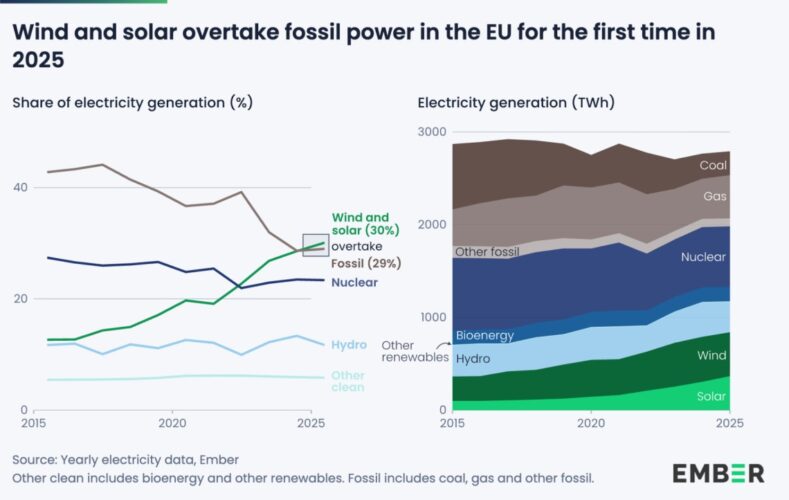
The European Electricity Review provides the first comprehensive overview of the European Union’s power system in 2025 and analyses full-year electricity generation and demand data for 2025 in all EU-27 countries.
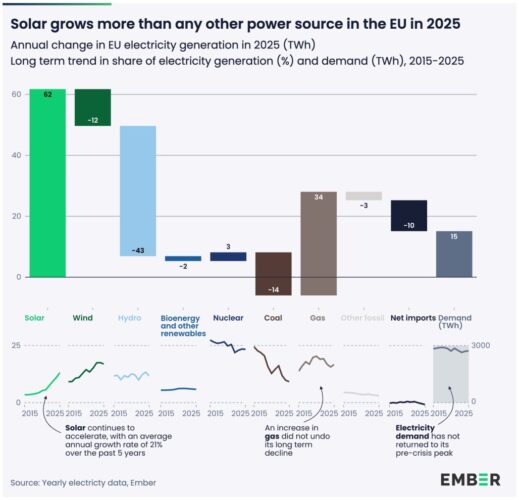
According to Ember, the milestone of wind and solar overtaking fossil fuels in 2025 is can be “largely attributed to a staggering rise in solar power” which grew by 62 terawatt-hours (TWh), or 20.1 per cent, compared to 2024.
Throughout the year, solar across the EU generated a record 369 TWh in 2025, more than double the output recorded in 2020, and continuing a trend that has seen average annual growth in generation of 21 per cent over the past five years.
This growth in solar was also not relegated to just a handful of powerhouse countries, but was seen across all EU countries, all of which saw an increase in solar generation compared to the year before.
There nevertheless remain a handful of dominant players, with solar providing more than a fifth of electricity in Hungary, Cyprus, Greece, Spain, and the Netherlands.
Wind and solar also generated more electricity than all fossil sources across 14 of the EU’s 27 countries in 2025.
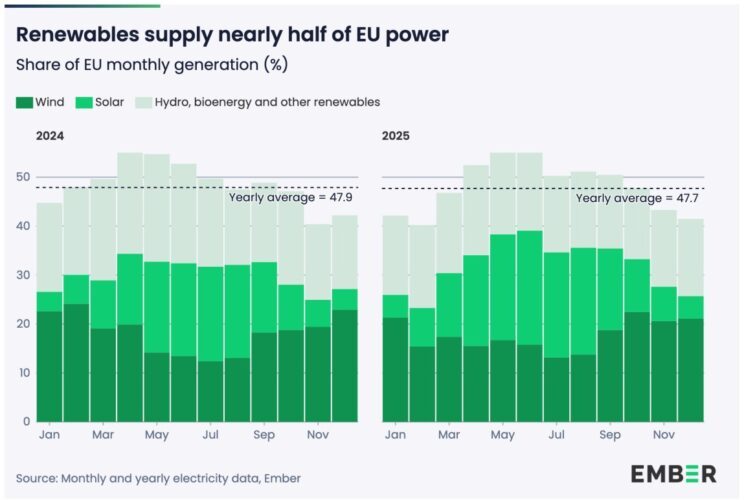
All renewable energy sources combined to provide nearly half of the EU’s power (48 per cent) even as “unusual weather conditions” caused hydro generation to fall by 12 per cent and wind energy generation to fall by 2 per cent.
Wind nevertheless remained the EU’s second largest electricity source, accounting for 17 per cent of EU power.
Despite the good news for renewables, the fall in hydro generation opened the door for gas generation to increase by 34 TWh, or 8 per cent, in 2025, even though Ember’s analysis shows it remains in a long-term decline in the EU, sitting 18 per cent below its most recent 2019 peak.
The rise in gas subsequently pushed the EU power sector’s gas import bill up to €32 billion in 2025, 16% higher than the previous year. Unsurprisingly, hours with the most gas use drove electricity price spikes across the EU, with average prices for those hours increasing by 11 per cent across the EU compared to 2024.
“The next challenge will be to put a serious dent in the EU’s reliance on expensive, imported gas,” said Petrovich.
“Gas not only makes the EU more vulnerable to energy blackmail, it’s also driving up prices. In 2025 we saw some early signs of using more battery storage to shift homegrown renewable power to gas-heavy hours. As this trend accelerates it could limit how much gas cis needed in evening hours, therefore stabilising prices.
“By investing across the power system to harness the potential of batteries, grids and electrified tech, the EU can make use of homegrown renewable power to stabilise prices and insure against energy blackmail.”
Ember’s analysis also showed that coal continued its ongoing decline toward obscurity, falling to a new historic low of 9.2 per cent of power generation across the EU.
This was driven by its virtual nonexistence in 19 EU countries where coal power is at zero or less than 5 per cent. Even in the EU’s biggest coal countries, Germany and Poland, coal power generation still fell to all-time lows.
If you would like to join more than 29,000 others and get the latest clean energy news delivered straight to your inbox, for free, please click here to subscribe to our free daily newsletter.