It’s become a favourite pastime of professional consultancies and other pundits to place a bet on how far Australia will fall short of its ambitious renewable energy targets for 2030. At least it’s a change from predicting blackouts.
The predictions range from reaching 60 per cent to just shy of 80 per cent, while others prefer to speak in time frames, suggesting that the actual target of 82 per cent renewables won’t be reached by 2032, or 2035, or not at all.
The latest analysis comes from the annual Australia country report from one of the world’s leading energy analyst outfits, BloombergNEF.
It doesn’t come up with an actual renewable percentage number for 2030, but it makes clear that Australia needs to do a lot more if it is to reach its target on time, and on current predictions will probably not produce enough new wind and solar capacity until a few years later.
“More needs to be done, and faster, for Australia to achieve its target for 82% renewable energy penetration by 2030,” it writes.
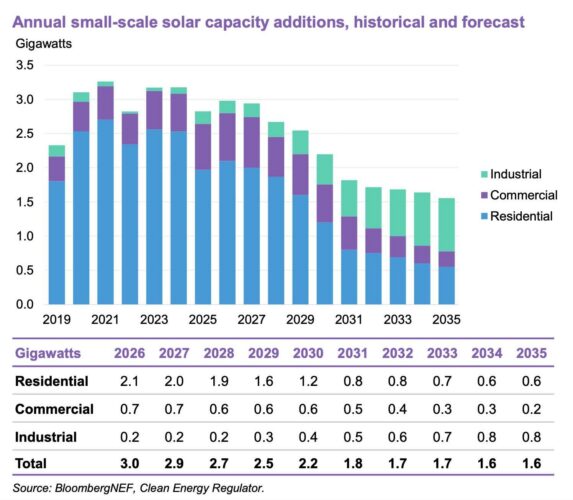
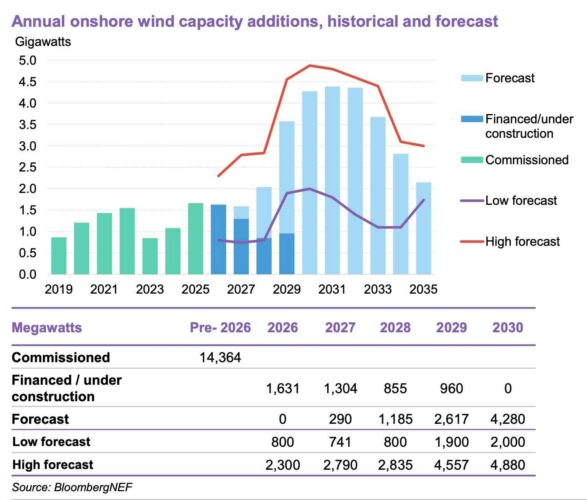
Indeed, it suggests that 41 GW of new large scale wind and solar, the sort of numbers required to get to 82 per cent renewables might not be delivered until 2035, and it also suggests that the uptake of rooftop solar has also peaked, albeit with another 22 GW to be delivered over the next decade.
The good news is that the battery storage markets – both grid scale and household – are likely to be met, or even bettered.
Grid scale storage has been the major driver of investment in the grid in recent years, thanks to the plunging cost of battery cells and the comparative ease in planning approvals and logistics.
“Energy storage is growing rapidly with 9.9GW of utility-scale batteries currently under construction,” the report states. “BNEF’s base case forecasts capacity to reach 23.1GW by 2035.”
And household battery installations are also booming, thanks to the expanded federal rebate, and BNEF now forecasts that behind-the-meter battery capacity could reach 35.8 GWh by 2035, up from 6.5GWh in 2025.
The good news is that the battery storage markets – both grid scale and household – are likely to be met, or even bettered.
Grid scale storage has been the major driver of investment in the grid in recent years, thanks to the plunging cost of battery cells and the comparative ease in planning approvals and logistics.
“Energy storage is growing rapidly with 9.9GW of utility-scale batteries currently under construction,” the report states. “BNEF’s base case forecasts capacity to reach 23.1GW by 2035.”
And household battery installations are also booming, thanks to the expanded federal rebate, and BNEF now forecasts that behind-the-meter battery capacity could reach 35.8 GWh by 2035, up from 6.5GWh in 2025.
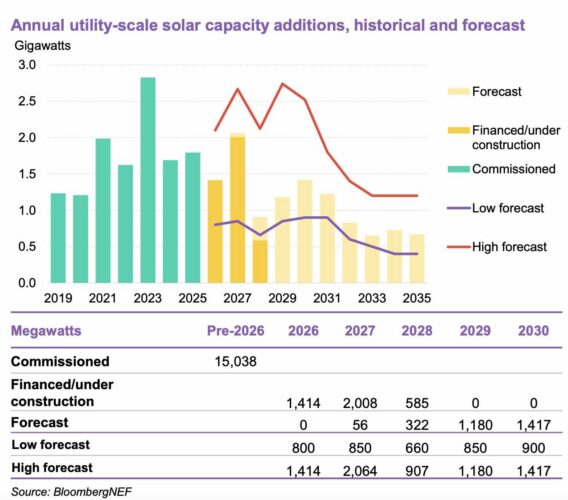
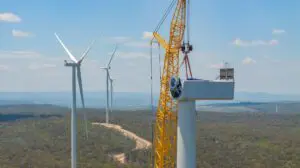
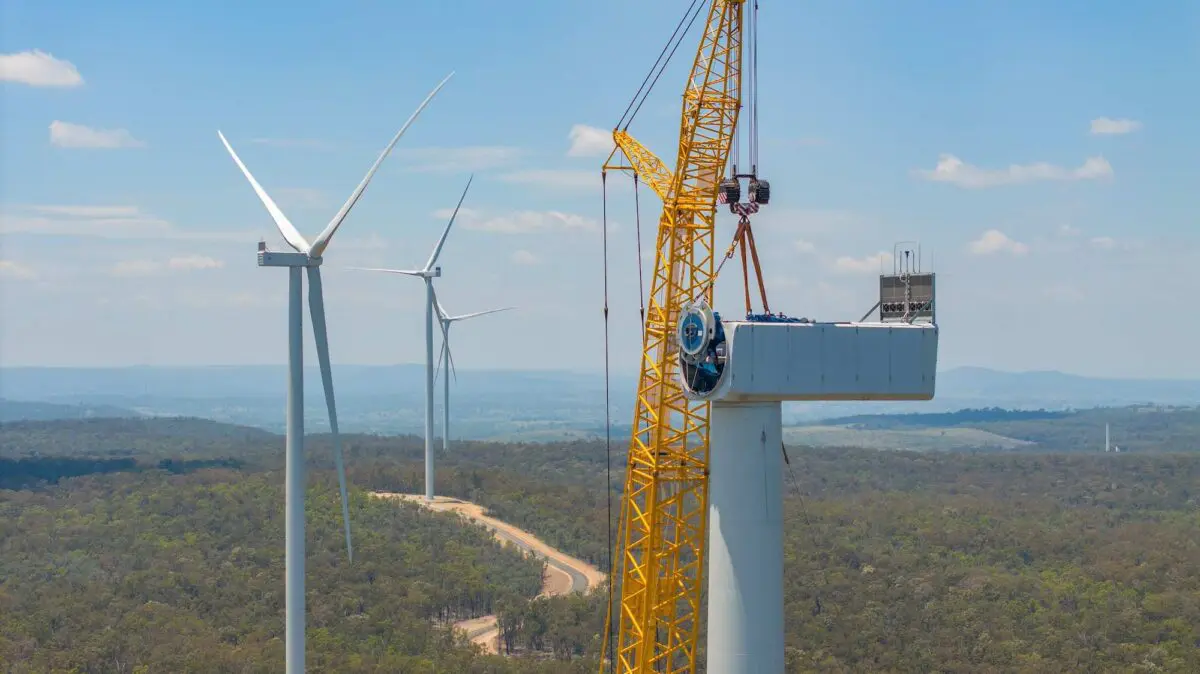
That’s all well and good, but where Australia is in danger of falling short is in new generation. BNEF forecasts just 8.8 GW of new large solar to be commissioned by 2030, and 13 GW of wind, well short of what is required for the 82 per cent renewables target as the go-slow in Queensland offsets gains elsewhere.
Even rooftop solar is past its peak, with BNEF predicting a significant decline in installations in coming years. The big boom in wind energy occurs after 2030, not before, likely due to the longer lead time in projects.
BNEF also has a dismal outlook for offshore wind, predicting nothing will be built before 2035. But that forecast is predicated on the Victoria state government deferring its already delayed auction beyond the next election due later this year. But the state has already earmarked August this year to kick off that tender process.
Despite these and other predictions, Bowen though, is confident that he will get there, or maybe at least close enough that it won’t matter much if its missed by a few percentage points.
This week, he pointed to the 64 GW of projects identified by AEMO in its latest Connections Scorecard as being in the investment pipeline.
“There’s a lot of noise out there on the internet and in certain newspapers saying that the transition is off track and we can’t possibly hit our 82% renewable energy target,” Bowen said in a LinkedIn post.
“There’s a big issue with that – it ignores what’s actually happening.”
If you would like to join more than 29,000 others and get the latest clean energy news delivered straight to your inbox, for free, please click here to subscribe to our free daily newsletter.