The post-election joy didn’t last long for the newly victorious Labor government, who were quick to snap at the Greens for their perceived losses (some real, some exaggerated).
But whatever the mixed emotions among the Labor party, the Greens and the various ‘teal’ or teal-adjacent independent candidates, there is no way they’re down in the same pits as the Liberal-National coalition opposition party, who’ve suffered their worst election loss in living memory.
When Peter Dutton was confident that he was going to win the 2025 federal election, he said “I’m very happy for the election to be a referendum on energy, on nuclear, on power prices, on lights going out, on who has a sustainable pathway for our country going forward”.
Notably, it was actually Chris Bowen who first suggested the election was to be a ‘referendum on nuclear‘. Several media outlets christened it, in June 2024, the “nuclear election“.
The Coalition’s nuclear plan was never sincere. The technology was presented a distant mirage, designed to distract from the party’s real plan to jam a crowbar in the wheels of the accelerating Australian renewable energy industry so that coal and gas clunkers can burn through megatonnes of fuel for many, many more years than current projections and scenarios envision.
Nuclear power – and specifically small modular reactors – are expensive and slow enough to never really end up existing, but also quasi-feasible enough to be believable excuses. As I’ve written elsewhere, they sit perfectly in the ‘greenwashing habitable zone’:

Tactically, the Coalition’s nuclear power was essentially a giant troll – a snarky ‘what about nuclear’ comment put through the modelling machine which then spat out something looking vaguely like a policy. But it has been politically disastrous.
As the ABC’s David Speers wrote: “There were swings against the Coalition in nearly every seat where it proposed a nuclear plant (except Flynn in Queensland). The biggest was a thumping 17 per cent swing in the NSW seat of Calare towards independent MP Andrew Gee….by contrast, there were swings to Labor in every seat where offshore wind projects were planned”.
Speers cites an exit poll that claims nearly a full quarter of respondents would’ve been more likely to vote for the Coalition sans their nuclear plan.
You would be right to feel a little surprised, after this phenomenal backfire, that within days of the election, one of the party’s most precariously re-elected members has used his first post-success words to utter a ringing restatement of the nuclear comments section philosophy:
“I, in my core sense of belief, believe in the role of nuclear power, not as an end but as a beginning,” said Tim Wilson, who had just unseated Teal independent Zoe Daniel. “If we don’t do that, then we are saying either we’re going back to coal, or we as a nation are going to end industrialisation. That is not a future I am prepared to accept.”
Not only is it a proud declaration of continued focus on nuclear, it’s the same opposite-world gaslighting that marked the Coalition’s disastrous, contradictory and muddled campaign. A Climate Change Authority research project quantified the massive volumes of extra coal that would be burned under the Coalition’s nuclear climate delay trajectory, and the Coalition’s own modelling relied on a scenario that assumed the collapse of heavy industry, including the rapid erasure of the aluminium smelting industry, because that drop in power demand was the only way the numbers would come out as dramatic as they liked.
Tim Wilson has a long and storied history of presenting as a ‘moderate’ on climate, but also pushing the more aggressive anti-renewable message during his time as a policy director for the far-right “think tank”, the Institute of Public Affairs. Wilson once described Labor’s 50% by 2030 renewable energy target as ‘virtue signalling‘ (Australia will likely pass this milestone some time in the next two years).


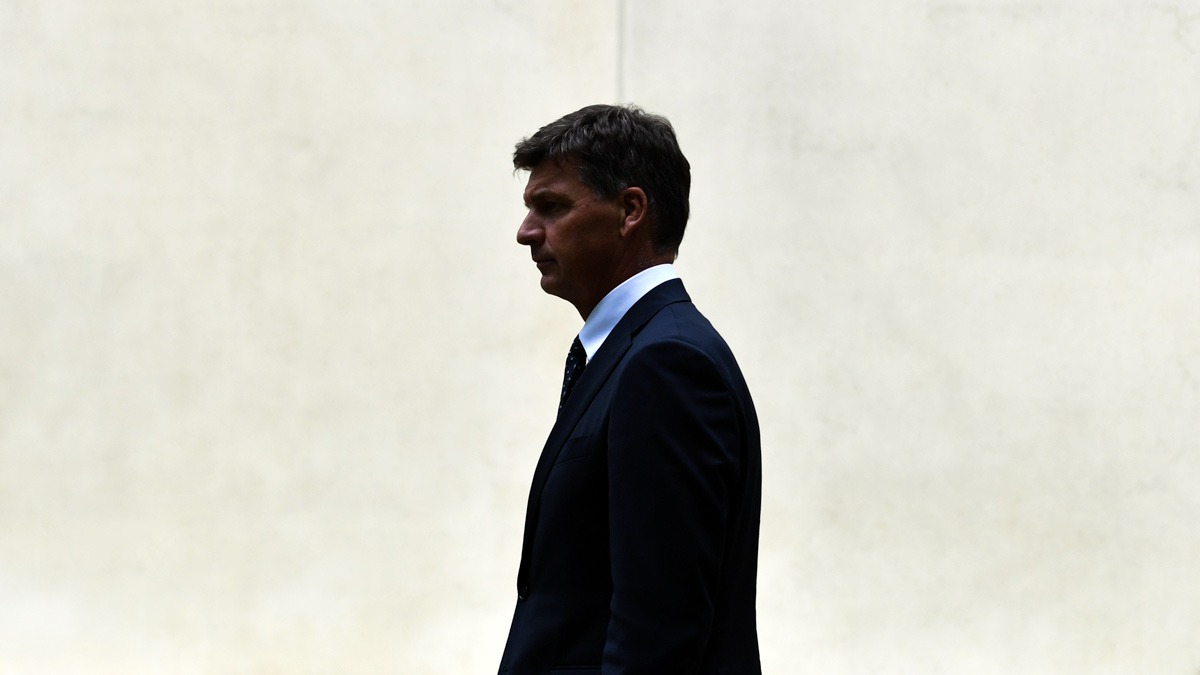
There is a more-than-decent chance that another long-time opponent of renewable energy and climate policies – who has similarly posed as a ‘moderate’ voice – could have influential position. Angus Taylor, well known to most readers of this site I imagine, is vying to be opposition leader.
His emergence in parliament was wrapped around the intense anti-renewable and anti-wind in particular push, not just under the Abbott government of 2013-2015 but in communities and regions around Australia during the first major surge of construction under Labor’s renewable energy target scheme. Taylor spoke at anti-wind rallies, cautiously keeping distance from the crazier elements of the movement and even attending pro-wind fun runs.
The intense tensions around large-scale renewable energy sites has always been fertile ground for political exploitation. Angry communities often feel overlooked and ignored, and there are any number of professional disinformation and conflict escalation groups more than willing to be the connective tissue between political interests and community backlash to big wind, or big solar.
A Taylor-led opposition party, featuring politicians like Tim Wilson, won’t reject the trolling tactics of the Dutton era. In fact, I predict they will lean even harder into them. It is not 2013 anymore: the problems of social media has blended with the ease of machine generated bullshit (thanks, ChatGPT) and all of this means the barriers to actively worsening conflict around large-scale renewable energy sites are far lower.
The Coalition has shown it has lost the capacity to win elections – but sticking a giant crowbar in the energy transition is far, far easier, and they may have the staffing with the callously destructive experience necessary to pose a real threat.