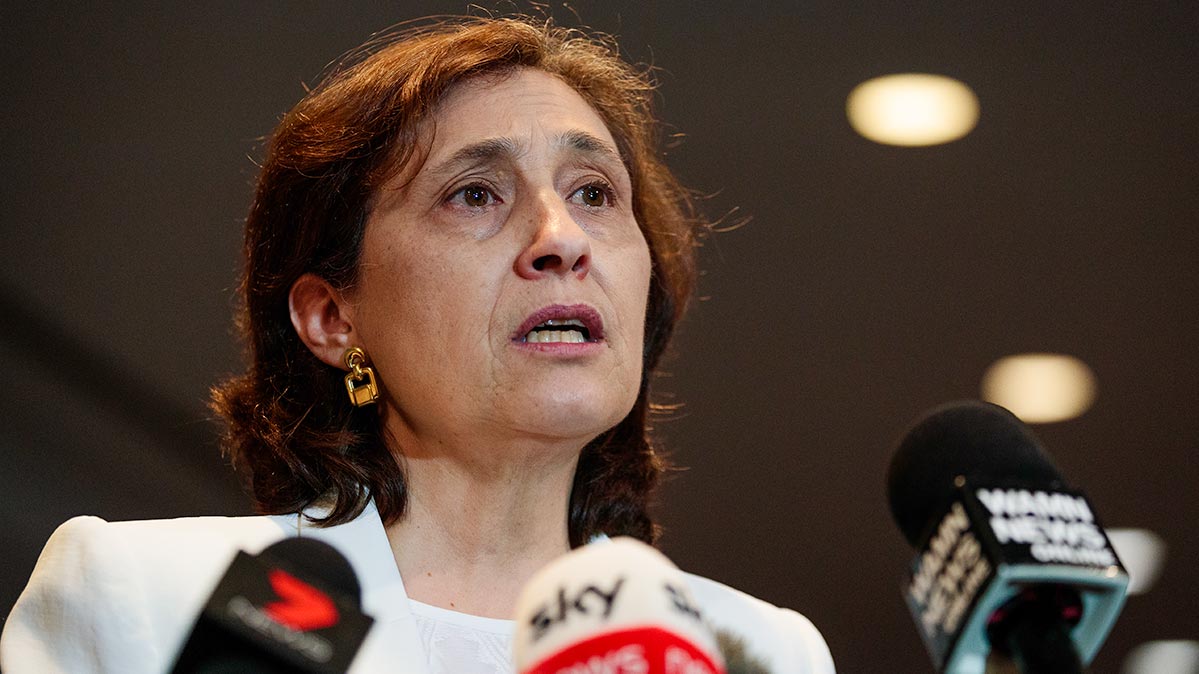
The Victoria state Labor government says it will legislate a renewable gas target, as it looks for ways to guarantee gas for industrial users in the face of looming shortages and ushers gas use out of homes.
The industrial renewable gas guarantee will create the first such target in Australia and open revenue opportunities around methane sales in the agricultural sector, Victoria’s energy minister Lily D’Ambrosio told a CEDA conference in Melbourne on Thursday.
“We listened clearly to the needs of Victoria’s business community. They told us they needed a renewable gas target, and that’s what we will deliver first in the country,” she said at the Energy and Climate conference.
“It will offer a long term decarbonisation pathway for Victorian industrial users who cannot electrify. It will spur a new industry in renewable gas production, offering increased revenue streams for the agricultural sector when you consider buying methane as an example.”
The announcement was light on detail of what it will cover, but a final directions paper from the two year consultation process called for a 4.5 petajoule (PJ) target by 2035, or about 6 per cent of the state’s projected industrial gas needs.
It adds to the state’s legislated targets, most notably its goal of reaching 95 per cent renewables for electricity use in the grid, which is expected to rise because of electrification of transport and homes and business.
The state market-funded certificate scheme would start in 2027 and have a milestone target of 1PJ after three years.
The guarantee will be solely for industrial users.
The government intends for household gas use to eventually be entirely phased out, creating with D’Ambrosio calls “equivalent [to] finding a new source of gas”.
The government foresees biomethane can be used as a drop-in replacement for fossil gas in industrial cases where electrification is not possible, while green hydrogen could also play a role as a way to store energy to meet the state’s long-duration storage requirements.
It also expects green hydrogen to play a big role in long haul transport, both on land and in shipping.
The Victoria government has been working on a so-called renewable gas guarantee since 2023, with final submissions on the directions paper closing in February.
D’Ambrosio says she is pushing for a national target as well to create a backstop for the current low levels of demand the industry is seeing right now.
“If demand is not there, then you can push and push all you like in terms of incentives to get hydrogen production happening in Australia and Victoria, but we do need to look at other means to create a responsive market for the production,” she said.
“You need the demand being possible, and that’s why, for example, having a scheme that helps to incentivise the production of gas is really important.”
The Victorian move to set a target for non-fossil gas echoes comments by Superpower Institute cofounder Ross Garnaut earlier during the conference, who said the green hydrogen industry is not dead, just returning to its original use case of supplying hard-to-decarbonise industrial processes.
“The high costs of international transport for hydrogen mean that its main economic value is producing, here in Australia, many of the products that are currently made overseas with Australian coal and gas,” he said.
“Foremost amongst these is the reduction of iron and some other minerals into metals and the use of hydrogen with sustainably harvested biomass in production of green transport fuels and some other chemical manufacturers.
“The bursting of the bubble returns the emphasis to the use of hydrogen in zero-carbon industrial production.”
He said investment in new hydrogen-based export industries is ready to go now, naming green iron in Whyalla and other Upper Spencer Gulf towns in South Australia, and transport fuels in northern Tasmania.