Victoria has given environmental approval for the 750 megawatt (MW) Marinus Link transmission line, with some tweaks, with the project now waiting on a twice-delayed federal decision.
This milestone will inform the federal EPBC decision, which has been delayed until June as new environment minister Murray Watt gets comfortable with the portfolio.
The $5 billion project has been in the Victorian planning process since 2021, two years before it was halved to a single high voltage direct current (HVDC) electricity interconnector between Heybridge in northwest Tasmania and the Latrobe Valley in Victoria.
Victoria’s section of the project is from the three nautical mile limit of Victorian coastal waters to the greater Hazelwood area in the Latrobe Valley, and includes that section of subsea cable, the shore crossing at Waratah bay, and onshore facilities and cable laying.
The cable itself will be underground along almost its whole length. The ocean section will be handled by a ship that comes with its own equipment that lays and then buries the cable at the same time.
Horizontal directional drilling (HDD) is being used to get the underground sub-sea cable under beaches and onshore.
But operations on land and sea will still create some environmental damage, although in onshore Victoria this has been limited to 6.75 hectares of native vegetation, said the report outlining the decision handed down by planning minister Sonya Kilkenny.
Kilkenny’s extra requirements for the project include that bog gum losses are minimised and that plans for crossing 82 waterways – 22 of which are significant – be revised to take into account “an integrated understanding of waterway values and aquatic habitats and other factors such as geology”.
“This is a major step forward for the project and a testament to the dedication of our environment and sustainability team and our expert advisors,” said Marinus Link Pty Ltd (MLPL) project director Mike Carter.
“Their technical rigour, collaboration with stakeholders, and commitment to strong environmental outcomes have enabled us to clear a critical hurdle.”
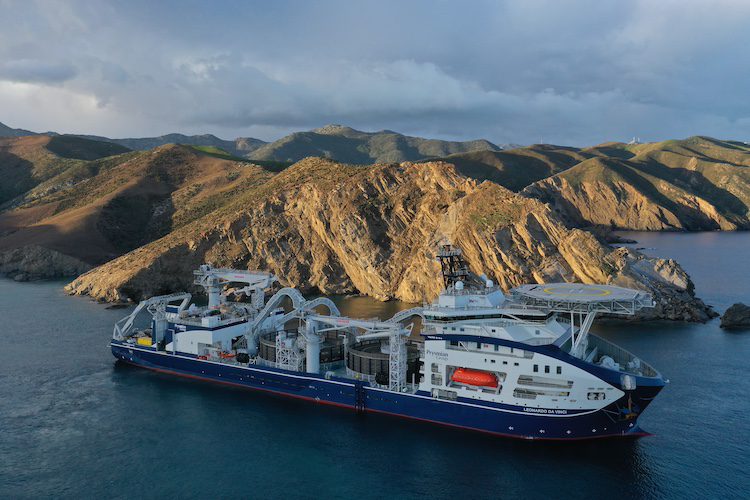
The Leonardo Da Vinci transmission cable-laying ship. Image: Prysmian.
The current plan to use horizontal directional drilling under the beach and sand dunes at Waratah Bay, the beach made famous by local children’s book writer Alison Lester, is still high risk.
“The concept design included HDD construction for several locations including the shore crossing at Waratah Bay to avoid potentially significant impacts on the intertidal area and coastal dunes,” the report said.
“While avoiding surface impacts, HDD carries potential risk of impacts on the geology and stability of the coastal dunes. Such risks can be managed through design and construction with an appropriate understanding of ground conditions and appropriate HDD design, which is accommodated for.
“There was some residual uncertainty for Waratah Bay as to whether the potential risk of ground movement could be reduced to a tolerable level within the easement. If this is not possible, realignment will be necessary.”
But using that beach for the shore crossing is “unavoidable” because rocky outcrops and ocean reefs between Cape Liptrap and Wilsons Promontory national park limited the number of places the cable could come onshore.

The Heybridge converter site. Image: MLPL
Other environmental effects are unavoidable such as a 300 square metre section of endangered Tasman grass-wrath sea grass, the report found.
Kilkenny said this needed to be offset elsewhere.
The EES identified a range of threatened species in the line of the Marinus cable, including trees, grasses and woodlands, and 25 endangered and threatened birds, animals and sea life, and their habitats.
The report also showed how this has had to flex with the changing project.
When the project was initially sent for Victorian environmental approval in 2021, it was still a dual cable, 1.5GW project.
“The construction program provided in the EES [environmental effects statement] indicated that stages 1 and 2 would overlap between 2025 and 2030, with stage 1 being operational by end of 2029 and stage 2 by the end of 2030.
On 20 May 2024, the proponent updated its advice that while it would seek approval for both stages, stage 1 would still likely be commissioned by 2030, and this would be followed by a potential gap in construction with stage 2 being commissioned by 2033 (subject to market demand).”
Marinus Link was supposed to cost $3 billion for two cables, but cold feet caused by building cost inflation caused Tasmania to pull out in 2023 and the federal government to agree to cut the project in half. Now the price tag is almost $5 billion, with construction due to start in 2026.