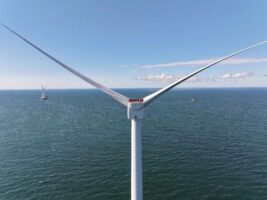
Danish wind turbine manufacturer has installed its first commercial 15MW wind turbine, the first of 64 to be installed at the 960MW EnBW He Dreiht offshore wind farm off the coast of Germany.
First unveiled back in early 2021, the V236-15.0MW offshore turbine was at the time the world’s new largest offshore wind turbine, boasting a massive area in excess of 43,000 m2.
Since then, a prototype went on to break the record for the most power output generated over 24 hours at the Østerild National test centre for large wind turbines in Denmark. The V236-15.0MW subsequently secured its type certification at the end of 2023 and has since gone on to rack up 14GW worth of firm supply orders.
The V236-15.0MW has since been repeatedly surpassed by other larger turbines – most of which have been unveiled and built by Chinese wind turbine OEMs – but the milestones continue to be checked off, with the first commercial 15MW turbine installed last week.
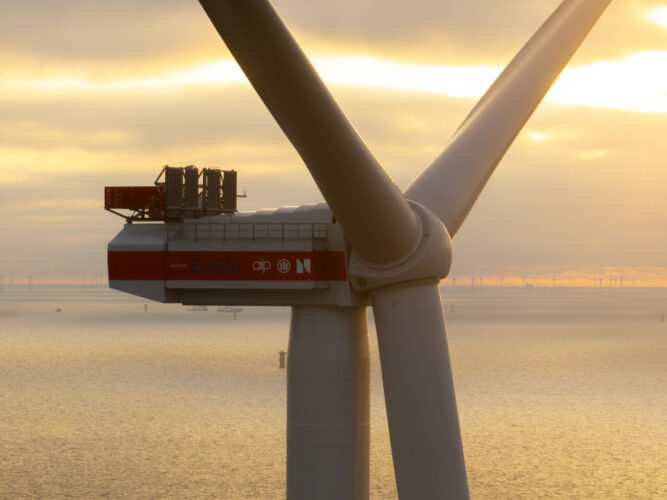
Installed in collaboration with German energy company EnBW Energie Baden-Württemberg AG (EnBW) and Heerema Marine Contractors, the first V236-15.0MW was installed at the 960 He Dreiht offshore wind farm, located off the coast of Germany.
He Dreiht, which translates to “it spins”, will be one of the largest offshore wind farms in Europe, and the largest in Germany, and is being built without government funding. Consisting of 64 wind turbines – each of which can supply four households with electricity for a day on a single rotation – the He Dreiht offshore wind farm is expected to produce enough electricity to supply the equivalent of 1.1 million households.


“We are honoured to partner with EnBW on the He Dreiht project and provide them with our flagship offshore technology,” said Nils de Baar, president of Vestas Northern & Central Europe.
“With the installation of the first V236-15.0 MW, we have reached an important milestone for both the He Dreiht project and our offshore ramp-up, which helps Germany build a more secure, affordable and sustainable energy system.”
Construction of the wind farm has been interesting even before considering the power of the turbines, with a noise mitigation system used during installation of the monopiles to significantly reduce underwater noise which can be harmful, and even deadly, to sea life.

Multiple techniques were used during installation of the monopiles, including a double bubble noise barrier that creates a wall of bubbles to serve as a barrier for sound reduction and pollution containment. Other technologies included IQIP’s PULSE system, and an innovative new noise reduction system constructed in collaboration with Heerema Marine Contractors that effectively contains noise emissions within a massive steel structure around the installation of the monopiles.
All told, the noise mitigation technologies used during construction helped to reduce underwater noise by up to 24 decibels (dB).
“The development of the free-standing T-NMS-10000 for application with floating installation vessels was initiated in 2022 by EnBW considering the application of an [noise mitigation system (NMS)] fundamental to the installation of its 9.2m diameter monopiles in the He Dreiht project within applicable noise limits,” said Stefanie Höper, project manager at EnBW.
“By pioneering the T-NMS-10000, Heerema, IQIP and EnBW not only meet regulatory requirements but also contribute to a sustainable future and set an example for sustainable marine construction.”