A unique trial of renewable hydrogen power in an off-grid coastal community in Western Australia has validated the “operating” capabilities of the nascent technology, even with repeated failures from the project’s hydrogen fuel cell.
The $9.8 million Denham Hydrogen Demonstration project, backed by $2.6 million of funds from the Australian Renewable Energy Agency and another $5 million in state government money, looked to demonstrate the ability to incorporate renewable hydrogen into a microgrid powered with wind, solar and diesel.
Hydrogen, of course, has faded from view as the solution to renewable integration challenges, beaten by the plunging cost of battery storage, but it remains an option in some regions where hyper-expensive and polluting diesel is the main competition.
The Denham micro-grid combines just 790 kilowatts (kW) of wind capacity, from three small Enercon turbines and 500 kW of solar, both located out of town on the road to Monkey Mia, along with a small 1.5 megawatt (MW), 1.7 MWh battery.
Renewables accounted for around of a third of the 800-strong Denham community’s power needs, with most of it – the town’s peak is 1.7 MW – provided by seven diesel gen-sets totalling 2.6 MW.
The aim of the renewal hydrogen trial was to capture spilled wind and solar power and displace more diesel, and to test the hydrogen technologies and management system to see if they can be integrated into a small off-grid facility and boost its reliability.
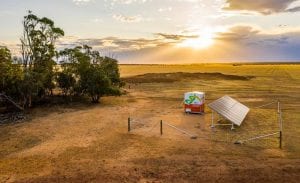
A new dedicated 600 kW solar plant was added to the micro-grid, along with two 174 kW electrolysers and a 100 kW PowerCell fuel cell. The aim was not to validate the costs of renewable hydrogen, but to prove the ability to integrate the technology in such a set-up. Water use was estimated as equivalent to that of four households.
And it seemed to work fine. Horizon Power – the local grid operator and project manager – says it successfully proved that the technology can be integrated, and that it proved valuable learnings for future projects.
But it failed to meet all its deliverables, most notably the planned 60-day reliability test, because of the repeated technical failures with the fuel cell which meant the plant only ever achieved brief periods of continuous operations.
“Despite support from the European OEM, including site visits, the fuel cell failed to achieve sustained operation,” the report notes.
“Although the fuel cell’s performance issues have limited the duration of continuous operation since handover, these challenges have provided important information on equipment reliability, environmental impacts, and vendor support requirements.
“This learning will assist Horizon Power and the broader industry in understanding the practical considerations associated with emerging hydrogen technologies in remote applications.”
Will it use the technology again?
In its media release from 2020, Arena said that if the project is successful, Horizon Power will look to scale up the solution with increased hydrogen and solar penetration and replicate the technology in other remote power systems across its portfolio.
It expected it will also provide a reference case for remote power systems in other states and territories including Queensland and the Northern Territory.
“(The project) has strengthened Horizon Power’s capacity to assess how hydrogen may contribute to future decarbonisation opportunities across regional Western Australia,” the final report says.
“Horizon Power will consider the future of the plant as part of its broader Future Energy Systems strategic planning, ensuring that any decisions regarding ongoing operation or repurposing align with long-term system needs, emerging technology pathways and the government’s evolving energy and decarbonisation priorities.”
That sounds like a “maybe” at best, particularly given the success of the project’s EPC contractor Pacific Energy at number of off-grid mines – with much bigger loads – which are operating with a combination of wind, solar and battery storage at levels of more than 90 per cent renewables.
Those levels are averaged over months and quarters, and have almost eliminated their exposure to soaring diesel costs.
If you would like to join more than 29,000 others and get the latest clean energy news delivered straight to your inbox, for free, please click here to subscribe to our free daily newsletter.