
In an address to the Australian Clean Energy Summit in Sydney last month, New South Wales energy minister Penny Sharpe told the audience that “one of the great things about also being the environment minister is that I get to boss people around on that one as well.”
Last week, we saw this in effect when Sharpe thrust the sticky subject of solar stewardship – traditionally the purview of environment ministers – onto the agenda of the August 15 meeting of the Energy and Climate Change Ministerial Council.
There it sits, in black and white in the meeting communique published Friday afternoon, albeit all the way down the bottom of the document under the subhead ‘Other Matters:’
“Ministers also discussed the need for mandated stewardship arrangements to proactively manage the waste challenge arising as solar panels reach their end-of-life and how this could be leveraged to grow a domestic re-manufacturing industry,” the communique says.
“It was noted by all Ministers that reusing the critical minerals within solar panels will also be crucial. Ministers further agreed that NSW will work with other states to develop a regulatory impact statement while the Commonwealth will work with states to proof a national product stewardship scheme.
“The Commonwealth and New South Wales will lead investigations into how different models of a national product stewardship scheme will work including evaluating Commonwealth and state-based approaches. All parties have agreed to report back on progress in early 2026.”
Well played, Penny Sharpe. The establishment of a national scheme making it mandatory for solar panels to be recycled or reused has been in desperate need of some bossing.
And not just because the number of modules being discarded by solar-hungry Australian homes is going through the roof, fuelled by the added momentum of the Cheaper Home Batteries rebate.
It’s urgent because the nearly decade-long failure of successive federal governments to mandate a national stewardship scheme is pushing the barely launched PV recycling industry to the brink.
“Time’s up,” said the Smart Energy Council on LinkedIn on Monday.
“It has been a decade since the federal government officially acknowledged solar PV going into landfill as an issue, but we’re yet to see action to prevent it from happening.
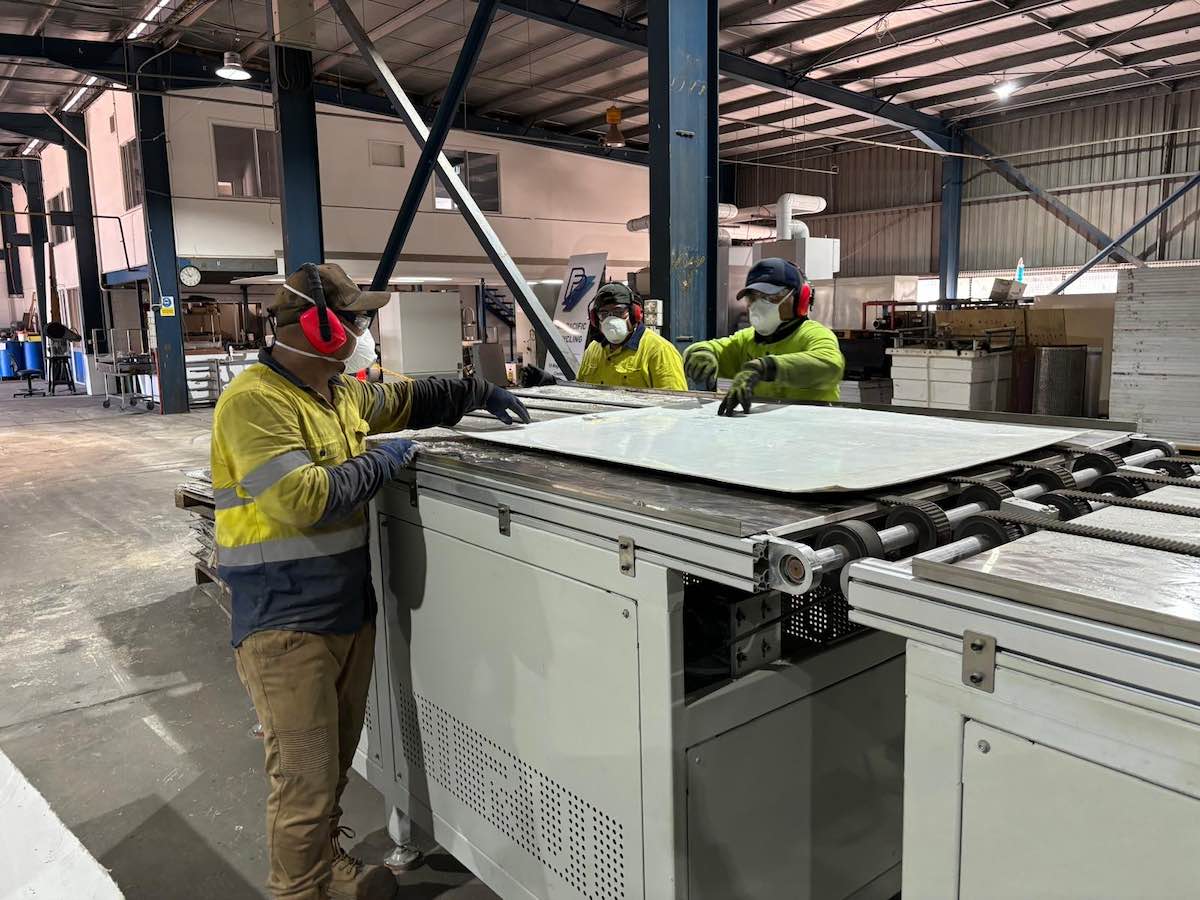
“Meanwhile, the recycling industry has stepped up by investing in innovative technology that enables the recovery of up to 99% of the precious materials contained in panels; silver, copper, aluminium, polysilicon, glass.
“We commend the NSW government for pushing their federal counterparts to act, by initiating a mandatory national stewardship scheme,” the post says.
“There is a very real risk that if governments continue to delay on this issue, the recycling industry may no longer exist due to investor fatigue.”
“This is getting too hard”
This is an outcome the Smart Energy Council (SEC) has been warning against for some time now.
“Investors are starting to become fatigued,” SEC executive general manager of sustainability, Darren Johannesen, told Renew Economy’s Solar Insiders podcast in May.
“They’re investing millions of dollars in these plants …. on the basis that we’re going to have clear policy and regulatory framework, and it hasn’t come.”
Johannesen, who has headed up the nation’s most comprehensive solar stewardship pilot, yet, in collaboration with governments and industry in Queensland, says there are two key issues that need urgent attention: one is that the PV waste stream is rapidly increasing, and the other is investors starting to say ‘this is getting too hard.’
“We might end up with the perfect storm where investors hit pause while they wait for that regulatory framework to come and then we get this massive increase in volume and we’re unable to invest accordingly,” he told the podcast in May.
“And it sort of dovetails into that other problem, and that is that these materials that we have in these products are valuable and in short supply.”
Resource solution vs waste problem
Johannesen points to a critical minerals report published by the International Energy Agency in 2024, which warns of a 30 per cent global shortfall in copper by 2040 – and says the only way to bridge that gap is to have a highly developed waste recovery stream.
This is the part that particularly frustrates Johannesen and the team at the SEC – that for all of the policy focus on solar R&D and building a domestic solar supply chain, governments have somehow failed to grasp recycling and reusing panels as a “resource solution, rather than a waste problem.”
“Millions of panels are being decommissioned each year, yet fewer than 5% are being recycled, not because we don’t know how, rather due to the failure of successive federal governments to work with industry to close the loop on our cheapest form of energy generation,” the SEC said on Monday.
“Australia is an international solar success story, but it cannot claim to be a true champion of renewables if the energy transition is not a circular economy.”
Push for a nationwide pilot
The “immediate first step” the SEC wants taken ahead of state and federal governments developing a Regulatory Impact Statement for a mandatory national stewardship scheme is a nationwide reuse and recycling pilot.
“The reason you want to do [pilots] is to make sure that when we stand up a national program, that that it’s well informed … and that the decision makers, which are ideally the federal government, are making decisions based on detailed evidence, rather than on assumptions,” Johannesen explained in May.
“There’s been lots of work, and we’ve learned so many things,” Johannesen says of the Queensland pilot, which he describes as “humble.”
“Certainly, we’ve learned how not to transport [modules] and we’ve learned, you know, where are the highest volume, lowest cost locations to consolidate [modules]. So making sure that drop off locations are easy for [industry] to access.”
But the main message from the SEC is that there is no time to lose, as discarded panels continue to pile up in tips and suburban back yards, for want of a better solution.
As Johannesen told Solar Insiders, based on the data the SEC has gathered in Queensland, about 1.2 million solar modules a year are being decommissioned, while nationally, it is estimated that the numbers sit at around 4-4.5 million panels a year.
But the SEC believes that these numbers could balloon under the federal home battery rebate, as households replace old rooftop modules with newer much bigger systems to go with their discounted storage.
“The good news is we’re going to get lots of batteries and expanded systems, the bad news is it’s going to create decommissioning … somewhere between an additional 7.5 million to 15-20 million [modules a year],” Johannesen said.
“So it’s a lot of modules that will be de-installed and this is why, getting back to pilots, why pilots are important. And critically, it’s why we need action on a national scheme.”
See also: Australia researchers find silver lining in breakthrough technology for discarded solar panels