Next week I am attending a trade show in the Beijing and Shanghai areas. That’s because in my investment banking career kicking factory tyres became something I loved to do.
You can call them junkets, but I’ve been to visit coal generators in NSW, Victoria, Queensland and Shanghai region, gas generators in Queensland, Victoria and South Australia, and flown by helicopter over wind farms in South Australia.
On the building materials side I’ve toured plasterboard factories in Shanghai, Seoul, Bangkok, Brisbane, Sydney, Melbourne, quarries and cement works in Florida, NSW, South Australia, Queensland, brickworks/fibre cement plants/rooftile plants in various US and Australian States.
And you can add sugar mills and factories, insulation plants, aluminium smelters even a carpet factory.
I mention this partly to remind myself, before I forget, and partly to explain how factory visits become an itch that since I left UBS 10 years ago, I’ve had little opportunity to scratch.
So when John Grimes decided to run his China tour about which every one says great things I signed up. Instead of being overpaid to sell the businesses, as shares listed on the stock market (investor education, or research) now I pay! Talk about passing it on.
Anyhow ahead of the official part of business my wife and I went on a Silk Road tour. In fact I used Claude to find the operator https://www.silkroadtourcn.com and that turned out very successfully.
One of the side benefits of the tour is see China’s North Western provinces from a little bit closer. Not to see it as they see it, you must be kidding, but at least to see them close up. And it’s different to the East.
Although prices are low and China’s economy is down a bit, it seems to me that life has been transformed for many over the past 25 years.
High speed railway is common place. We did 1,100 km in about 6 hours, 100s of km through tunnels. Expressways were everywhere and really good quality. In the US the freeway system has a concrete surface, noisy and unpleasant. In China its bitumen like in Australia.
Hotels are of a good standard, at least the ones we stayed in, and at very reasonable prices.
In Beijing prices are less than Australia, but it’s still not cheap. In Xian, a city of 10-13 million people you can eat as much as you like and have a beer at a good restaurant for $10. And yet the cars on the road are mostly modern, and lots of them. People seemed happy, or at least not unhappy. Domestic tourists were out in big numbers.
The other thing that came out of this week was to see close hand one of the more energy intensive area of China.
We drove and trained past untold numbers of wind turbines in the Gobi desert. My economist friend and I estimated more than 5,000, yes 5,000 wind turbines.
We trained past maybe 100 km of coal mine tailings, but they went as far as the eye could see out over the plain.
We also passed a couple of oil fields.
Commercial vehicles have compulsory rest stops of 20 minutes every 2 hours, including our 6 person people mover. Stricter than in Australia for sure.
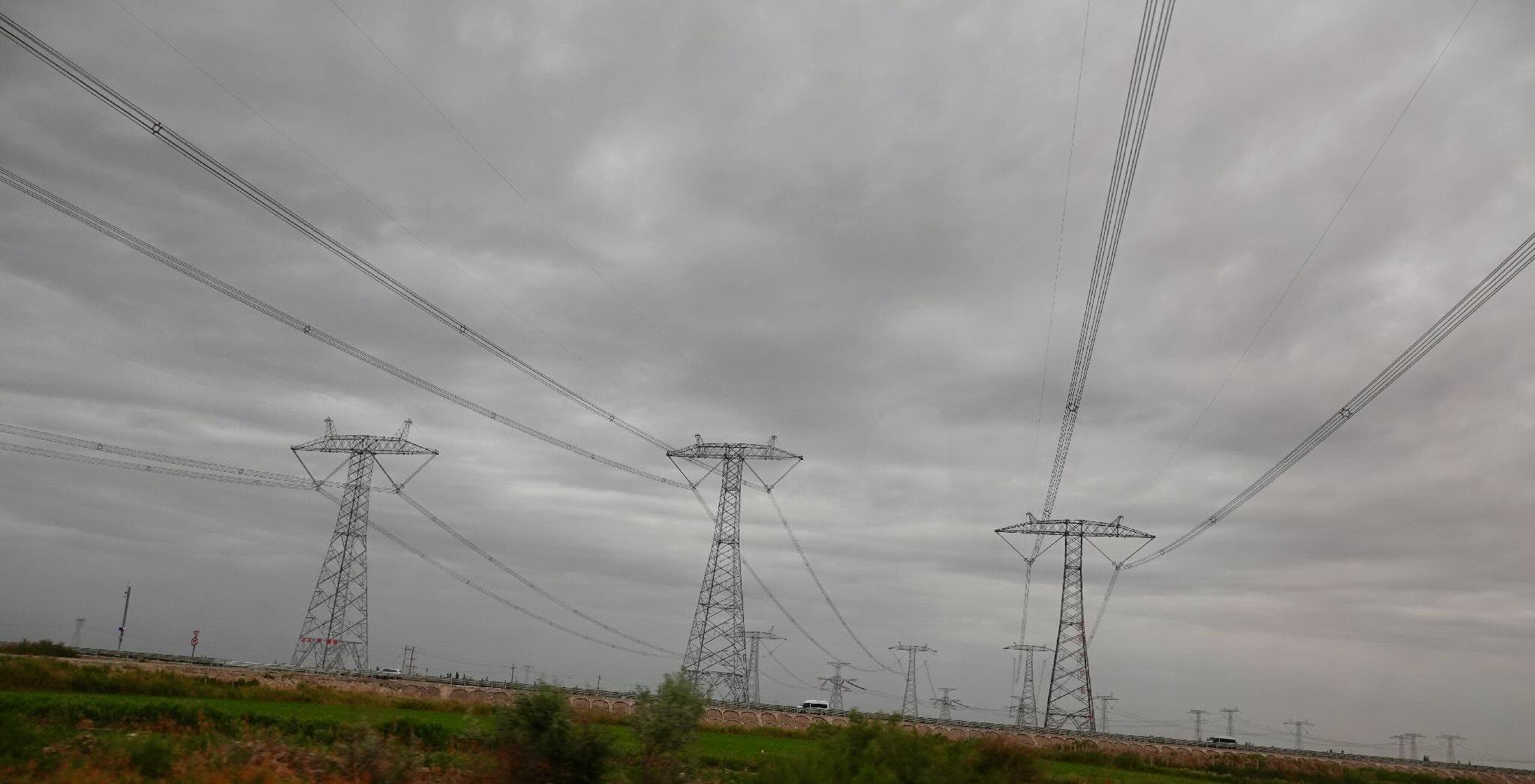
Transmission lines were everywhere, including in the Turpan Farmer’s market.
Electric cars were very plentiful although the further into the “boondocks” we went the less plentiful, but never less than 15% of the cars on the road.
Perhaps the irony of it was best expressed in talking to our very smart, tour guide in Turpan. When Covid hit, touring came to a complete stop and so did the need for tour guides.
Unlike in Australia where you could just ask Scott Morrison for a handout, unless you were a musician, in China you had to find a new job. So our guide took up driving a truck delivering coal to a coal generator.
It turns out that the trucks are electric. He said that at one coal generator the coal came from 50 km away and the electric delivery trucks could do 2 round trips in a day, recharging at lunch and with the driver earning 400 RMB a day, in Winter working maybe 28 days a month.
However, on the expressway I didn’t myself notice any electric trucks the ones I did see were LNG. I thought they must be LPG but they definitely said LNG.
In conclusion, if you are interested in history, interested an economy that has changed out of sight in 25 years or interested in seeing the energy system changing in front of your eyes I can recommend the Silk Road, Xian to Urumqi.
The photos are just random selections from many I took.
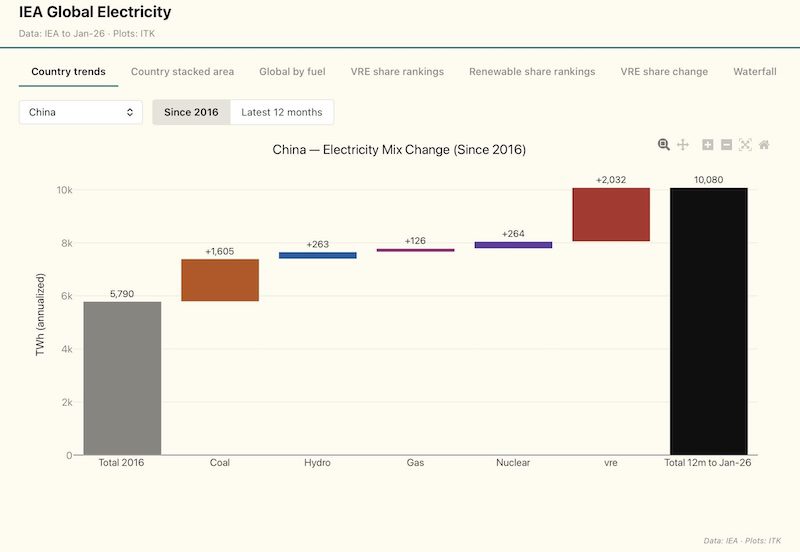
I also include a couple of plots from my IEA electricity dashboard so that a weeks touring can be compared with statistical reality.
The Xiaomi is an eye catching car and would sell like crazy in Australia.
South Australia unveils project proposals totalling 13 GW of new wind and solar which it…
Australian developer snaps up portfolio of operating and developing wind and solar projects as a…
A massive 244-tonne transformer has completed a 2,165 km road trip to the site of…
The battery industry is about to witness another change in chemistry and technology. Valo Energy…
Energy minister says imminent closure of coal is "indisputable," and "ideology-driven" policies to scrap transmission…
The supplier to the biggest battery currently being built in Australia expects to announce its…