Andrew Forrest’s Fortescue may have slipped badly on its ambitious plans for global green hydrogen dominance, but it insists that rapid technology changes are keeping its equally bold target of reaching “real zero” emissions by 2030 at its iron ore operations on track.
Fortescue is deploying a range of technologies – wind, solar, battery storage, electric trucks and fast charging gear – to meet that goal, which will mean burning no fossil fuels – gas or diesel – for its terrestrial mining operations in the Pilbara.
It means decarbonising its electricity supply, its road transport, its mining operations, and even the massive trains that transport the ore to port. That will save at least 900 million litres of diesel a year. And CEO Dino Otranto says progress is good.
“We’ve still got … just under five years left, and technologies are changing so rapidly that, almost month by month, we’re gaining confidence,” Otranto says in an interview in the latest episode of Renew Economy’s Energy Insiders podcast.
“We’ve just announced a series of really exciting partnerships which broadening the rich tapestry of partners we have and gives us more and more confidence to make sure that we will be at real zero and, more importantly, it’s profitable.
“(We can) demonstrate to the world that this is about economics, not just climate change.”
Fortescue’s push to real zero in just five years is in stark contrast to other in the industry, whose best offering is “net zero” by 2050. Forrest has rejected the use of offsets, and Otranto says that if Fortescue can reach its target, it can be a “beacon” to the iron ore industry and others, looking to cut emissions and costs.
The partnerships that Fortescue signed in Forrest’s latest international sweep are mostly with Chinese technology giants – Longi for solar, Envisions for wind turbines, BYD for battery storage, and XCMG for battery electric trucks.
The most interesting of these – in terms of radical new technology takes – is the deal with Envision that will use “self-lifting” technology from Spain’s Nabrawind, which Fortescue has just purchased.
Otranto says this technology is similar to that used for giant cranes in CBD buildings and has several advantages – it massively improves logistics, reduces concrete requirements, avoids the need to ship massive cranes to remote areas, and even lifts the turbines higher to where the wind speed is better.
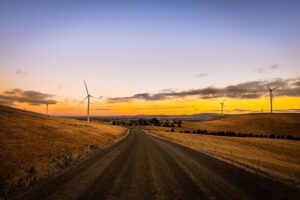
The first of these turbines will be installed in the Pilbara in 2026, in the first stage of a proposed 2 gigawatt wind project.
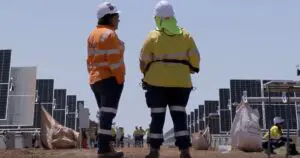
Fortescue is also building a number of large scale solar plants (two have already been built or under construction), including the new Turner River project, and plans to roll out autonomous and robotic technologies to cut the cost of solar installations, which is already a difficult process in hot remote areas like the Pilbara.
Read this story about the Chichester solar farm, powering one of Fortescue’s mines: Hot, humid, dusty and …. boring: Building solar farms in the outback is not piles of fun
“This abundance of sun and wind we have in the Pilbara, we’re very uniquely position,” Otranto says.
“We have nearly 3,000 hours of sun (a year), and when you realise that in China they are making it (solar) economic with 1,200 hours, then it’s largely a no-brainer, really, to do it in the Pilbara.”

The advances in battery storage technologies is also important, both for grid scale storage, for battery electric trucks which will start to roll out in numbers in 2026, and for perhaps the most challenging task – cutting emissions in the rail route that takes the ore from mine to port.
Fortescue has been working on an “infinity train”, where the idea was to use regeneration to charge up giant batteries in the locomotives as it went downhill to the port, to the point where the empty train could return with batteries alone to the mine.
Otranto says the technology is familiar and available. The problem facing Fortescue was that its ore trains are two kilometres long, weigh 40,000 tonnes, and while it is mostly downhill from the mine to the port, there are foothills along the way, and it needs some grunt to get over those.
“We’re not quite there with the amount of storage you can get onto your battery to get over those hills, but …. battery energy densities are doubling and tripling, so we are very confident that battery energy density will get to a point very soon that we can incorporate that into the train design we’ve already got.”
Fortescue has also been working on two-stroke green ammonia engines – similar to those it is rolling out for green shipping – that can also play a role. This may be where, along with the green iron pilot plant that Fortescue is building in the Pilbara, the green hydrogen plan finally starts to take shape.
“We sail our ships to Singapore and China, fill them up with a fuel and sail them back down to Australia. Why not fill them up here,. load them here, and create a bunkering opportunity for Australia,” Otranto says.
“I mean, we have all of the sun, we have all the wind, we’ve got the technology now, batteries and solar panels and wind turbines and Nabra towers, all coming together to then deploy that into a really exciting new industry.”
It is the same principal for green iron, where Fortescue plans to use hydrogen in its chemical form, rather than its energy form, to replace coal to make green metals in Australia.
“If we can solve the equipment cost challenge (electrolysers) we can mass manufacture theses units and deploy them in the Pilbara …and then this instantaneously solves what is one of the most hardest to abate sectors, the steel industry.
“We intend to demonstrate that in the Pilbara, in our own operations, with our own lower grade fine iron ore and demonstrate to the world it is possible.”
So, given Fortescue is a listed entity, under the constant scrutiny of analysts more worried about near terms returns and dividends and cash flow that big ideas about decarbonisation, how is that community reacting?
“We do talk a lot about our aspirations, but we balance, we answer that with the demonstration of real, tangible technologies, like you can see solar panels now, you can see upwards of 600 kilometers of high voltage 220 KV network that’s being installed,” Otranto says.
“You can see electric trucks. You can see mining excavators. You can see battery storage solutions being installed now. So this isn’t something we’re going to be doing. We’re doing it now.
“So once the investment community understands, you know, the announcements around solar and battery and economics of deploying electricity in the Pilbara, for instance, which is very different to a city that you and I may live in around Australia, very quickly you’ll start seeing that, hey, this actually makes sense.
“We’ve always said we want to be somewhat of a light on the hill for people to look to with real, practical solutions to help decarbonisation of big industries.
“And what we’ll create by 2030 at Fortescue is a complete orchestra of products, the software, the hardware, the distribution, the energy solutions, all of those solutions, which we believe is a commercial product in itself, under the banner of Fortescue zero.
“But more importantly, we’ll have the only iron ore in the market with a zero carbon footprint that’s going to be quite profound. I mean, it sounds I mean, it’s good for Fortescue, both as just a miner and a supplier, but also as a technology provider.”
You can listen to the entire interview with Otranto in the latest episode of Energy Insiders here: Energy Insiders Podcast: Fortescue’s bold charge to real zero by 2030
You can also read about Otranto’s comments on the development of the electric haul trucks on our EV-focused sister site The Driven: “It was a bit of a Frankenstein:” The rapid evolution of Fortescue’s giant electric haul trucks