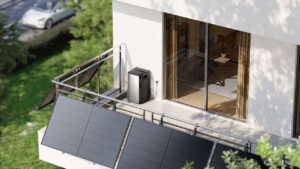
Engineers from Monash University have developed a water-based redox flow battery that they believe could help households store rooftop solar energy more safely, cheaply, and efficiently.
Flow batteries have emerged in recent years as a potential alternative to more traditional lithium-ion batteries due to the technology’s large-scale capacity, potentially longer life span, high energy efficiency, and increased safety with the absence of fire risk.
But the technology has often been relegated to large-scale energy storage solutions due to size and slow charge speeds. It has also proven difficult to commercialise.
One of Australia’s biggest battery technology hopefuls, Redflow, was last year placed into voluntary administration after struggling on the issue of costs, particularly as the price of lithium-based batteries continues to fall.
Engineers at Monash University, however, believe they have developed a safer, cheaper, and more efficient water-based battery that will bring flow batteries into homes around Australia – a target market Redflow abandoned very early in its decade-long efforts.
Wanqiao Liang, a PhD candidate at the Department of Materials Science and Engineering at Monash University, and first author of a study outlining the new discovery, says a new membrane design is at the heart of his team’s breakthrough.
Liang says it fixes the slow charge speed problem and subsequently paves the way for a next-generation flow battery design that is more compact and much cheaper than current lithium-ion battery storage systems – and more competitive than other flow battery designs.
“The key was improving ion selectivity; letting the good ions through quickly while keeping unwanted ones out,” says Liang. “Our new membrane achieves this balance, allowing fast, stable operation even at high current densities.
“We’ve taken a safe, affordable chemistry and made it fast enough to capture rooftop solar in real time.
“We’ve engineered a membrane that finally makes organic flow batteries competitive for residential and mid-scale storage. It opens the door to systems that are not only cheaper, but also safer and simpler to scale.”
Liang says that, in testing, the technology has outperformed the industry-standard membrane in both speed and stability – running 600 high-current cycles with virtually no capacity loss.
“That’s a major leap forward for this kind of battery,” she says.
“This is the kind of battery you’d want in your garage. It’s non-toxic, non-flammable, and made from abundant materials, all while keeping up with solar power on a sunny day.”
The Monash University engineering team is now 3D printing prototype systems and testing them under real-world conditions.
“If the prototypes keep performing the way we expect, this could be on the market in a few years’ time,” says Liang.
Their findings are published in an article published in the journal Angewandte Chemie Novit, a journal of the German Chemical Society.