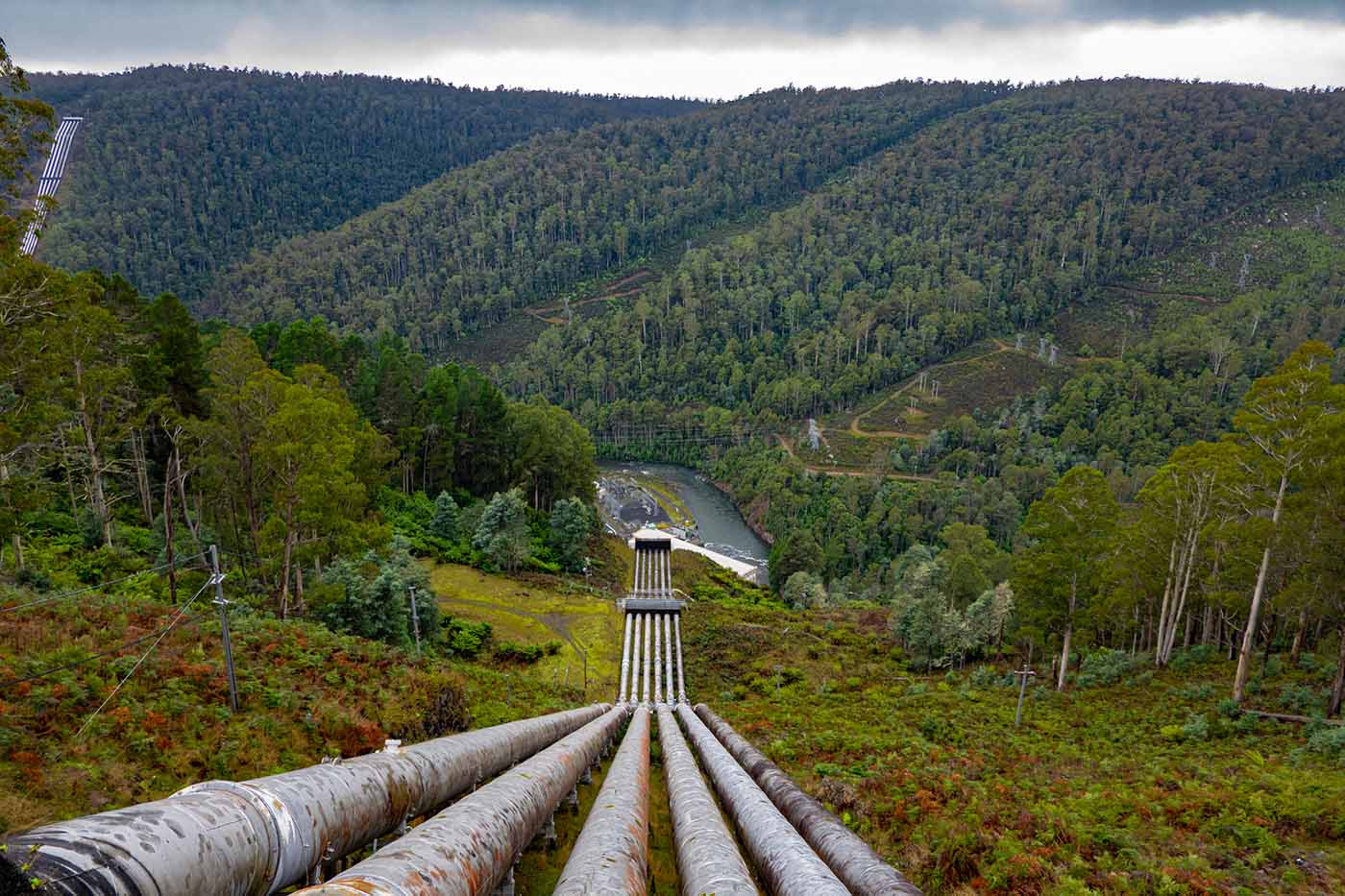
Tasmania has long been regarded as the renewables leader in Australia, thanks to its massive hydro power resources, although that mantle has been challenged recently – by South Australia, which uses only wind and solar, and a change in thinking about how to use its hydro fleet.
Over the last year, for instance, Tasmania hydro has supplied only around 59 per cent of local demand, supplemented by wind (16 per cent) and a growing percentage of rooftop solar (3.4 per cent).
Last week, however, Tasmania recorded a mean hydro share of just 35.4 per cent – its lowest since 2018 when rooftop PV data was first recorded, and most likely its lowest share since the creation of the National Electricity Market.
GPE NEMLog’s Geoff Eldridge, who spotted the record low, says it is part of a trend that has seen hydro’s share steadily decreasing. Over that last week, the state imported 36 per cent of its native demand needs from Victoria, which had all ten of its brown coal generator units on line for most of the period.
“Rather than discharging energy, Tasmania appears to be preserving hydro resources, much like a battery — potentially storing inflows for use when price signals strengthen or system needs emerge,” Eldridge wrote in a post on LinkedIn.
He says the record low hydro share does not reflect scarcity, but strategic conservation – in line with Tasmania’s Battery of the Nation ambitions, which it wants to be delivered with the new sub-sea Marinus Link and with more wind and solar generation in the island state.
“The longer-term data points to a clear transition in Tasmania’s role within the NEM: from baseload hydro to flexible, dispatchable storage,” Eldridge wrote. “A quiet, deliberate shift — one that underscores the value of hydro as a flexible, storable energy resource in a dynamic NEM.”
Renew Economy reached out to Hydro Tasmania to confirm if this was the case, and the company said it was – the long term strategy is shifting from baseload to firming capacity.
“Tasmania is part of the National Electricity Market, which has increasing variable renewable generation like wind and solar,” executive general manager of Commercial Vedran Kovac, said in an emailed statement.
“As more wind and solar generation is built across the NEM, Hydro Tasmania can support this new generation through firming rather than baseload generation, which helps to fill the gaps when the sun isn’t shining and the wind isn’t blowing.
“We manage our water carefully with a long-term view and strategically release water at the most valuable times.”
Energy experts have urged Tasmania to use its hydro resources and transmission links to act as a kind of “solar soaker”, using excess capacity during the day to import power from Victoria, before sending it back when it is needed most.