For half a century South Korea and Australia have been tied together by cargoes of coal and LNG. Since the 1970s, minerals dug in the Pilbara and gas tapped off Western Australia have fired blast furnaces in Pohang and boilers in Incheon, forging a durable “resources partnership”.
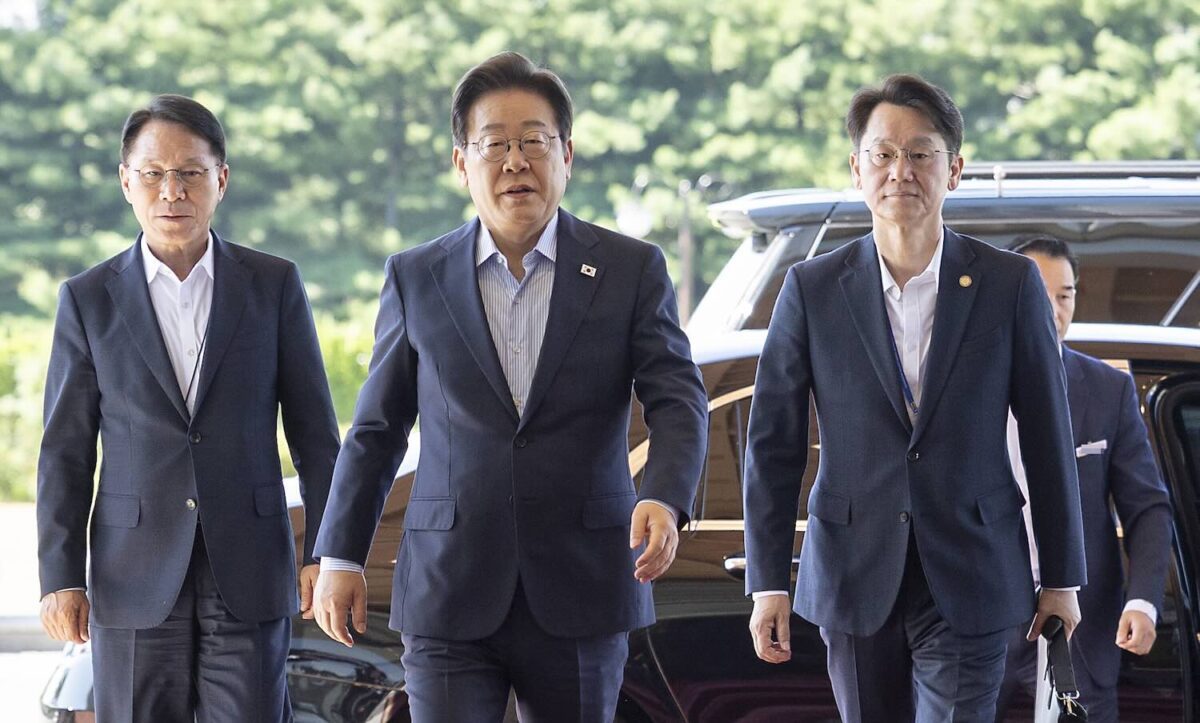
But the landscape shifted in June 2025 when President Lee Jae-myung took office pledging to “accelerate the transition to renewables”. The new South Korean president proposed achieving 30% renewable electricity by 2030 and a total coal-fired phase-out before 2040.
At the same time, Australia is searching for growth paths that do not depend on exporting ever more fossil fuel, with Prime Minister Anthony Albanese saying action on climate change is an economic opportunity and bidding to host the COP31 summit.
The old model of carbon-intensive fuel trade has reached its limit; the new task is conversion, from commodity trading to a joint green value chain built on critical minerals, green hydrogen, offshore wind and grid technology.
There is now a window of opportunity for both countries to work together on a brighter future that delivers new jobs and a safer climate. But what exactly might a new era of Korean Australian trade and cooperation look like under the new leadership?
Critical minerals: from ore to precursor
Western Australia’s red dust hides world-class deposits of lithium, nickel and rare earths, and Korean firms already hold equity stakes in several mines. Construction of a major lithium-hydroxide refinery in Gwangyang has been completed and will be in operation from November 2025.
The next step is vertical integration. By co-investing in refining and precursor production in Australia, the partners can satisfy the CPTPP origin rules and anchor a two-way battery supply chain. Updating the KAFTA free-trade pact to eliminate tariffs on processed minerals and introducing a joint ESG audit standard would lock in the gains.
Green hydrogen and ammonia: Ditching transport, focusing on steel and chemicals
Korea’s dream of a hydrogen powered passenger car fleet is fading fast. Battery EVs dominate sales, Fuel Cell Electric Vehicle (FCEV) incentives are being curtailed, and hydrogen fueling infrastructure is under-utilised. Industry, however, is desperate for low-carbon feedstock, especially for steelmaking, chemicals and fertilisers.
Steel maker POSCO is already running a 45 MW hydrogen direct reduced iron (DRI) pilot with ENGIE in the Pilbara, and plans to significantly ramp up production by 2035
Korea already imports a lot of ammonia each year for fertilisers and chemicals. Switching from grey to green ammonia could cut 5 Mt of carbon dioxide per year and future-proof exports against any future carbon border adjustment rules.
Hence the Korea–Australia hydrogen story belongs in smelters and chemical plants, not in filling stations. The two governments should make mutual recognition of the K-Green Hydrogen Standard and Australia’s Guarantee of Origin a 2026 deliverable and enlarge the joint Australia/Korea export finance project window (for EFA and K-EXIM) to $A5 billion focused exclusively on industrial hydrogen.
Offshore wind and grid technology: Matching wind with wires
Australia’s southeastern seaboard is lining up 25GW of offshore wind leases but lacks heavy-lift vessels, floating foundations and HVDC experience. Korean yards and Engineering, Procurement and Construction firms (EPCs) – including Hanwha and CS Wind – are already on short-lists for Victoria and New South Wales projects, bringing assets honed in the East China Sea.
Conversely, Australia’s 4000 km onshore transmission line corridors offer valuable lessons for Korea as it grapples with high renewable penetration. A bilateral Clean Grid Taskforce could turn this complementarity into joint standards and shared innovation.
Finance and talent: Building the arteries and nerves
The Green Economy Partnership Arrangement (GePA) signed in 2024, together with a $A2 billion dollar EFA–K-EXIM co-finance line, forms the alliance’s main artery. Raising that line to $A5 billion and earmarking it for green iron, green ammonia and critical mineral refining would pull private capital off the sidelines.
Both K-EXIM and EFA have previously been significant sources of money to finance and de-risk fossil fuel projects, but we will likely see this begin to shift to industries like green iron, ammonia and critical minerals.
Skills are the nervous system. The Busan–Newcastle Green Tech Campus – already teaching hydrogen metallurgy, ammonia cracking and battery recycling – could graduate its first 100 engineers by 2027 and erase much of the cultural and technical language barrier.
Policy triage: Reclaim misdirected carrots
Bold targets mean killing legacy subsidies. While the energy transition is no small feat, the easiest place for any government to start is removing public funding for fossil fuel like coal-ammonia co-firing and hydrogen transport incentives
Accelerating the coal exit by clarifying that no new coal will operate beyond 2028 and setting a firm retirement ladder through 2035 will cut risk premiums and speed up renewable deployment.
The 18 month action clock
Key deliverables that the Korean government has flagged include:
– 2025: Signing the hydrogen and mineral certification MoU; injecting an extra $A2 billion into the EFA–K-EXIM line;
– 2026: Final investment decision for the Pilbara Green Iron project; launch Green Tech Campus cohort 1;
– 2026: First long-term green-ammonia offtake signed; integrated certification platform goes live.
If the roadmap holds, bilateral clean-energy investment will top $A6 billion by 2030 and help Korea lift its 2035 NDC ambition to a 61% reduction from 2018.
Seizing the golden 18 months
Alliances stagnate if they do not evolve. The coal and gas bond that once served Korea and Australia must give way to a four-track partnership – in critical minerals, green hydrogen, renewable power and low-carbon manufacturing.
The first 18 months of the Lee administration are the golden window to align standards, scale finance and up-skill people. Capture that moment, and by the early 2030s the two nations will stand as the Pacific’s most resilient clean energy community – proof that an old fuel trade can indeed grow into a cutting edge value-chain alliance.
Seongho Lee is a Korean renewable energy and policy expert, currently head of renewable energy at Samarkand International University of Technology in Uzbekistan. The scholar previously served as director of Korea Energy Agency’s Renewable Energy Center and has advised government and civil society on energy transition for over two decades.