One of the winners of Australia’s largest renewable energy tenders is still wading through the EPBC, as it tries to convince federal bureaucrats it is doing enough to protect koalas.
The public has another chance to comment on the 250 megawatt (MW) Hopeland solar project until February 10, as part of the federal assessment stream it’s going through.
The slightly more complicated assessment process came about because the federal Department of Climate Change, Energy, the Environment and Water (DCCEEW) wants more information about how the developers will mitigate potential damage to threatened flora and fauna.
Developer Pacific Partnerships originally identified 10 threatened or endangered species as potentially living in the area – the painted honeyeater, white-throated needletail, fork-tailed swift, koala, grey-headed flying fox, grey snake, yakka skink, Dunmall’s snake, Brigalow woodland snail, and Corben’s long-eared bat.
Now the focus is squarely on looking after koalas.
Documents accompanying the invitation for public comment outline plans for a 100m-wide koala corridor, koala-proof fencing to stop them from getting in among the solar panels, a dam-turned -waterhole, and a koala offset area 45km to the south.
Pacific Partnerships says it will now be possible to avoid most of the remnant eucalypt open forest and all of the endangered Brigalow scrub, and disturbing a maximum of 62 per cent of the land area
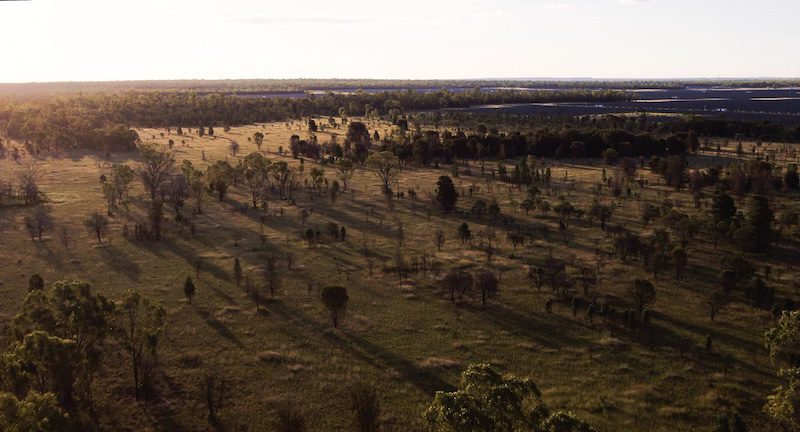
The problematic part is the project requires significant tree clearing, even though the land itself is in a heavily farmed area, and the focus is very much on koalas.
Pacific Partnerships will need to clear 140.3 hectares of koala habitat that could house koalas and grey-headed flying-foxes.
That’s about 40 per cent of the remnant and regrowth eucalypts on the site. Other patches of vegetation such as brigalow, acacias, and sparsely growing eucalypts will also need to be felled.
Battery is on the way
The southern Queensland project will also come with a 175 MW, two hour battery and which is pitched as a partial replacement for the nearby Kogan Creek coal-fired power station.
The developer has left the door open to expanding that battery up to 250 MW and 500 megawatt hours (MWh), after securing a connection agreement from the Australian Energy Market Operator (AEMO) for the battery component a month ago, it said on LinkedIn.
The journey to construction is proving to be a longer route out of the planning process than usual for a solar-battery project, thanks to the more intense EPBC pathway.
The project locked in development approval three years ago, and a connection approval in April 2024 to hook into the grid via Powerlink’s neighbouring 275kV Western Downs substation.
But even if federal DCCEEW is giving the project closer scrutiny, it has the backing of other parts of the federal government.
In December 2024, Hopeland solar was one of 19 wind, solar and hybrid projects to win what was at the time Australia’s largest ever renewable energy tender with 6.4 gigawatts of projects awarded.
The Hopeland project is one of construction group CIMIC’s initial forays into renewable energy.
It bought the project via its in-house developer Pacific Partnerships from Brisbane-based Renewable Energy Partners in August 2023, and says the battery element is its third large-scale renewable asset to gain a connection agreement.