A plan outlining how the Pacific Islands can shed their crippling dependence on expensive and important diesel fuel and go 100 per cent renewables for electricity – and for some transport – is to be presented at the Pacific Islands forum this week.
The 100 per cent Renewables Pacific plan has been prepared by the Smart Energy Council and the Renewable Energy Council Asia Pacific, and is designed to reduce and possibly eliminate their dependence on imported fossil fuels, which amounts to up to one quarter of their GDP.
Thom Woodroofe, an international counsellor with the SEC, and a former key advisor to UN climate talks that helped seal the Paris Treaty in 2015, says the green paper to be released this week will “start the discussion” on how 100 per cent renewables can be achieved.
Scott Hamilton, a senior adviser to the SEC and professor at Monash University says Pacific nations currently spend $6 billion a year on fossil fuel use. “That’s up to about 25% of their GDP,” Hamilton said at the SEC conference in Brisbane on Tuesday. “It’s enormous in terms of the amount of money that goes straight into diesel fuel.”
The green paper notes that renewable energy sites are already underway in 14 different South Pacific islands and some – such as the Cook Islands, Fiji, Nauru, Marshall Islands, Samoa, Tuvalu and Vanuatu have all pledged to achieve 100 per cent renewables by 2030.
It now suggests a “regional political commitment”, that could draw support from key international bodies such as the Asian Development Bank, and the UNDP to support the transition.
Australia would also play a key role, given its technology expertise, its access to funds and its desire to be a regional leader as it bids to host next year’s UN climate conference. It is being signalled as key plank of the COP31 partnership between Australia and the Pacific Islands.
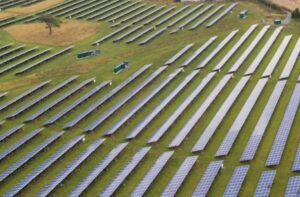
The technologies involved will mostly come from solar, battery storage and even electric boats, although the green paper emphasises there is no “one size fits all” approach.
“Some countries and urban centres will be suitable for large-scale renewable infrastructure, many outer islands will face logistical and cost challenges,” the report says.
“Small-scale renewable systems, including rooftop solar, microgrids and small battery systems can also extend to more communities across the region.” It notes that Melanesia and Papua New Guinea have more than 70 per cent of their population living in energy poverty, or with no access to electricity.
The green paper estimates that the cost of replacing fossil fuel generation in just eight Pacific Island countries could total as much as $US1 billion, but argues that the falling cost of solar PV and battery storage will deliver a reasonably quick payback. The challenge is to unlock the money for the up-front investment.
Woodroofe says it is estimated that achieving 50 per cent renewables in the South Pacific, a region that has up to 2 GW of off and on grid fossil power capacity, could save 620 million litres of diesel a year, and nearly $US1 billion per year in savings.
Palau president Surangel Whipps, who will help launch the program with the governments of Tuvalu and Vanuatu, says the plan could be a “beacon to the world” for the rapid decarbonisation needed to keep the Paris climate goal of limiting global warming within reach.
“Changes in the availability of green technology such as solar photovoltaic panels, batteries, and electric vehicles, now mean that we can rapidly move to the next step of achieving 100 per cent renewable energy, becoming the first region in the world to do so,” Whipps says in the foreword.