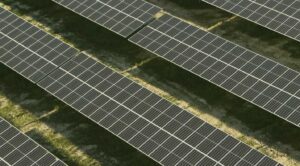
European energy giant Siemens Energy has won a highly lucrative contract to install seven synchronous condensers – huge spinning machines that do not burn fuel – to support the rollout of wind and solar projects in the first major renewable energy zone in NSW.
The giant syncons will be installed in the Central West Orana REZ and will be used to provide what’s known as “system strength”, a broad basket of grid services that include voltage stability and inertia.
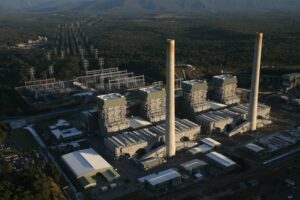
These services have traditionally been provided by thermal generators such as coal and gas, but as the grid transforms to inverter based technologies such as wind, solar and battery storage, the grid operators are turning to fossil free spinning machines such as syncons.
However, there is a growing and intensifying debate in power engineering circles about how many of these machines are needed, and if so called “grid forming inverters” can deliver the same services, as outlined by a new white paper issued in the US by Tesla.
The Australian Energy Market Operator says it’s possible that grid forming inverters will be able to provide all those services, but says it wants to see more evidence that they can do that in all situations before dismissing the need for syncons, or even allowing the grid to operate with 100 per cent inverter based technologies.
So for the moment syncons have the upper hand, and the extent that they do so seems to be largely dependent on how individual transmission companies in various states assess the technologies.
In NSW, the seven syncons to be delivered by Siemens for the CWO REZ will be installed at the new energy hubs (essentially substations and other infrastructure) within the zone that spans across 20,000 kms2 across Dubbo, Dunedoo and Mudgee.
The syncons will be equipped with flywheels and auxiliary systems to help deliver those key grid services. The CWO will support at least 7 gigawatts of new wind, solar and battery capacity following the awarding of access rights to 10 projects announced last month.
Siemens won the mandate for the syncons after a tender held late last year by the AceRez consortium – Endeavour Energy, Cobra and Acciona – that is delivering the transmission infrastructure in the new zone.
The value of the contract has not been revealed, but based on similar contracts in South Australia, where four syncons were installed to support that grids surge towards 100 per cent net renewables, and to allow gas generation to be dialled down to a minimum – it could be worth upwards of $500 million.
The machines themselves are massive. Siemens Energy describes them as being the size of a building, and nearly that of a soccer pitch.
And while it did not want to share their weight, the syncons installed in South Australia weighed 175 tonnes. And the syncons in the CWO REZ will be big, each rated at 250 MVAR, for a total capacity of 1,750 MVAR.
Siemens installed two of the four syncons now operating in South Australia, and also the first syncon to be installed at a solar farm in Australia – at the Kiamal solar project in Victoria.
Many solar farms were obliged to install syncons to support system strength, but the ad-hoc nature of the “do no harm” rule raised questions over whether they were making the grid stronger or weaker, and the rule was dumped.
The creation of REZs is an attempt to bring order to those installations and improve grid management. But the rules of the grid are also tipped in favour of the syncons – the network managers that order them get to include them in their regulated asset base. That is not the case with big batteries.
The managing director of Siemens Energy in Australia, Samuel Morillon, says the machines will be made in Germany and will be installed over the next three to five years.
Asked about the different views between those advocating spinning machines – Siemens also specialises in installing clutches in gas generators that allow the turbines to be used for such purposes without burning fossil fuels – Morillon says:
“We are engineers, and we are very pragmatic, which means that we know that there is no black and white solution. It’s in between, and for some very specific applications, batteries fit extremely well. And for others, basically you need synchrons.
Morillon suggest that as Australia moves towards and beyond its 2030 target of 82 per cent renewables, it will need more such machines. “I can already tell you it will be more than 50 or 60 machines required for the next 10 years, absolutely,” he says.
That remains to be seen. Grid operators are looking at a variety of options, and the battery industry is pushing hard to have grid operators accept its own engineering assessment that grid forming inverter technologies can provide those same services.
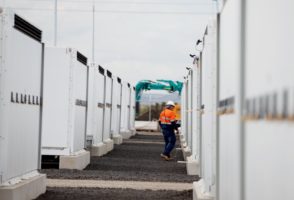
Tesla, for instance, has released a white paper in the US that seeks to challenge some of the accepted wisdom on issues such as short circuit current, and dispel some of the myths around grid forming inverters.
“A common misconception is that a higher short-circuit current indicates greater grid strength,” it says. “However, grid-forming inverters can support voltage without significantly contributing to the short-circuit current , so these measures may no longer be reliable indicators of grid strength.”