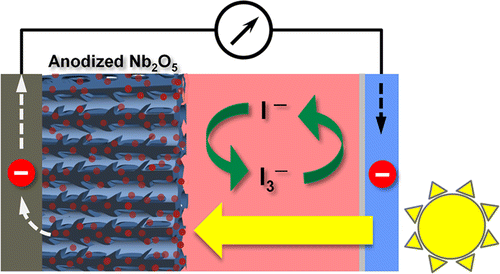
New RMIT-led research has replaced silicon on solar panelling with dye-sensitised solar cells to turn light energy into niobium pentoxide – an environmentally friendly metal-oxide that can improve panel efficiency by at least 30 per cent.
The Conversation reports that PhD student Jian Zhen Ou from RMIT led four other universities – from Australia, the US, and Korea – in the revolutionary study arising from a technique that is widely used in industries generating hard coatings and glazed surfaces – but rarely used for this application.
“Here, we demonstrate that niobium pentoxide (Nb2O5) is an ideal candidate for increasing the efficiencies of dye-sensitized solar cells (DSSCs),” says an abstract to the study, published in the latest edition of the ACS Nano journal. “The key lies in developing a Nb2O5 crisscross nanoporous network, using our unique elevated temperature anodization process.”
The team ascribe the “exceptionally large photoconversion efficiencies” to a combination of reduced electron scattering, greater surface area, wider band gap, and higher conduction band edge, as well as longer effective electron lifetimes.
To read more about it, click here.