Home » Commentary » Renewables surge to 74% of German demand on Sunday

Renewables surge to 74% of German demand on Sunday

Renewable energy created a new record in Germany on Sunday, with wind and solar, supported by biomass and hydro, accounting for 74 per cent of demand in the middle of the day.

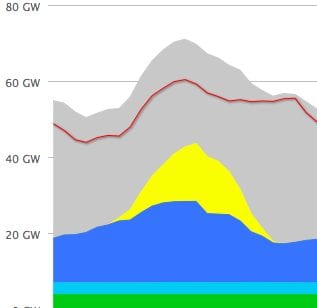
As this graph below from think tank Agora Energiewende shows, the combined contribution of renewables reached 43.54 gigawatts between noon and 1pm.

agora sunday in may

That accounted for three quarters of demand, although the inability of some baseload generators to switch themselves off (many did) meant that a record level of more than 10GW of surplus capacity at its peak was exported to neighbouring markets.

The solar output was 15.2GW at its peak, which is just half its rated peak capacity (more than 33GW), but that is because most of the northern half of the country was shrouded in clouds and rain. Wind accounted for 21GW at the 1pm peak, while conventional sources such as nuclear, coal and gas accounted for 26GW – around half their normal daily production peaks.

According to BDEW, the share of renewable power in Germany’s electricity consumption jumped to 27 per cent in the first quarter of 2014, up from 23 per cent a year earlier. Below is a table that shows the various inputs for the past week, leading up to the record peak production day on Sunday.

agora week


Giles Parkinson is founder and editor-in-chief of Renew Economy, and founder and editor of its EV-focused sister site The Driven. He is the co-host of the weekly Energy Insiders Podcast. Giles has been a journalist for more than 40 years and is a former deputy editor of the Australian Financial Review. You can find him on LinkedIn and on Twitter.

Related Topics

Latest posts

S-curve modelling says renewables can kick coal out of Australia by 2032. But is this soon enough?

S-curve modelling says renewables can kick coal out of Australia by 2032. But is this soon enough?

In the race to renewables, the big question is whether “faster than we thought” is the same as “fast enough.” S-curves say we can do the first. Nothing in the modelling tells us we’re on track for the second.
“It’s a commercial system. And it has a customer:” Sodium-ion battery sale hailed as a first for Australia

“It’s a commercial system. And it has a customer:” Sodium-ion battery sale hailed as a first for Australia

The sale of a 100 kilowatt and 200 kilowatt-hour sodium-ion battery system is being claimed as an Australian first – and may herald next generation of storage tech.
Energy Insiders Podcast: Will the green bank save the Tomago deal?

Energy Insiders Podcast: Will the green bank save the Tomago deal?

CEFC boss Ian Learmonth explains why big wind projects may finally get delivered this year. Plus: Tomago aims for 100 pct renewables, and the big utility profits.
Balcony solar or building integrated PV? The emerging options for apartment dwellers and owners

Balcony solar or building integrated PV? The emerging options for apartment dwellers and owners

A Victorian parliamentary inquiry on apartment energy issues has recently reported and identified several issues that require urgent attention to address the failures of energy policy. One interesting issue that relates to both high rise apartments, and plug-in ‘balcony solar’, is where solar fits into apartment occupant energy costs.  High rise apartment buildings have very […]
7 Comments