Key Takeaways
- Pumped hydro can store wind and solar energy at a lower cost than battery storage, but site selection is crucial.
- Australia has significant potential for pumped hydro, with around 100 terawatt-hours of excellent sites available.
- Many current pumped hydro projects in Australia, such as the Borumba project, are located in poor locations, leading to increased costs.
Pumped hydro will play a huge role in Australia’s future grid, storing wind and solar energy at a cost that can be much cheaper than battery storage, but only if it’s in the right spot, says one of the country’s top experts.
ANU professor Andrew Blakers says Australia has about 100 terawatt-hours of “really, really great sites” for pumped hydro – and thousands more of slightly lower quality – but some of the sites where major projects are currently being developed are “really terrible.”
“One disappointing feature of pumped hydro so far in Australia is that most of the sites, apart from Snowy 2.0, are in poor locations,” Blakers told the Solar & Storage Live conference in Brisbane on Wednesday morning.
“And I really hope that developers pay attention and actually build in good locations when the cost is about half.”
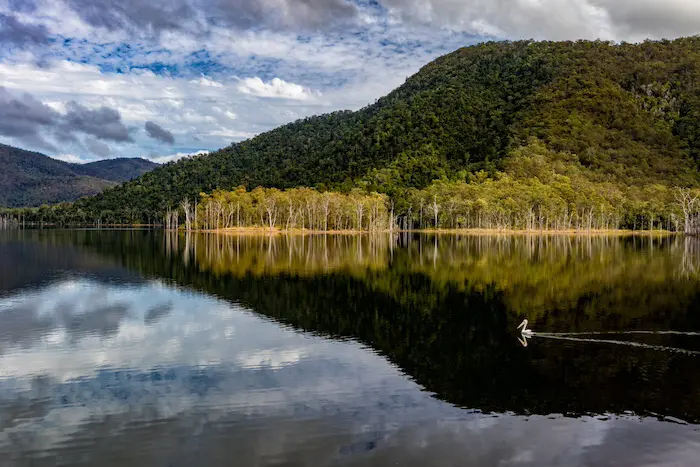
Blakers, who has long called for a bigger focus on pumped as Australia transitions to 82 per cent renewables, says Queensland’s 2,000 MW, 50 GWh Borumba Pumped Hydro project near Imbil, west of the Sunshine Coast, is one example of a poor location.
“So the Borumba site is a really terrible site because the head is small and the cost of the two reservoirs is large, and that’s going to triple the cost of storage … which is really sad. They could do much better.”
The costs of the Borumba project – which has so far survived Queensland’s change of government last year, where others did not – have blown out by more than $4 billion to more than $18 billion, according to a February update from the Crisafulli LNP government.
One of the first big moves made by the newly elected Queensland government was to dump the even bigger 5 gigawatt (5 GW) and 120 GWh Pioneer Burdekin Pumped Hydro project, proposed for near Mackay, amid claims that its capital cost had blown out to $37 billion.
The Crisafulli government has also said that alternative sites for the Pioneer Burdekin project will be considered, but Blakers says the site was not the problem with the Pioneer Burdekin project – and that the reason it was dumped was probably largely political.
As he has argued here, a differently engineered project design for Pioneer-Burdekin has been costed at $17 billion – less than half the price claimed by the Crisafulli government.
“You had a pretty good site up at Mackay, and that got canned in the last election,” he told the conference. “The big problem … the from an engineering point of view … [would have bee that it] was 24 hours storage – 5 GW for 24 hours, 120 GWh.
“It should have been a 1 gigawatt proposal, and then a couple of … batteries,” Blakers says. “And then you’ve got really cheap batteries and really cheap pumped hydro.”
Blakers’ theory – which he explains in detail here – is that energy storage is a “solved problem” using the right mix of PHES and big batteries.
That’s because batteries are relatively inexpensive for storage power ($/GW) but are expensive for energy storage ($/GWh). PHES is more expensive than batteries for storage power ($/GW) but much cheaper for energy storage ($/GWh). A hybrid system has both cheap energy storage and cheap storage power.
“By far the largest energy storage around the world is pump hydro,” he told the Brisbane conference on Wednesday. “It’s 95% of all global energy storage. But you have to change between energy storage and storage power.
“Batteries are going to dominate storage power – that is, short term, high power storage. Pumped hydro, as far as I can see, will continue to dominate energy storage.
“They work much better as a combination – batteries, taking care of short-term high power storage, pumped hydro taking care of low power, long duration storage. And so you put the two together, and you get cheap power and cheap energy storage system.”
If you wish to support independent media, and accurate information, please consider making a one-off donation or becoming a regular supporter of Renew Economy. Your support is invaluable.