The Queensland LNP government has officially dumped the state’s renewable energy targets, and locked in decades more high-polluting and increasingly unreliable coal generation, with the passage of new energy legislation through Queensland Parliament.
The Energy Roadmap Amendment Act 2025 drops any pretense that the Crisafulli government will act on climate change or transition the state to a cheaper and more sustainable energy system, dedicating $1.6 billion to propping up coal and just $400 million to be divided between renewables, storage and gas.
In a statement published late on Wednesday night, state energy minister and Treasurer David Janetzki says his government’s plan will reduce energy system costs for taxpayers by $26 billion to 2035.
Renew Economy is seeking more detail from Janetzki’s office on how exactly it came up with this extraordinary number, but in the report it is attributed to “lower system investment cost by running state-owned coal assets to technical life compared to an accelerated closure schedule.”
The report suggests that Labor’s plan was profligate in both its support of renewables and its closure of what the LNP believes to be perfectly good coal plants.
It says, “updated operating timeframes reflect that Tarong, Tarong North and Stanwell remain among the most reliable sources of baseload generation in the NEM, while Callide B has been extended at least to 2031 (subject to adequate system and market outcomes).”
Here’s a neat chart.

Source: Queensland Energy Roadmap
And while it’s true that some of Queensland’s remaining coal-fired power stations rank among the youngest on the National Electricity Market, this does not mean they are the most reliable. Indeed, the latest data from AEMO on coal reliability does not support that theory at all.
AEMO’s newly released draft Integrated System Plan takes into account the LNP’s determination to keep its coal plants online until 2049 in some cases. But it warns that the days of baseload are fast disappearing and that after 2040 even Queensland will have to prepare for times when there is no coal generation.
“Higher operating costs, reduced fuel security, high maintenance costs and greater competition from renewable energy in the wholesale market is challenging the financial viability of some power stations,” the AEMO ISP says.
“To extend their availability, many coal plant operators are investigating plant modifications that would enable two-shifting and other more flexible operations.
“Two-shifting means switching off during the daytime peaks of solar generation, and returning for the evening peak and through the night and morning. In some cases, coal generators may operate only during peak seasons – remaining active in summer and winter while shutting down during the shoulder periods.
“This flexible operation means that there would be many periods in which all coal is offline, and this possibility has been incorporated into the proposed ODP, in particular to allow Queensland coal plants to continue operating into the 2040s.”
All of which means that Queensland will need more renewables regardless of its energy roadmap targets – which make the bold assumption that no new wind and solar, apart from those already contracted and committed – will be built in the next five years, and not much in the following five years.
Janetzki’s claims about coal reliability also contrast with new analysis this week from Reliability Watch, which shows that in Queensland, an average of 26% of the state’s coal power capacity was offline over the six months from April to the end of September this year.
According to the roadmap, there is around 8 gigawatts (GW) of both private and publicly owned coal-fired generation capacity on Queensland’s grid. So that’s an average of 2 GW out of action at any one time.

Source: Reliability Watch
Across the entire state, Queensland coal power had 61 unplanned breakdowns over the winter period – a period where lower overall demand means coal plants are under less pressure and should be less prone to outages, and more likely to undergo planned maintenance.
The worst performer was the 49 year-old Gladstone power station, which had 33 unscheduled outages over the six months. The worst performing units were Gladstone 1, Tarong North, Millmerran 2, Callide C3, all being available less than 50% of the time.
Tarong North had the worst availability, offering on average only 33% of its capacity to the market.

Source: Reliability Watch
The report says that as at June 2025, Queensland hosted around 8 GW of coal-fired generation capacity, 3.5 GW of gas, 1.3 GW storage, 1 GW of wind, 3.2 GW of large-scale solar and close to 7 GW of rooftop solar (PV) – the highest uptake of any Australian state.
And then there is the price too.
Calum Harvey-Scholes, an analyst with Rewiring Australia, posted this graph below to remind Queenslanders of how much they pay for coal, compared to other sources. Queensland, of course, remains the country’s most coal-dependent state with a share of 66 per cent of total generation.
“LNP decides to abandon renewables in favour of pumping $$$ into coal, this is your regular reminder of how much Queenslanders pay for different sources of electricity,” the post says.
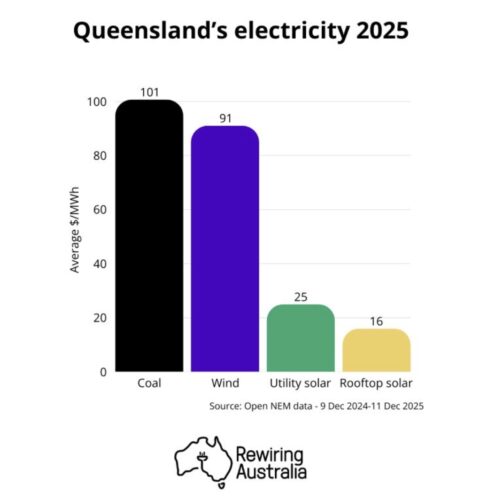
“Over 2025, coal generated nearly 2/3 of the Sunshine state’s electricity for a over $100/MWh. 25% came from solar panels, mostly rooftop, and for a fraction of the price,” Harvey-Scholes writes on LinkedIn.
“Queenslanders get it, running our homes on sunshine is cheap and brings down bills. In spite of the state government, households are charging on with transforming our energy system for the better – almost 20,000 home batteries have been installed in QLD since July, more than every other state except NSW.
“I doubt he will listen to me, but Crisafulli needs to sit up and listen to his fellow Queenslanders. They are voting with their wallets for an affordable, electric future.”
The targets scrapped by the Queensland LNP were for 50 per cent renewables by 2030, and 80 per cent by 2035. Victoria has a target of 95 per cent renewables by 2035, while South Australia is aiming for 100 per cent “net” renewables by 2027.
NSW expects to retire all its remaining coal generators by 2035, and Western Australia expects the last of its coal units to be closed by 2030.