Consumer energy advocates have called on federal and state governments to make plug-in solar and batteries legal to use in Australia within 10 months, following last week’s news that clearing a path for the technology known in Europe as “balcony solar” has been put on the national political agenda.
A meeting of federal and state energy ministers on Friday agreed to explore pathways to support the safe deployment of plug-in consumer energy resource (CER) devices in Australia, promising to identify measures that enable its safe use and report back later this year on next steps.
As Renew Economy has reported, this is welcome news, because portable solar and batteries are proving to be a major consumer energy game-changer in parts of Europe and the US, where similar regulatory and safety hurdles have been addressed and overcome.
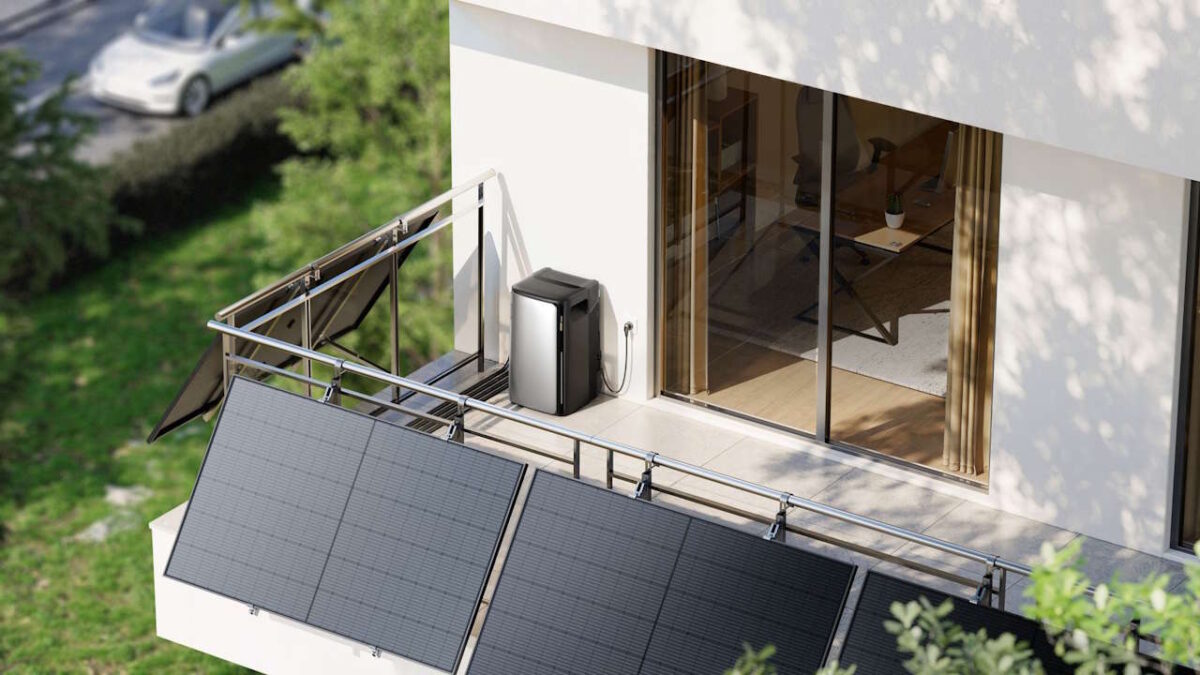
The main attraction of the technology – which currently can be bought in Australia, but not legally plugged in – is that it is one of the cheapest and easiest ways to extend the consumer energy revolution to the around 30 per cent of households currently locked out of traditional rooftop PV and wall-mounted batteries.
Portable solar and batteries can be, literally, plugged into power points to help offset the cost of energy hungry home appliances and then taken by renters when they move – and they don’t need to be installed by electricians.
Germany was one of the first countries in the world to showcase the technology, allowing apartment dwellers to install one or two panels on their balconies that could be plugged in to a powerpoint and used to run appliances when the sun is shining.
Plug-in batteries quickly joined the chat, to store energy – either from the grid or from the “balcony” or back-yard solar panels – for use later in the day.
Since the success of the tech in Germany, it has also taken off in Spain, and – just a few weeks ago – was deemed officially legal in the UK after the government prioritised it in March as part of a suite of measures designed to bolster national energy security in the midst of another global fuel crisis.
New Zealand has also been threatening to beat Australia to the punch after a major government review said legalising plug-in solar could be achieved within nine to 12 months given work has already started on determining the approach to developing or modifying standards.
Solar Citizens, a renewable energy lobby group that has run a major campaign petitioning the federal government to take action on portable CER, says Australia should move with a similar sense of urgency to make the technology legal here.
“Let’s get plug-in solar and batteries legal in Australia by 1 July 2027,” Solar Citizens CEO Heidi Lee Douglas said on Friday.
“We can’t wait to see renters and apartment residents, and more low income homes become ‘solar citizens’.”
In a press conference on the weekend, federal energy minister Chris Bowen said that while Australia was now “on the path” to opening up access to plug-in solar and batteries, he also warned that it would not happen “overnight.”
“We’ve got a lot of work to do on safety and on standards. We’ll be working with Standards Australia and with all the state safety regulators. States will need to review their Strata laws,” Bowen told reporters on Saturday.
“This is not happening overnight, we have to get it right, and the work on the standards is very important. But that work – I’m delighted the states and territories unanimously agreed with me yesterday, to begin that work.”
Bowen also said that – once covered by the appropriate Australian standards and safety rules – plug-in solar and batteries also should be “automatically covered” by existing rebates, including the federal Cheaper Home Battery scheme and the Small-scale Renewable Energy Scheme (SRES).
“But we’ll work those details through,” he said.
And he conceded that some of the most complicated work might include the regulations relating to landlords and tenants and – for apartment dwellers – Strata rules.
“That’s why, one of the reasons why this is not an overnight proposition. We’ve got to get the safety standards right,” Bowen said.
“It can be done safely, it’s done safely in Europe. It’s being done safely in the United Kingdom and New Zealand, but it’s not automatic. You’ve got to get the rules right. And also the rules around landlords and tenants, it’s not going to be for everyone. But it is a new option for people to use if they wish.”
Glen Morris, who is a solar and battery engineer and director of Smart Energy Lab, as well as a member of the Standards Australia committees that write the solar and battery installation rules, says the path to safe plug-in solar is “not complicated.”
“Germany has had over a million of these systems plugged in for years and the UK has just written the rules into its wiring regulations,” Morris said in a statement on Friday.
“We do not need to invent anything. We need a product standard so the inverter shuts down instantly when unplugged, a cap of around 800 watts so it cannot overload a normal power circuit, and a simple registration with the network so they know it is there.
“That is a job for the Energy Ministers to hand to the regulators with a deadline,” Morris says.
“None of the concerns raised about plug-in solar needs new technology, they need a rule that says what is acceptable.”
To join more than 29,000 others and get the latest clean energy news delivered straight to your inbox, for free, click here to subscribe to our free daily newsletter.