Plans to develop a 1 gigawatt wind farm in waters off the coast of Gippsland in Victoria have been referred for federal environmental assessment, just over one week after hundreds of locals attended a community meeting in protest of the project.
The Blue Mackerel Offshore Wind Project appeared in the EPBC queue on Monday, with developer Jera Nex bp seeking a green tick for its proposal to install up to 70 wind turbines around 10 km from the shore between Woodside and Seaspray in Victoria’s south east.
The referral says each of the up to 70 turbines will have a capacity ranging from 15 megawatts (MW) to 23 MW, while the height of the upper blade tip will be between 266 metres and 327 metres above sea level, depending on the turbine capacity the company settles on.
The project’s current design is based on 15 MW turbines, but the website notes that should alternative wind turbine technology become available, such as a larger 18.5MW turbine, the turbines would be higher and blades larger, but fewer, in total, would be required.
Blue Mackerel was one of the first projects to be awarded a feasibility licence for its spot in the Gippsland offshore wind zone and, last October, was further awarded Major Project Status by the federal government, in a nod to its key role in weaning the state and national grid off coal.
But it is also one of the most contentious of the nine projects still lining up to compete in the Victorian government’s offshore wind auction in August, due to its proximity to the shores of the 90 Mile Beach that connects the two Gippsland region towns.
In a Facebook post dated January 25, community group Celebrate Seaspray said about 400 people showed up to a two-hour social impact assessment meeting held the day before, facilitated by third-party consultancy Nous Group on behalf of Blue Mackerel.
“When asked for a show of hands, 100% of attendees said they do not support the proposed Blue Mackerel offshore windfarm,” the post says.
“And the Seaspray Windfarm Strategy Group also presented Nous Group with a petition of more than 2600 signatures opposing the project.”
Celebrate Seaspray says the community’s concerns include the loss of visual amenity, with the turbines proposed for just 10km offshore, directly in front of the Seaspray Surf Life Saving Club.
Other concerns range from the impact on tourism, noise and light pollution, harm to birdlife and marine life, and long-term effects on quality of life, social cohesion and mental health in the affected communities.
Also cited on the Facebook post is a “deep lack of trust in Blue Mackerel to operate transparently or authentically or present accurate visual representations of the visual impact of its proposed wind farms from Seaspray’s shoreline.”
Jera Nex bp is a 50:50 joint venture with the renewables arm of Japan’s largest power generation company, Jera, and global oil and gas supermajor, bp.
Its Blue Mackerel project was one of the first to be awarded a feasibility licence by the federal government and the project team have held a number of community information and drop-in sessions and provide extensive information on the project website.
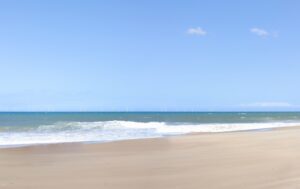
The website also offers 17 different visualisations of what the wind farm would look like from 17 different viewpoints along the coastline of 90 Mile Beach via a visualisation tool, including the above image from the beach neat the Seaspray Surf Club.
A separate set of visualisations on the website offer comparative visualistions using both 15 MW turbines and bigger 18.5 MW turbines.
In comments to the ABC published on Tuesday, Blue Mackerel project director David Ghaly noted that it was the federal government, and not the company, which had set the location of the development sites in the Gippsland development zone.
“The turbines are in a zone that was awarded to us by the Commonwealth government. They will be visible from the shore but we can’t move our licence area,” he said.
“We have one of the smallest licence areas that was awarded … so we are limited in what we can do in terms of how visible the wind farm is from the shore.
“We can’t make the turbines invisible, so that impact will be there.
“Whether it’s our project or another project, they will be visible.
“What we are trying to do at the moment is to move the conversation to a community benefits program. We’d like to hear from the community about how we can best be a responsible project, given that we will be there for 35 years.”
The EPBC referral documents note that the preliminary review of Seascape, Landscape and Visual Impact Assessment (SLVIA) considerations concludes that “at distances of 11 to 14 km offshore the turbines will be noticeable but not dominant elements in views from the onshore environment. Inland visibility is limited due to dunes, vegetation and local landform.”
The documents say that marine uses of the project area include recreational boating, recreational fishing, commercial fishing, and marine-based tourism opportunities including cruises, whale and wild-life watching, sailing, diving, snorkelling, surfing and kayaking.
But it also notes that most recreational boating and fishing occurs close to shore due to rough offshore conditions in Bass Strait.
The documents note that proposed project footprint is considered a Biologically Important Area (BAI) for the Pygmy Blue Whale, the Southern Right Whale, the White Shark, and eight seabird species.
Blue Mackerel has been contacted for further comment.
If you would like to join more than 28,000 others and get the latest clean energy news delivered straight to your inbox, for free, please click here to subscribe to our free daily newsletter.