Monitoring CO2 began in 1958 when the song At the End of the Rainbow was a big hit. The lyrics of Nat King Cole’s classic song, written by Earl Grant, included the line about finding a pot of gold at the end of a rainbow, endless love, and a story without an end.
It resonated when first released. It resonates today, but not as originally intended. Instead of finding a pot of gold at the end of the rainbow and never-ending love, we are confronted by mighty rivers – like the Colorado – that are literally sucked dry before reaching the ocean, and once-majestic glaciers that are receding before our very eyes.
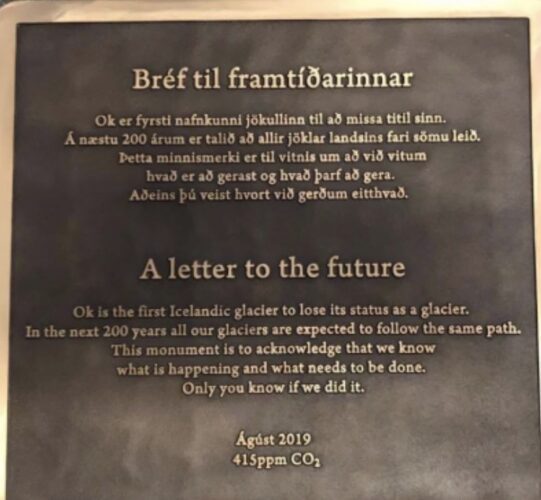
Nowhere is the message more poignantly on display than at a memorial plaque placed at the site where Okjökull glacier used to be in Iceland in August 2019.
The plaque signifies one of the many glaciers that are rapidly receding or have already been lost due to a warming planet. Okjökull was among the first of Iceland’s 400 or so glaciers threatened by the climate crisis. The plaque—like a tombstone on a grave—serves as a memorial and a somber warning for the future.
The Okjökull glacier, which used to cover over 15 square kilometers (5.8 sq miles) in western Iceland with ice as deep as 50 meters (165 ft.), had shrunk to barely 1 square kilometer of ice less than 15 meters deep, thus losing its status as a glacier.
To be considered a glacier, it must have a persistent mass of compacted ice that accumulates more mass each winter than it loses through summer melt and is in constant motion under its own weight. Okjökull no longer qualifies. It is now considered “dead ice.”
The plaque (below) reads: “In the next 200 years, all our (Iceland’s) glaciers are expected to follow the same path. This monument is to acknowledge that.”
As if that were not bad enough, the plaque reminds the reader: “We know what is happening and what needs to be done. Only you know if we did it.”
It is not entirely clear who “we” and “you” refer to – the present and future generations?
To top it off, the plaque includes “415 ppm CO2,” referring to the global concentration of carbon dioxide in the atmosphere recorded in May 2019, measured in parts per million.
Atmospheric scientists had long warned that to avoid a warming planet, the number should be kept below 350 ppm. As of July 2025, it stood at 427, far above the pre-industrial level of around 280 ppm.
By sheer coincidence, the National Oceanic and Atmospheric Administration (NOAA) began monitoring this critical indicator of the health of the planet starting in 1958 -the same year Nat King Cole’s song was released.
At that time, the number was in the low 310s, some 40 ppm below the 350 threshold. Today it is some 77 points above it, and it continues to rise as we speak.
Although climate skeptics have tried all sorts of gimmicks to blame the rising CO2 concentration on things other than human-induced causes – principally the burning of ever-increasing amounts of fossil fuels – they have not succeeded.
The iconic Keeling Curve is unequivocal, and the unpleasant data cannot be explained away no matter what. This is why the Trump Administration decided to cut future funding for the Mauna Loa Observatory on the Big Island of Hawaii. It’s the proverbial head-in-the-sand approach when confronted by inconvenient data.

Pretending that unpleasant facts do not exist, or don’t matter, however, is not going to make the problem go away. Not measuring the concentration of CO2 will not make future generations wealthier, happier, or better off. They will blame us – the “we” in the plaque – for leaving “them” with a damaged planet.
In the meantime, heat waves are becoming more common. There were an additional 41 days of extreme heat worldwide last year, the hottest on record.