Australia’s energy transition is often described as if it were one national grid making one cautious journey away from fossil fuels.
In reality, it looks much more like a rebellion of many systems – a constellation of islanded and semi‑islanded grids quietly rewriting the script while the minions of the old fossil empire still insists they are in charge.
Australia’s National Electricity Market has already crossed an important threshold. In the final quarter of 2025, renewables and storage supplied just over half of all NEM electricity for a full quarter, with wind output up strongly, grid‑scale solar hitting new records and battery discharge almost tripling in a year.
Coal generation fell to its lowest quarterly level since the market began, gas slipped further, and average wholesale prices dropped to around the $50/MWh mark.
The storyline that “more renewables mean higher prices” is just a phantom menace.
But the more interesting action is happening off the core grid, in the systems that used to be dismissed as peripheral. Western Australia alone now reads like a Star Wars map of outposts and waystations, each testing its own mix of solar, wind, batteries and residual fossil plant.
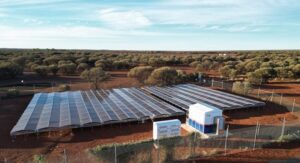
Horizon Power, responsible for about 2.3 million square kilometres of regional and remote WA, operates 34 microgrids and regional networks that serve mining towns, coastal communities and remote Aboriginal communities.
These systems used to be the very definition of the grid’s dark side: expensive diesel, fragile long lines, limited reliability. They are now a proving ground for high‑renewable, storage‑rich power.
Across multiple towns Horizon is rolling out large batteries to soak up rooftop and utility solar in the middle of the day and shift it into the evening peak, allowing fossil generators to ramp less and run shorter hours.
In several regional microgrids, trials with zinc‑bromine and other non‑lithium storage technologies are pushing diesel deeper into back‑up mode rather than daily duty. The aim is simple: keep the lights on, cut fuel costs, and make sure the system doesn’t go over to the dark side when the sun goes down.
That work now extends deep into remote Aboriginal communities. Under the ReGen program, standalone power systems built around solar and batteries are replacing ageing diesel infrastructure, with early sites cutting diesel use by tens of thousands of litres a year.
This is not a theoretical just transition exercise; it is real reliability, lower running cost and quieter air for communities that have often been the last to see modern energy infrastructure.
And it’s not just Western Australia. Across the Northern Territory, a patchwork of remote and regional power systems – from Darwin–Katherine and Alice Springs to dozens of Indigenous communities supplied by local microgrids – is also shifting from diesel‑heavy generation towards solar‑and‑battery hybrids, showing that even some of the most remote parts of the continent can run on a predominantly renewable “islanded” grid.
Meanwhile, the private sector is constructing its own fleet of rebel bases. In the Pilbara, Fortescue is fast‑tracking what it calls the world’s largest off‑grid green industrial system – targeting more than a gigawatt of solar, hundreds of megawatts of wind and several gigawatt‑hours of battery storage.
The intent is to eliminate diesel and gas from its mining operations and run heavy industry largely on firmed renewables, saving serious money on fuel and operating costs in the process. When your haul trucks and processing plants are running on electrons instead of oil, you are no longer at the mercy of galactic fuel markets.
Further south, remote towns like Exmouth and Leonora are shifting to hybrid microgrids where solar plus batteries supply the majority of annual demand and gas is relegated to a supporting role.
Remote tourist sites, cattle stations and agricultural businesses are following a similar path, installing solar‑battery‑diesel hybrids because they are cheaper, simpler and more reliable than pure diesel. One by one, these systems are stepping out of the fossil age and into a distributed, renewable present.
Viewed together, Australia reveals itself as not a single grid and more like a federation of energy experiments.
The NEM is demonstrating how a large market deals with 50‑plus per cent renewables and rising storage. South Australia shows how to operate securely with very high wind and rooftop solar shares for long periods.
The South West Interconnected System – getting an almost May the Fourth injection of new projects – is proving that an isolated urban‑industrial grid can follow the same trajectory without an AC lifeline to its neighbours.
Horizon’s 34 microgrids, Fortescue’s Pilbara green grid, numerous other mines, and dozens of smaller town and off‑grid systems are exploring what happens when renewables and storage become the default choice in places that used to rely on tankers and long‑haul fuel trucks.
Unlike the war in Iran, none of this is to pretend the fossil Empire is finished.
Transmission bottlenecks, planning delays and policy wobble still slow the roll‑out of new projects. Ageing coal units remain in the system longer than their engineering suggests is wise, and their failures still cause pain when they trip during heatwaves.
But the direction of travel is clear.
In system after system, the profitable path now runs through solar, wind and storage. Coal and gas increasingly survive by clinging to legacy advantages, not by winning on the open field.
For other islanded and semi‑islanded grids – from Pakistan to the Pacific – the message brings a new hope. You don’t need hyperspace‑age technology to decarbonise a constrained system.
The tools Australia is deploying now are familiar: good wind and solar, smarter inverters, grid‑forming batteries, better market rules, and planning frameworks that actually map where new generation and wires should go.
You don’t need to invent new physics; you just have to use the Force of existing technology properly.
On this May the Fourth, Australia’s experience suggests that the dark side of the grid is no longer destiny. When you treat renewables and storage as the core of the system rather than bolt‑ons, even far‑flung outposts can break their dependence on fossil fuel convoys and volatile fuel prices.
The fossil fuel empire will not collapse overnight. But rebel gains across Australia’s islanded grids you can already see its defences being quietly outflanked, one microgrid, one battery and one rooftop at a time.
With apologies to Star War fans.