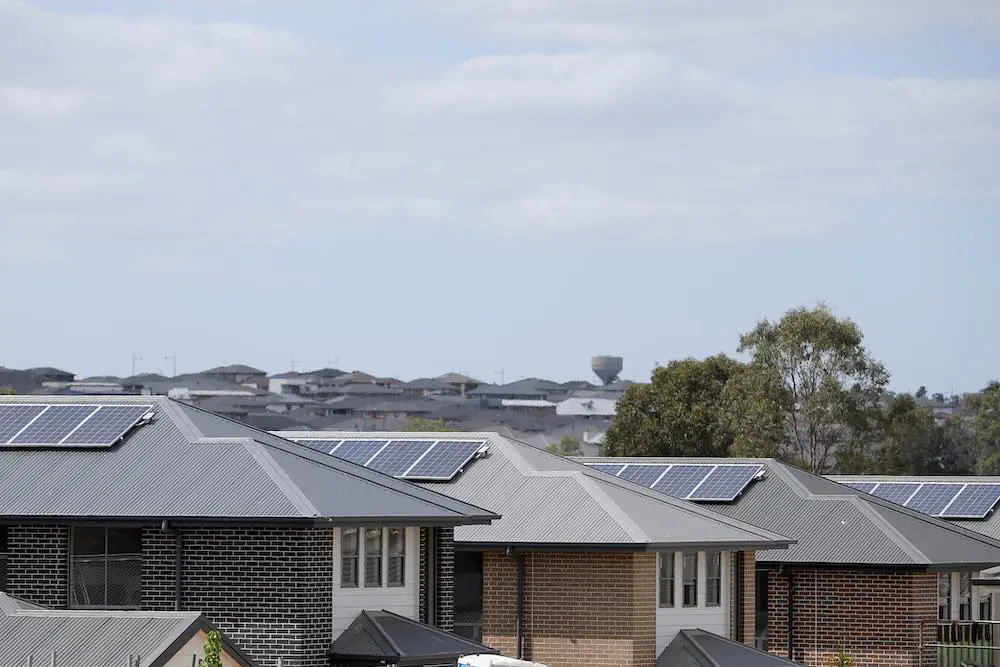
Efforts to get enough “firming” capacity on Australia’s grid quickly enough to support the target of 82 per cent renewables by 2030 are ignoring two huge opportunities: commercial and industrial battery storage, and full participation of demand-side resources.
In a range of submissions to the National Electricity Market (NEM) Review, some of Australia’s leading energy innovators are calling on the four-member review panel to fully dispense with ‘hub-and-spoke’ electricity market thinking and flip the focus to behind the meter.
The NEM Review, led by Tim Nelson, is charged with proposing fundamental reform of the national electricity market to make it fit-for-purpose for a renewables dominated grid.
So far, most of the policies guiding the paradigm shift from baseload and peaking to renewables and firming have focused on driving investment in big wind and solar generation and – more recently – big batteries and other large-scale and longer duration energy storage technologies.
But a growing chorus of voices says the focus needs to shift, again – from big to small and from front-of-meter to behind the meter – and rapidly outdated concepts of electricity supply and demand need to be tipped on their head.
“Previous NEM reviews have only given passing thought to the role of the demand side in the design phase,” says a submission from solar retailer Flow Power.
“They have ignored the relative advantages of demand-side investments, while the cost and implementation timeframes of large supply-side investments blow out.
“We’ve learnt that the demand side should be the Panel’s first, not last, consideration.”
Flow Power notes that previous proposals to establish a physical retailer reliability obligation (RRO), for example, have never considered how this might include distributed energy resources like rooftop solar and batteries, or demand response.
“Similarly, the Capacity Investment Scheme (CIS) does not allow participation of decentralised solutions. All previous reviews appear to have seen the demand side as a problem, rather than part of the solution.”
But this is a huge blind spot, Flow argues, considering that by 2050, more than 50% of the firming capacity in the NEM and the largest component of generation capacity will likely sit behind the meter – not just in the form of home battery systems, but batteries installed by business and industry and batteries on wheels in electric vehicles.
“While new large-scale capacity is clearly required, the rapid growth of assets behind the meter is a cost-effective solution that provides direct benefits to end consumers,” the submission says.
“The combination of residential, commercial and industrial batteries, demand side participation and EVs could and should be the central tenet of a reliable future NEM.”
Tesla agrees, arguing in its own submission to the review that any new NEM mechanism must be designed to be scale-neutral, giving behind-the-meter and demand-side resources “equal opportunity to participate” as grid-scale batteries and large-scale generators.
“This would facilitate retailers, operators and commercial innovators to engage directly with consumers and allow them to opt-in to dispatch (for requisite compensation) should they choose to,” the Tesla submission says.
Green Energy Markets goes as far as calling for a specialist organisation to be established with a specific focus on consumer energy resources (CER) or demand reduction – not unlike how the Clean Energy Regulator was set up to oversee renewables, energy and emission reporting and the development of a carbon offset market.
“The [Australian Energy Market Operator] and its predecessors have historically focussed on supply side solutions with little consideration for demand side solutions,” the Green Energy Markets submission says.
“It is now well accepted that CER, including demand reduction and energy efficiency are more cost effective than supply side alternatives.
“Some of the key innovations relating to big data, artificial intelligence, developments in communications, LED technologies, solar PV, heat pump technologies and storage are happening on the customer side of the meter.”
On demand response, GEM says that while this has long been considered as an alternative to network augmentation, to date the level of actual demand response has been “underwhelming.”
“The pay-off for customers is massive if demand response is effectively activated,” the submission says, pointing to recent analysis that showed more than 5 gigawatts (GW) of demand-side capacity could be available in Australia by 2035, from the residential sector alone, with net benefits of $4.3 billion.
But, it adds, “unless the blueprint of energy market operation organisations is rewritten, these options will remain untapped.”
As a representative of the industry behind some of the biggest electricity demand in the country, the Australian Aluminium Council is also keen to see reform in this area.
“While the Council recognises that the [Capacity Investment Scheme (CIS)] is intended to invectives new investments, the exclusion of existing assets may exclude the participation of large industrial loads,” AAC chief Marghanita Johnson says in another submission.
“These may have lower cost and efficient capacity which is not currently incentivised to be provided to the market.
“The Council believes this least cost delivery needs to be facilitated as it may be delivered more efficiently and quickly to the market than through the CIS and should be considered for future capacity mechanism design.
“Further, the ‘Capacity’ offered by industrial user for minimum demand periods should be rewarded and compensated, recognising the avoided impacts on reliability and transmission congestion which it delivers.”
Meanwhile, factoring in electric vehicles and commercial and industrial loads and storage adds a whole new dimension.
“Policy and funding support for new battery capacity in the NEM to date has focused on deployments in the residential, community/network and utility-scale sectors,” says Flow.
“However, one of the largest, mostly untapped, opportunities in the NEM is the installation of batteries at commercial and industrial sites.
“Bloomberg NEF is projecting a cumulative capacity of C&I batteries of 11GWh by 2035. We believe that this is a material underestimation of the capacity that could be unlocked with some government support.
Flow estimates that a C&I battery storage penetration of just 30% by 2035 this would equate to approximately 25GWh of storage across the NEM close to load centres – no new transmission or social licence required.
Renewables gentailer, Engie, also calls for the NEM Review panel to investigate whether a separate market for CER flexibility could co-exist with the current wholesale energy market, or a variation of it.
“With the rate of change within the CER space, the rapid uptake in rooftop PV and the eventual mass adoption of EV (as seen elsewhere), it would be a missed opportunity to not reform how CER interacts with the market,” Engie says in its own submission.
South Australia Power Networks – the poles and wires company operating the grid with the highest share of renewables in the world – says it’s about ensuring that least-cost sources of generation and supporting infrastructure are appropriately identified and incentivised.
“In AEMO’s long-term system planning process, distributed generation, including Consumer Energy Resources (CER) such as rooftop solar and residential battery storage, as well as larger distribution-connected generators, serves only as an input to AEMO’s modelling,” the SAPN submission says.
“Distributed generation, and the associated distribution network capacity to host that generation, is not placed on an equal basis with large-scale generation and transmission capacity in any long-term system planning process in the NEM, despite the potential for more efficient consumer outcomes.
SAPN recommends reforms to AEMO’s system planning processes model distributed generation, including CER, as both an input and output, “with equal opportunity provided for distributed and large-scale generation to be included in an identified least-cost generation mix.”