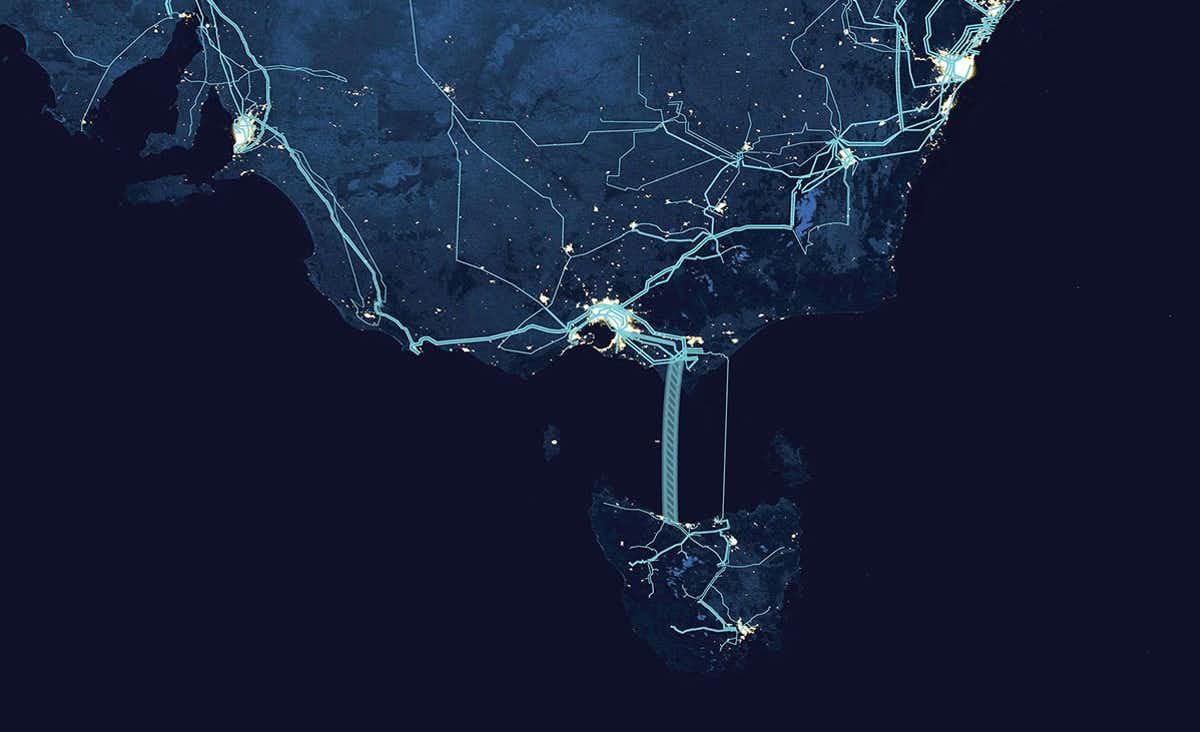
At the end of this month the board of Marinus Link Pty Ltd (MLPL) will recommend a ‘Final Investment Decision’ on building the first of two proposed new electricity cables across Bass Strait. The arrangements are complex – Marinus is a company jointly owned by the energy ministers of Tasmania, Victoria and the Commonwealth.
This complexity, combined with the long time-frame and the largely hidden nature of the project has resulted in minimal public scrutiny and discussion. Yet this is a $4 billion plus commitment (at least five times the cost of the controversial proposed Macquarie Point stadium in Hobart).
The Marinus Board will be making a decision when many necessary factors are unresolved. Around half the costs are estimated rather than based on market-tested quotes. The national regulator (the AER) has not yet made a final decision on whether all the expenditure is justified.
The claimed benefit assumes a cost of $2.4bn over 20 years for one Marinus cable, including the associated transmission lines in Tasmania. Yet this is effectively half the likely actual cost because the analysis spreads the capital cost of the project over 40 years.
This decision may seem hasty but the Board of MLPL are keen to see the project built and want to transfer most of the risk to electricity consumers after 2030.
A final decision will be made in the middle of this year by the three energy ministers who are shareholders in the company. We will be told there will be many benefits for Tasmanians, including cheaper electricity.
Other claimed benefits include the construction jobs, the lower costs for the generators in the National Electricity Market and a contribution to the decarbonisation of the national electricity supply. This article focuses on the costs, risks and benefits for electricity consumers.
The existing claims by MLPL about the benefits to Tasmanian electricity consumers are based largely on modelling undertaken by FTI Consulting. This modelling has several serious limitations.
The FTI report assumes that Tasmania will see a large increase in electricity demand from 2030 onwards, mainly due to hydrogen production. This increased demand is assumed to exist even in the ‘world without Marinus’ calculations.
This in turn leads to higher modelled wholesale prices without Marinus because this demand is modelled to be met by increased use of gas-fired generation and imports from Victoria. In fact the increased demand is not expected to materialise if Marinus is not built.
In calculating the assumed benefit, FTI compares cost to consumers (which is definite if Marinus is built) with modelled wholesale energy cost reductions (which are notoriously difficult to predict).
By presenting the results of the modelling as indicating a net benefit to consumers with Marinus compared with a no-Marinus scenario, the impression is given that Marinus will reduce prices. In fact the claimed benefit is that the increase in costs will be lower with Marinus than without.
MLPL proposes that 27.6% of the costs will be met by Tasmanian electricity consumers and the remaining 72.4% from Victorian consumers once cost recovery starts in 2030. This is despite the fact that Victoria has 92% of the combined population of the two states.
On top of this disparity, over $900m of transmission developments in Tasmania will be paid for totally by Tasmanian consumers, yet most of this development is only necessary to support Marinus and the projects it is expected to facilitate.
MLPL is also proposing that most of the risk of contingencies and cost over-runs (as well as the benefits of far less likely savings) be borne by consumers rather than the company.
Most tellingly, in 2024 APA (the new owners of the existing Basslink cable) applied to the AER for Basslink to be a regulated interconnector, which would mean that consumers pay for the cable as part of their electricity bills. The AER’s draft decision was that it was not clear that the benefits to consumers would outweigh the costs.
This was with a proposed price of $831m for a 500MW link. Yet MLPL assure us that a project with a cost four to six times higher for a link only 50% bigger would be a benefit to consumers. Go figure!
In summary, Marinus Link and the Tasmanian government are about to commit energy consumers to paying for a project where the final cost and benefits are unknown and the risks are almost entirely borne by electricity consumers from 2030 onwards, and disproportionately by Tasmanian consumers.
The Tasmanian government has promised a ‘whole of Tasmania business case’ will be released 30 days before the final decision by shareholding ministers. It will be interesting to see if this has any better modelling to justify the costs and risks for consumers.