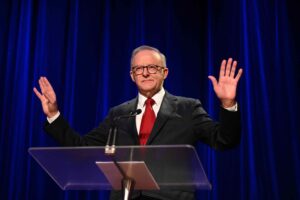
Climate change got one fleeting mention in Anthony Albanese’s jubilant, ear-to-ear-grinning victory speech on Saturday night.
“We will be a government … for every Australian who knows that climate change is a challenge we must act together to meet for the future of our environment, and knows the fact that renewable energy is an opportunity we must work together to seize, for the future of our economy”
Contrast it against Albanese’s 2022 victory speech:
“Together we can end the climate wars. Together we can take advantage of the opportunity for Australia to be a renewable energy superpower.”
In 2025, there are no climate wars. There is no jostling to be a global renewable enery superpower (a phrase with has noticeably dissapeared from government messaging in recent times). This isn’t about survival, or conflict, or dominance. Albanese opened his second term with gentler and more confidently diminutive statement: whatever the climate reality out there in the world, Labor’s climate wars ended a long time ago. Labor sought and achieved re-election off the back of three full years of governance. The Australian electorate saw Labor’s governance on climate and energy, and didn’t hate it enough to vote in Peter Dutton.
Labor’s thumping majority is, unfortunately, likely to cement complacency in the attitudes of the government. While the make up of the senate isn’t yet finalised, it’s clear the party will have a clearer runway for legislation.
But just as Labor will insist on a clear mandate for their existing policies, they will see any further ambition beyond that level as a breach of the platform they were elected on. We saw echoes of this in the debate around legislating a shockingly weak 43% target for 2030, where any more ambition was framed as a breach of public trust. As if people voted for both minimum and maximum climate action at election.
The stakes will be higher for Labor’s second term in a huge variety of ways. The fight to host COP31 is right around the corner, and the fight to own the narrative in 2026 if Australia hosts it will be shockingly intense.
The Trump administration in the US is guaranteed to trigger a monthly crisis within energy, climate and minerals trade: Australia has never faced an authoritarian US before. And chaos in the gas markets in the US will inevitably cause chaos for domestic and exported gas in Australia. All of this while undergoing the process of setting a 2035 climate target, and taking it to COP30 in Brazil later this year.
Labor now has to face real scrutiny on the deployment and measured impacts of its tentpole climate policies: the capacity investment scheme, the safeguard mechanism and the vehicle efficiency scheme. The most recent projections put forward a vision of steep, real drops in Australia’s emissions thanks to all three of these policies, and if they don’t materialise, it’ll be seriously embarrasing for the government.
If the government reduces emissions by any material or consequential amount, if coal or gas projects are threatened or if there’s any sign of greater climate ambition, the fossil fuel industry will switch from slumber to mad outrage. And there’s every chance the Coalition’s new leader will slip into a mode of wrecking, trolling and destruction from their first day.
When Labor won election in 2022, I wrote here that the party will only act with deep, material ambition on climate if they’re pushed. There is no chance of a minority Labor government that has to deal with the Greens or crossbenchers to pass legislation.
In this setting, Labor can only face real scrutiny from the outside: from journalists, from publications such as Renew Economy, from opinionated bloggers like me, from emerging social media voices and – most importantly – from trusted climate groups that should now switch to a significantly more critical tone.