Andrew Forrest’s iron ore and green energy company Fortescue has voiced its frustration and disappointment after years of negotiations for a global agreement on shipping emissions were scuppered by the world’s two biggest oil producers – the US and Saudi Arabia.
Fortescue had high hopes of a deal being agreed at a meeting late last week in London of the International Maritime Organisation, called to vote on a “net-zero framework” that had been worked on for years and had broad international support, including from Australia.
It was seen as a huge opportunity to replace highly polluting bunker fuels – shipping accounts for 3 per cent of global carbon emissions – with green ammonia technology. Fortescue is leading the pack on green ammonia, one of the most promising parts of its deflated green hydrogen play.
But US president Donald Trump, who has waged a war on climate initiatives and green energy since being returned to office, lashed out at the plan last week, describing it as a “global green new scam tax on shipping,” and threatening sanctions against any country that supported it.
US official were accused of bullying and intimidation over the introduction of the small charge on the emissions produced by vessels, which Fortescue and others say will provide incentives to seek cleaner alternatives, including sales and the use of green ammonia. A vote late Friday decided to put the idea on hold for another year.,
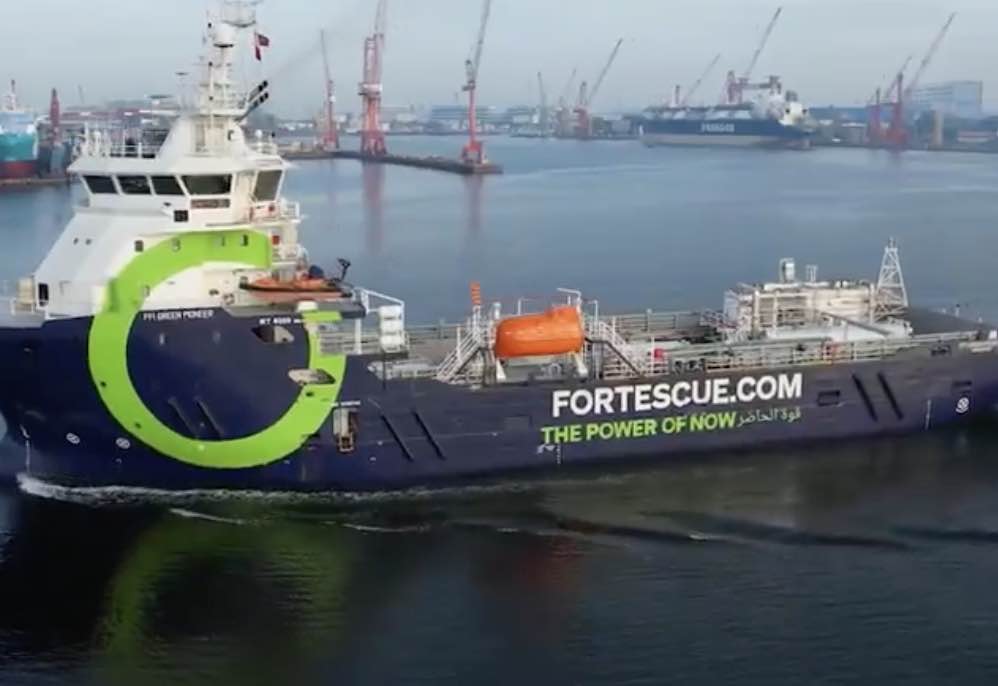
Fortescue, which has been sailing its dual-fuelled 60 metre vessel Green Pioneer to ports around the world to promote the technology, had hoped it would pave the way for widespread adoption, potentially rekindling hopes for its broader global green hydrogen plans.
It argues that bunkering ammonia-based fuels, sourced from wind and solar power generated in the Pilbara, could cut emissions and create a huge economic opportunity for Australia.
“Fortescue is disappointed by the delay in adopting the International Maritime Organization’s Net-Zero Framework — a landmark proposal that would have set global shipping on a clear course toward decarbonisation,” it said in a statement.
“After years of negotiation and broad international support, today’s outcome represents a lost opportunity for the world to take collective, decisive action on one of the hardest-to-abate sectors.
“While some countries chose to defer progress, the direction of travel for shipping is already clear. The transition to zero-emission fuels is inevitable — and the technologies to enable it already exist.”
Fortescue CEO Dino Otranto spoke at length about the green ammonia technology in an interview in the latest episode of Renew Economy’s Energy Insiders podcast last week.
See: Energy Insiders Podcast: Fortescue’s bold charge to real zero by 2030
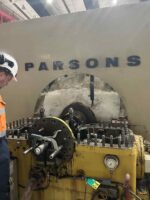
“Ammonia works very similar to bunker fuel,” Otranto said. It requires some modifications to the engines, particularly in the injector manifold, and Fortescue has been working on its own two-stroke engine prototype at its R&D centre near Perth.
That technology is destined for train locomotives and shipping, and has already been retrofitted on the Green Pioneer. Otranto see potential in the huge 2 km long trains that transport ore from mine to port, and for shipping routes to Asia.
“We sail our ships to Singapore and China, fill them up with fuel and sail them back down to Australia,” Otranto told Energy Insiders. “Why not fill them up here, load them here and create a bunkering opportunity here for Australia.
“We have all of the sun. We have all the wind. We’ve got technology now, batteries and solar panels and wind turbines and Nabra Towers all now at the precipice of coming together to then deploy that into a really exciting new industry.
“And we’re looking forward to the International Maritime organizations vote this week, which will then include ammonia for the first time as a bunkering fuel source for the global shipping industry.”
That last part turned out not to be the case, but Fortescue says it is ploughing on. “It is not over,” it said in a LinkedIn post.
See also: “This is about economics:” Fortescue says rapid technology changes keep its real zero goal on track