State governments that choose to delay the closure dates of their remaining coal fired generators, in the hope that it can lead to lower prices and improved reliability, may be in for an unpleasant surprise, according to one of Australia’s leading energy experts.
Paul Simshauser, now the head of the Australian operations of Spanish energy giant Iberdrola, says the decision to delay the closure of some of the country’s biggest coal fired generators is understandable, given concern about grid reliability, grid security, and the risk of a spike in wholesale electricity prices.
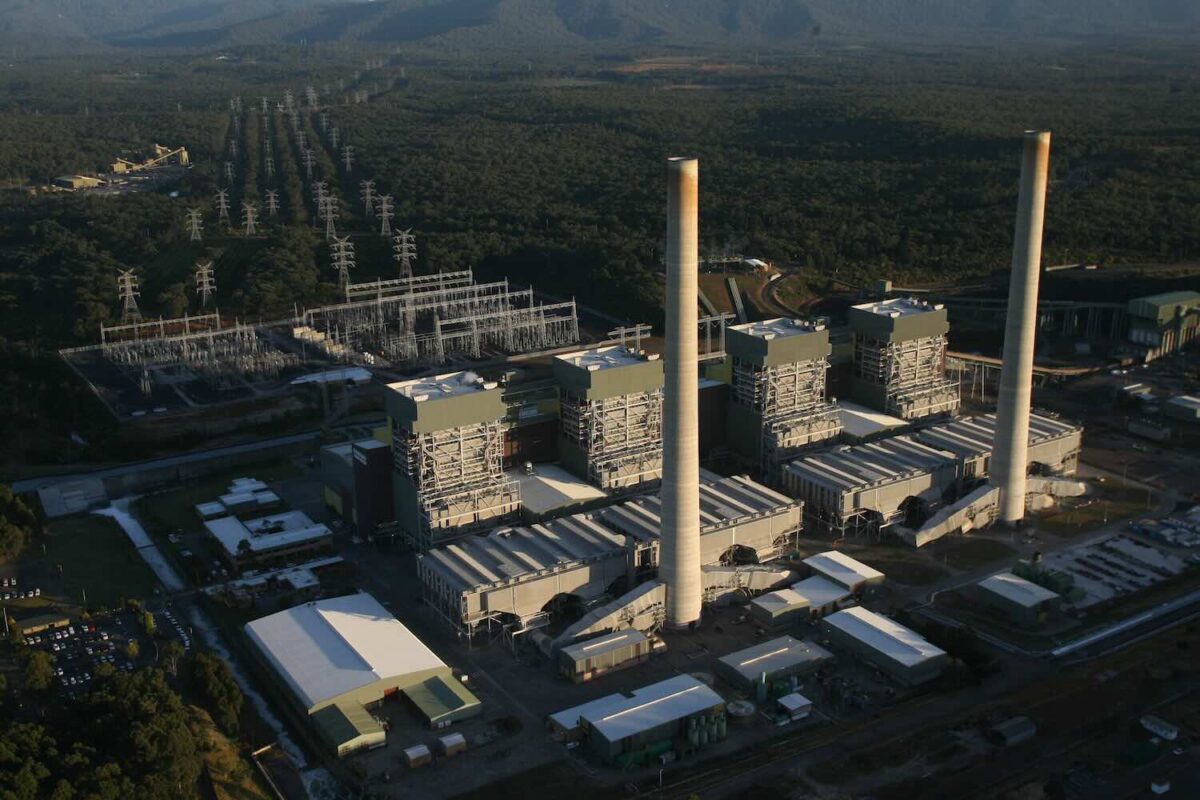
In NSW, the closure of the country’s biggest coal fired generator, the 2.88 gigawatt (GW) Eraring facility has been delayed twice, firstly from 2025 to 2027 because of reliability and price concerns, and more recently to 2029 because of energy “security” concerns.
But Simshauser, a former head of the energy department in the Queensland government and more recently CEO of its transmission company Powerlink, and a leading academic at Griffith University, says there are risks involved.
“This is actually a pretty risky game that we’re going through at the moment with all the old, ageing coal-fired power stations,” he said in a presentation to the EN26 (Energy Networks Australia) conference in Adelaide last month.
Simshauser’s view are important. Last year, Simshauser and fellow Iberdrola executive and Griffith Uni academic Joel Gilmore, produced a landmark paper illustrating that without the influx of renewables, generation costs would be 50 per cent higher than they are now.
It was an important study, because it helped debunk the far right argument that renewables have been the cause of higher power bills. Now, Simshauser is raising the flag again, saying the coal plant extensions and resulting renewable investment delays will result in higher bills.
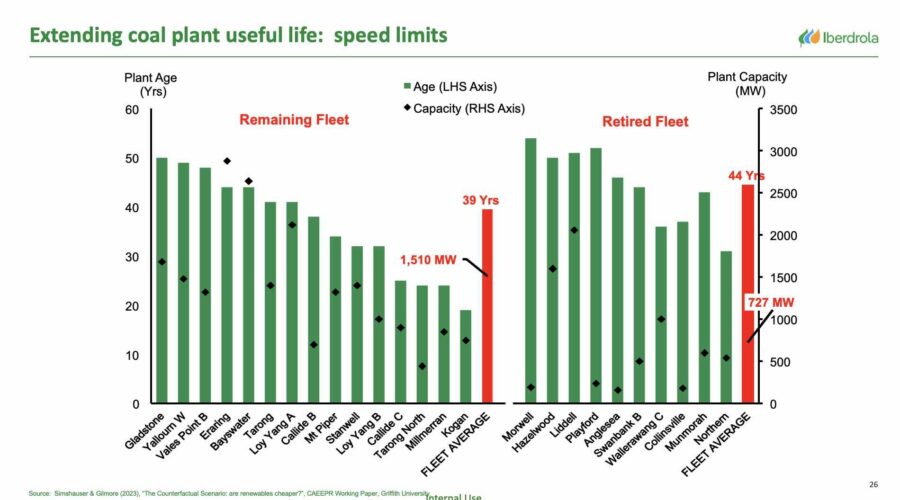
Simshauser pointed to two graphs (above and below) to illustrate his point. The first graph above highlights the average age of Australia’s retired and remaining fleets. The average age of the retired fleet was 44 years, and the average age of the remaining fleet, even including four relatively youthful coal generators in Queensland, is 39.
“If you look at the remaining fleet, the left hand side of that axis, they’re pensioners right?” Simshauser said. “These are pensioner power stations, and they are being starved of Medicare because they are expected to go. It’s kind of not a good mix.
“This is not a blow (criticism) of the operators, they are trying to work out how to hold these things together.”
The implications are illustrated in the next graph below, using data supplied by Energy Edge’s Josh Stabler, that shows the increased outage rate as coal fired power stations push past their initial design life and towards their assumed greater “economic” life.
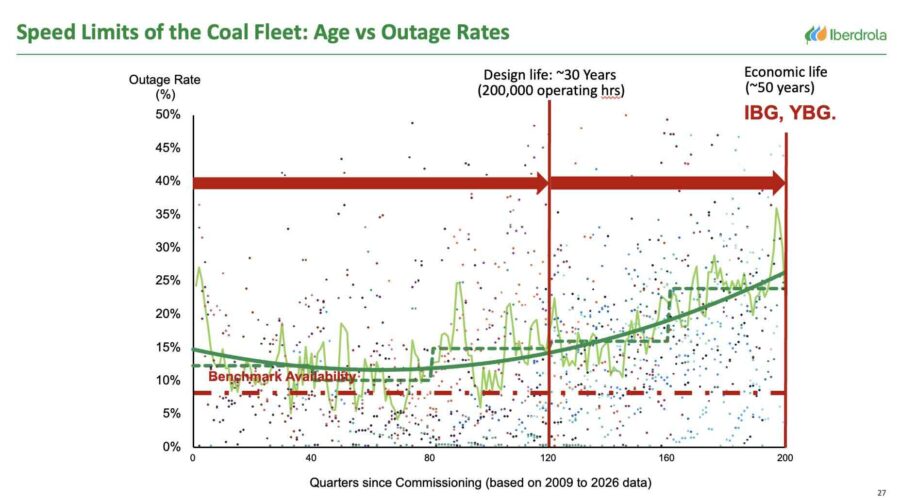
“You can see very clearly what’s happening as the plant gets older,” Simshauser said. “Look at that final 10 years. We’re extending stuff that’s really old, and those are the outage rates. We shouldn’t be surprise by this, and sooner or later it won’t be about reliability, it will be about health and safety.
“So it’s a pretty risk strategy to think that we can keep doing this.”
As if on cue, on Thursday, Watt Clarity reports, the country’s biggest single generation units, and its youngest coal generator – Kogan Creek in Queensland – tripped without warning. The size of the plant (it was generating 723 MW at the time) makes it a particularly tricky challenge for the market operator.
And, of course, the issue gets more complicated with the challenges of rooftop solar, which is still surging in capacity as systems get bigger and prices continue to fall. In states with ongoing premium tariffs – such as Queensland and South Australia – a massive upgrade in system size is expected in coming years.
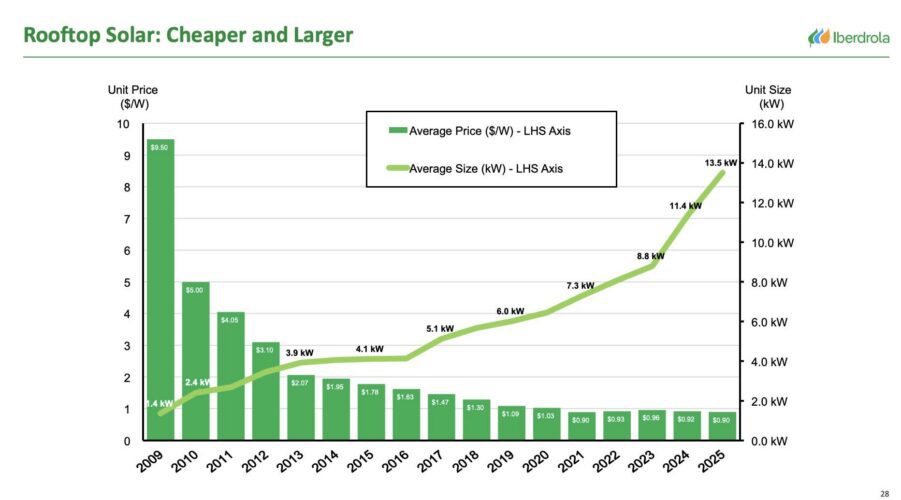
This is eating into the coal generators’ traditional lunch and forcing them to either ramp up and down significantly, or even switch off some units for a shift or two. But this is not easy and mechanically it is draining. Economically, it’s a nightmare for the coal generators.
“Coal generators can’t turn off easily,” Simshauser said. “So you’ve got a problem. It is an economic problem. You’ve now got an economic problem, and a physical problem.”
This, he says, should lead to coal plant closures, but they are being delayed, for good political reason.
“”Our policy-makers, our politicians, who are ultimately held accountable for what happens in the state, whether it’s price, reliability or both, if they can’t be confident of the planned stock they have to intervene, right.
“That’s what a government must do. But we are running out of time. There’s only so much time that we can keep kicking this thing down the road.
“The problem is that every time a coal plant is delayed it does created this sort of circular problem. To extend a coal plant and that weights on prices, and all of a sudden, all those renewable projects ready to jump into the market … that’s going to blow the first two years of revenue.”

That leads to the latest graph above. The based market is contracting, but forward prices are also falling, partly helped by the coal closure delays. That might be good for governments, but it diminishes the signal for new generation, just when it is needed.
“Only a fool would keep proceeding,” Simshauser says.
“Government have stepped in with the Capacity Investment Scheme, and it’s not working. There has been thousands of (megawatts) of announcements, but the projects coming through seems to be working well for batteries, but not for wind and solar, I haven’t seen anything additive yet.
“So it’s a real problem. The most successful policy we’ve had to get plant moving has been the renewable energy target, and then the old LGC price.
Simeshauser says it would be difficult to go back to that mechanism, but suggests there may be some “middle ground” that could be found to “get the market firing” again.