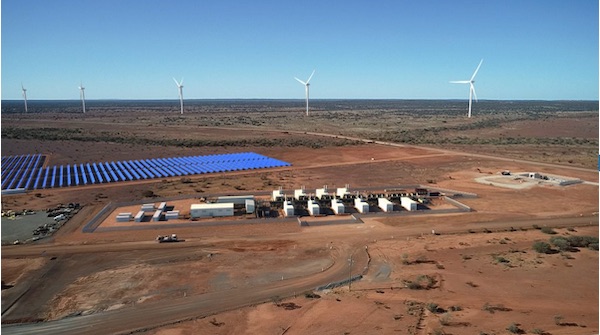
Australia’s first mining sector project to use wind power as part of a large hybrid renewable microgid is starting to take shape, with the first turbine components arriving on-site in the Western Australia northern goldfields region.
Goldwind said on Thursday that deliveries had begun to the Agnew gold mine site, where five GW140/3.57MW turbines would be combined with an existing 23MW solar, gas and diesel power station, and a 13MW/4MWh battery and control system under construction.
The huge turbine parts, including 60 meter blades, made the 630km road trip from Port Hedland in what is believed to be the longest such truck-trip for components of this size in the world.
Goldwind announced in July that it had inked a deal to deliver the wind farm component of the microgrid project, which EDL is developing and operating under a 10-year agreement to supply power to the Agnew gold mine, which is owned by the company Gold Fields.
The first stage of the $112 million, ARENA-backed project incorporated a 4MW solar farm, with supply supplemented by a 16MW of gas and 3MW diesel generation capacity.
Goldwind Australia managing director John Titchen said a total of 55 turbine components would be transported to site over the next few weeks, with installation of those turbines to begin “shortly.”
Once the wind power component is complete – EDL says this will be around mid-2020 – the 54MW microgrid is expected to supply the Agnew gold mine with more than 50 per cent renewable electricity.
Gold Fields executive vice president Stuart Mathews said last month that he hoped the project would lead to more and more mines integrating renewables into their power supplies.
“This is a significant milestone for both the Agnew gold mine and the broader Gold Fields Group, demonstrating our ongoing commitment to strengthening our energy security, optimising energy costs and reducing our carbon footprint through the adoption of new technologies,” he said.
“We are hopeful that this will also enable other companies to consider the options for decarbonising their operations.”
As noted above, the project has received funding support from the Australian Renewable Energy Agency, which provided $13.5 million in recoupable finance.
To read the original story on RenewEconomy sister site One Step Off The Grid, click here…
Arena says the pursuit of ultra-low cost solar is making "good progress" at the panel…
Gas turbines aren't the only large equipment with long lead times.
All Electric Homes founder Trent Jones warns that a shortage of skilled tradies, fragmented business…
For asset owners, buyers, managers and O&M teams, the webinar will cover performance metrics, service…
Less than two years after starting construction, four-hour big battery energy storage system powers up…
Fascinating chart backs up AEMO chief's observation that people are piling in on the offer…